Class Blog

reVilna

screen-shot-2016-11-06-at-11-10-02-pm

reVilna is a digital mapping project about the Vilna Ghetto in Nazi Germany, focusing on eight narratives: Formation of Ghetto, Aktionen, Judennat, Health & Education, Life in the Ghetto, Art & Culture, Resistance & the FPO, and End of the Ghetto. Each of these stories first inform the user with historical context and an image gallery before revealing the map (created on Leaflet).

screen-shot-2016-11-06-at-11-06-04-pm

Formation of Ghetto, Aktionen, Resistance & the FPO, and End of the Ghetto are structured by a timeline. The points on the map are linked to a specific dates in history with corresponding images and text. The present point is most red in color while upcoming points are pink and light pink. The user can request more guidance through the story by clicking the play button, however, this functionality moves through the points very quickly making it difficult to follow (it’s easier just to manually click through the timeline).

screen-shot-2016-11-06-at-11-08-44-pmIn the non-temporal stories, such as “Health and Education,” the points are color coded by type of place, people, or activity (i.e. Soup Kitchen, Sport, Ghetto Police ). Certain locations can more objectively be categorized as “Hospitals.” Other categories such as “Life” are more broad and can include varied locations. These groupings create certain assumptions about the types of locations they include and impose different meanings onto the locations.

The purpose of the green line superimposed onto the map is unclear. It seems as though the map designer assumes that the user would understand it’s outlining the Ghetto areas (even though it’s never explicitly stated).

screen-shot-2016-11-06-at-11-12-34-pm

As Turnbull says in Exhibit 3, “Maps have been thought to be objective in that they are independent of the view of a particular observer.” reVilna is a subjective representation of Vilna Ghetto that constructs an educational narrative about the landscape’s history. At the same time, the aerial perspective imposes a territorial point of view. Users see the map through the lens of the Nazis who controlled the Ghetto. The POV is from the vantage point of those who had the most authority, exemplifying what Bruno Latour demonstrates in his theories about power hierarchies embedded in maps.

The exhibits in Turnbull’s Maps are Territories discusses the subjective nature of maps, even when most continue to consider maps as objective representations of the real world. Maps are inherently flawed by the very act of flatten a spherical shape onto a two-dimensional plane. Iconic representations, symbolic representations, color palettes, titles, labels, orientation, scale etc. are all variables that construct subjective views. Even the base map for Google Maps, the Mercator Projection, is inaccurate, yet we’ve grown so accustomed to it that we take it as a scientific representation of the world.

For an alternative version of this map, I would restructure the POV to be through the eyes of the Jews in the Ghetto. The map would use virtual reality (Oculus or HTC Vive) or renderings similar to Street View on Google Maps to adopt a humanistic perspective. In this way, the user could be more immersed into the Ghetto, rather than being removed with an aerial perspective. Furthermore, instead of using arbitrary colors and shapes for the markers on the map, I would use icons to symbolize the locations. Also, more advanced versions of the map could reach a wider audience by being translated into other languages and text-to-audio abilities for the blind or illiterate.

Digital Harlem

I spent some time with the Digital Harlem map and found myself wondering how the researches responsible for its organization must have felt about the data as it presented itself. The description of the project contained in the About section details the wishes of the authors to create a sort of snapshot into the lives of the poor and working class ordinary African American denizens of Harlem during the period in question. At one point they refer to arrest and legal records that indicate the behavior not only of hardened criminals, but of first time offenders and ordinary people driven to criminal acts out of desperation. It bears noting that the jurisdictional recordkeeping of the local authorities gave criminal designations to private behavior, such as the category of “Divorce Raid”. My research found that this designation referred to the police breaking and busting up illicit unions between people married to others, most often deployed by wronged spouse to either assure or prevent the issuance of alimony.
Turnbull states:
“Any recounting, whether ancestral, historical or contemporary, is framed by a discussion of place: where events happened. Events coalesce in space rather than in time; landscape punctuates stories, and behind this is the ‘working assumption’ that human activities ‘create’ places by socialising space.” (Exhibit 5, page 2)
If this is so, then these forays into the more somber and entirely human landscape of early 20th century Harlem would demonstrate a place created almost entirely by a white power structure that sought to control and police a black population corralled by definitions. White on Black policing is far from peaceful, even today. That Harlem in the maps is defined by language more likely than not generated and issued by law enforcement officers where were not part of the community and judgments were implicit in the generation of arrest records. An overlay of the categories Gambling and Meeting reveals a correlation between social gatherings and gambling, which might have it reconsidered less as a facet of organized crime and more as an aspect of social gathering – but it is booked as a crime.

screenshot-2

An overlay of Divorce_Raid and Prostitution creates an interesting diagram of good and bad neighborhoods in Harlem – Divorce Raids happened in every quarter and at every income level, but prostitution clusters to specific lower income areas. One must ask oneself when the two overlap, was there an automatic prostitution charge leveled on women who found themselves in these rooms as the police burst in?

Per Turnbull, human activities created these places and spaces. How and why the activities were recorded is one thing in the estimation of the people who wrote it down a hundred years ago and another in the estimation of those who sought to recreate a very specific window into early 20th century Harlem. The map opens a perspective on the human activities of the residents of that community, but the prejudices inherent to the initial recording of the events does little to give a reflection of life in the sunlight vs in the shadows. The ontologies of the moment used to categorize these activities reveal a government bent on intrusion and subjugation. While there is a great deal of beauty in the truths that are ferreted out of these records, there is too much left unsaid.
An alternate map would effect a more accurate picture of life on the ground. I imagine an image gallery that details the morning and evening commutes of the residents of Harlem. There would photographs of the home of each subject, of their commuter line (train, streetcar, morning walk) and of their workplace. The juxtaposition between where they live and where they work might tell us a great deal more about how they experienced the world. I would try also to include photographs of local merchants they might visit on the way home and as much moving image stock as possible that would detail the activity and energy of the streets and routes they took.

Locating London’s Past

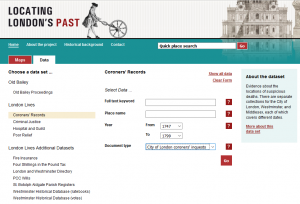
I chose to examine the map Locating London’s Past. This mapping project compares two early maps of London, John Rocque’s 1746 version and the 1869-80 Ordinary Survey map, which was the first accurate map of London. These geo-referenced maps were then indexed with historical databases that documented various records such as taxation, elections, coroners’ records, parish registers, and archeological evidence. The user is able to navigate between drawn and modern maps of London and individual sets of data. The user is asked to choose a base map on which to begin mapping data. When a specific data set is selected, the map feature digitizes the area of most concentration on the map itself or provides pin points to indicate the precise location of a data set. The represented data is color coordinated and David Turnbull writes in his project, “Maps are Territories” that maps are generally defined as selective, as the cartographer or printer maker can decide what to include or exclude. Locating London’s Past, I believe, gives a pretty well rounded representation and as Turnbull states, allows the data to be indexical as it recognizes its connections to humanity.

untitled-picture

The data sets on the site allow for the user to both interact with the map, and cross reference early drawings of London with modern day maps while providing extensive information on the data set themselves. I would make the argument that this site largely focuses on the data presented, rather than the graphical interface of the map. This is also attributed that the interactive map is displayed on its own individual tab on the site and the user is expected to go back and forth between this and the “Data” tab. The data tab is important to have because it provides citations of information, however I think that it would be more been more effective to have the data and maps on the same page in order to see changes made on the map as you play with data sets.

Week 7 Post–Cholera Outbreak

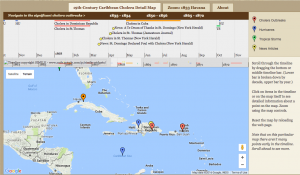
This week I looked at the 19th-Century Caribbean Cholera TimeMap; this project was conducted by a team in Duke University. There is an “About” Section with tabs such as “Project Team”, “Methodology Considerations”, “Seasonality Correlations”, and “Migratino and Cholera”. (Unfortunately I could not access this information because each time I clicked a tab, the link would not take my anywhere. Maybe other students had better luck with this). However there is information I can access by simply looking at the home page. Turnbull believes that all maps are perspectival and subjective. Furthermore, on the homepage of the Turnbull reading and exhibitions, the site indicates tells the readers that Turnbull “analyses maps both as a metaphor for knowledge and also as a major means of knowledge representation in a wide array of cultures”. From Turnbull’s perspective of maps, I tried to decipher the perspective that the Caribbean Cholera TimeMap portrays.

.screen-shot-2016-11-06-at-9-26-43-pm

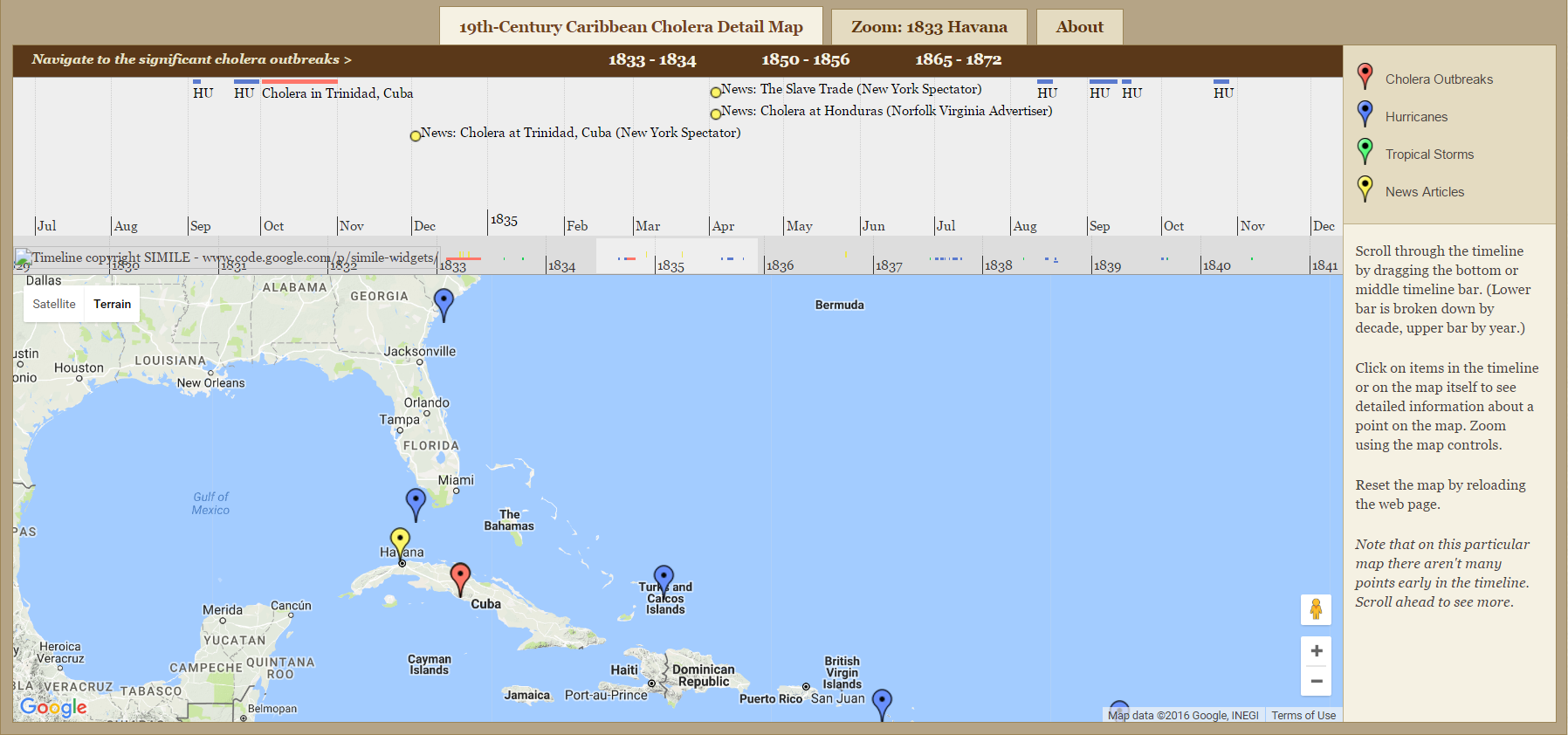
This map reflects the point of view of the team that created the map, and what they deemed important about the outbreak. They have a timeline starting from the early 1830’s to the late 1870’s, and based on the time period you choose, the map also changes to that time period. Each time period navigates to significant cholera outbreaks, but also marks the locations where there were hurricane, tropical storms, and particular news articles about the cholera outbreaks. We are missing a lot of contextual information, especially in terms of the significance and outcome of these outbreaks to the community. We do not know why the Duke team chose this particular time period as well. Although easily navigable, this map lacks information to give us a solid perspective. And since this was created by a team in a university in the U.S., we do not have the perspective of those who lived in the Caribbean and experienced these outbreaks. Therefore there may have been more outbreaks in different locations that we are missing, or stories about these outbreaks. An alternative map would include local stories and interviews (although difficult since they begin in 1830’s) and context to why they chose this outbreak to map out.

Based on this exercise there’s no disagreeing that maps are usually indicative of knowledge from its maker(s), and an array of maps would definitely represent a wide set of cultures. Maps are one way someone can view another’s perspective of the world around them, or in other words, how one “how humans see and depict the natural world”. Although cholera is the main focus of this map, we cannot see in what regards it was significant e.g. culturally, socially, and economically. With the spotlight on the Caribbean, we can definitively assume the creators of the map believed cholera as an important factor to those who lived there. However I heartily agree with Turnbull when he wants us to be careful “not to take one’s own view as definitive of all maps”. 

Week 6: Digital Harlem

For this week’s blogging assignment I chose to continue exploring Digital Harlem, the project we began to dissect this past Friday in lab.

Digital Harlem is a virtual exploration of what the authors claim is everyday life in Harlem, NY 1915-1930. The sources for this project include closed case files from the New York DA’s office, newspaper records, and pieces from the Writers Program Collection. The researchers’ process then included organizing these sources by date and location. All of this information is presented using a google map.

I have a lot of issues with this project so bear with me.

This map is confusing and hard to use

While I applaud the research team on the specificity of their search functions, this project presents itself less like a map and more like an index. When I think of a digital map, I think of something that is interactive, guides the user. The way this map is set up, you have to know exactly what you are looking for (ie dates, types of crime, location) to actually view something of worth. There isn’t a lot of opportunity for true exploration, and this leaves the overall narrative and user experience lacking.

What even is everyday life?

Digital Harlem claims that their project is about everyday African New Yorkers, writing, “this project focuses not on black artists and the black middle class, but on the lives of ordinary African New Yorkers.” But aren’t artists, the middle class, and their respective cultures a part of everyday life in early 20th century Harlem? This is an example of Turnbull’s assertion that, “A map is always selective. In other words, the mapmaker determines what is, and equally importantly, what is not included in the representation” (Turnbull, Exhibit 2, 1).

Thus, if a grim crime record this is what the researchers at the University of Sidney believed everyday life to be, then I cannot argue with them. They may believe that crime is worthy of record, but family history is not. However, I believe there is more to everyday life in Harlem’s past than what they have presented and claimed to communicate.

All this map does is reveal a pattern of depressing crime statistics, with little individuality or narrative. By claiming that this map, this project, depicts everyday life at the time, they are obscuring the facts and presenting a biased side of history, a side only told by police records and newspapers.

My solution

To present a DH project that is true to everyday life in early 20th century Harlem, I’d begin with changing the sources. When I think of everyday life, I’m not thinking of major events or crime statistics. Instead, I think about culture, experiences, family, and the everyday interactions that give each human a unique perspective on the universe. Thus, I would search for sources that exemplify these qualities, like family photographs, pictures of apartment interiors, popular advertisements in the community, and music. I would then present this information on a map that doesn’t require a search function to be fully utilized. I would want my user to feel completely submersed in the world I communicated towards them, with a simple legend that allows the user to isolate content by its medium (ie art, music, family photos instead of date, location, type of crime). I wouldn’t necessarily omit evidence of crime, for that too is a part of everyday life, but I would make sure it isn’t the only interaction the user is left with.

Week 6 – Caribbean Cholera Map

I decided to take a look at the Caribbean Cholera Map. There wasn’t any background information provided related to the creation of this map so my analysis will be just based off of the map itself.

The map timeline did not really provide much humanistic insight on the cholera outbreak. The timeline mainly consisted of the duration of different cholera outbreaks with occasional descriptions of newspaper headlines related to the outbreaks. It also included instances of different hurricanes and tropical storms. Looking at this data, I’m under the impression that the creator was only concerned about looking at the cholera outbreak as a whole during the time period 1833-1872. The only descriptive information about the outbreak comes from the perspective of a newspaper reporter and even so the newspaper reports were trying to summarize the cholera outbreak into a couple of sentences. In a way I felt like I was reading a doctor’s diagnosis of a patient- short and straight to the point, only including information relevant to the illness. Seeing that the creator also information about the hurricane and the storms, I also predict that the creator was trying to find a relationship between the outbreak and the different types of storms. This timeline does a good job on reporting the patterns of the cholera outbreaks in the Caribbean – although I do wonder if the cases shown on the map were the only cases-  and maybe even showing the relationship between the outbreak and the different storms. On the other hand, it doesn’t do a good job on what the life might have been like in the areas that did have the outbreaks. However, it might have been difficult to portray that information on a map that tried to illustrate the cholera outbreak across the entire Caribbean. An alternative to solve that problem is to find a specific location to report on. Then it would be easier to depict the details of the outbreak and the impact that it had on the different societies; the map could include the pictures from that time and have a density map to portray how many people had been affected by the outbreak. I do think that this method also has additional problems since it would be getting rid of the potential to relay information about the Caribbean as a whole.

Blog 6 Mapping: Digital Harlem

This week I decided to explore the Digital Harlem map. This map aims to present information about the everyday life conditions in the New York City Harlem neighborhood during the time period 1915-1930. The researchers aimed to focus on “ordinary” African New Yorkers, and not black artists and the black middle class which was unlike most other projects depicting Harlem at the time. 

The Digital Harlem map reinforces David Turnbull’s argument that all maps are perspectival and subjective because “the mapmaker determines what is, and equally importantly, what is not included in the representation” (Turnbull, Exhibit 2 , Page 1). The collaborators on this project pulled their information and sources from mainly institutionalized records such as the district attorney’s closed case files, probation department case files, newspapers, committee of fourteen papers, and the writers program collection. These sources give bias towards the government and police point of view. The data uses their standards, language, categorization, and therefore the map shows their perspective. Also, newspapers often do not include information about daily life, but newsworthy info such as crime. The map cannot claim to represent ordinary lives of African New Yorkers if the data comes from sources like newspapers and legal records.

The list of events, seen on the left side, give many options for crimes but not many for "everyday life" events.
The list of events, seen on the left side, give many options for crimes but not many for “everyday life” events.

The map allows the users to filter events based on categories, and it shows that the majority of the listed categories are related to crime. Sure, there are a few categories that depict “everyday life” such as baseball games, church services, and party, but the majority of categories depict crime such as abduction, assault, burglary, drugs, and the list goes on. If I were to just look at the list of events I could choose from, I would assume that this map aims to present information on crime in the neighborhood of Harlem.

If the collaborators of this project did indeed aim to present everyday life, an alternate map could focus on more everyday events and less crime. This map makes the audience believe that crime was a large part of the everyday life in Harlem. To make the map include more everyday events, it could include more information on everyday events like work, school, transportation, family, food, etc. This map could also be enhanced with photos and descriptions, instead of just points on a map. With these additions, users would be able to have a more holistic idea of what everyday life in Harlem was like, instead of being led to believe that Harlem was simply a crime-ridden neighborhood.

Blog Post #6: Digital Harlem

I chose to focus on Digital Harlem, a digital humanities project focusing on everyday life in Harlem, New York from the years 1915-1930. The 4 people who created this digital archive were from Australia and chose to display Harlem in a different light. Rather than portraying life from black artists and the black middle class, as usually done when thinking of Harlem, they chose to chow regular New York City life. Their sources were mainly legal records, such as the district attorney’s closed case files, the probation department case files, newspapers, the committee of fourteen papers, and the writer’s program collection.

Their interface and research is mainly observed through their usage of maps. As we learned in class, maps are often subjective and can be created in a way to strengthen the point of view of the author, can be misleading, or easily misinterpreted. This is not all maps, however, as most are thought of to be historically authentic and not open to interpretation. Below is a map showing arrests from 1915-1925 without a specific tag. screen-shot-2016-11-06-at-11-50-28-am

Although, I do not believe that these maps and the ability to thoroughly search through crimes is inaccurate, I believe that the authors might have been trying to show Harlem as a crime ridden neighborhood throughout those times. This is because even though there is a chance to look for searches including “weddings” and “parties”, almost 90% of the tags have to do with crimes, arrests, or illegal things of some sort. Just like David Turnball mentions that it is impossible for a map to absolutely show everything, it seems as if this map is specifically trying to show one thing: crimes. It might even reflect the point of view of law enforcement at the time, since being law enforcers meant that most of their word revolved around solving crimes, which led to crime being their lives.

I would propose to keep these same maps, instead of creating a whole new one, but change the title of the project itself. This is not a representation of everyday life, since I am almost certain that most people in Harlem at that time did not just rob, steal, deal drugs, etc. I understand that the authors do not want to focus on only black life, but I believe that they could focus on only crime (although it already seems they did) and could just retitle the project to: Crime in Harlem 1915-1930. If I could propose changes to this map, it would simply be removing the other tags, such as “weddings” and “parties” and tabs like “churches”. I would also find it interesting to have the mug shot of the person who committed the crime; that would be interesting to see there.

Mapping Decadence Blog Post

I decided to explore the Mapping Decadence project, which serves to show how location influenced the collaborations between Decadent writers and their publishers at the end of the nineteenth century in Paris. There is a separate satellite map for each author in question – Joris-Karl Huysmans, Jean Lorrain, Rachilde, and Marcel Schwob – with color-coded pins indicating where the author lived and where the publisher was located (red). Each pin has a pop-up box indicating when they lived at a certain address, what books they published and with whom, where they were living or working at the time, and where their publishers were located.

screen-shot-2016-11-06-at-11-16-51-am

Although this project appears to be straightforward in providing factual and objective information, there are several aspects that enforce Turnbull’s contention that maps are perspectival and subjective. The maps only indicate where the authors and publishers lived at certain times and the titles of what they published, but fails to give any other information on how these factors influenced the collaborations. Publishers are more associated with the final product of an author’s work rather than the process of writing it, and this map assumes that recognizing the publishers’ presence captures the heart of the Decadent movement. Other factors of environment and proximity that could have been acknowledged on the map are schools or churches, which may have had some level of influence over the symbolism and aestheticism that Decadence writers followed. For instance, one of the pins states that Lorrain “studies law and moves frequently” – this could be expanded on, such as if he still studied law in Paris, where he studied it, and if that correlated with his works. 

Some background information about each author and publisher would be useful as well. Surely as figures in the Decadent Movement, the writers were familiar with one another or found inspiration from other writers/artists. This could be shown in more detail with additional pop-up boxes on the map, or even on the webpage itself on each author’s page as a sort of premise to the map. The map only shows connections (the lines) with authors and their publishers, but the close proximity amongst all the writers likely also fostered relationships. I believe that an alternate map could keep the satellite layout, but include a larger color-code key to include different writers/ other locations besides the publishers’, as well as more lines connecting pinpoints to show the effects of location. 

Blog Post 6: Caribbean Cholera

For this blog post, I decided to work with the Caribbean Cholera Map. This particular digital humanities project illustrates the outbreaks of the cholera disease around the Caribbean area. While simultaneously utilizing both a timeline and a set of points within a google map, it tells a very compelling argument of how these outbreaks are tied to naturals disasters, such as tropical storms and hurricanes. By depicting that these outbreaks occur subsequently after the storm on the timeline, the project logically proves that the origins of cholera were due to natural causes. The project managers were able to supply news journals and articles as evidence to further prove this. However, this project only reinforces David Turnbull’s argument of how maps have the ability to manipulate the narrative without meaning to.

map

The fact that it only provides information about the natural disasters implies that these storms are the only causes of the cholera outbreak. It assumes that there aren’t any other types of causes of cholera because it omits these possibilities on the timeline. According to my outside research, the first cholera outbreak originated in Russia through trade routes. Who is to say that human contact from the slave trade and poor conditions on the boat didn’t contribute to further development of cholera, yet it isn’t evident in the timeline.

Since this current map is very vague and generalizes the causes of the outbreak, an alternate, yet ideal map for this particular project would specify what other factors may have played into the causes of the outbreak. In the timeline, there are other storms that occur around the Caribbean area especially in 1937 to the early 1940s without an outbreak to cholera following it. This goes to show that there may have been another factor played into this, otherwise there would be multiple cholera outbreaks throughout that listed time period. Or could it possibly be because of the intensity of the storm? The map only provides us information of the duration and coordinates of the storm, but there could be very light storms that can go on for days as opposed to a heavy one. The map should provide some sort of measurement of the storms if possible. Also another question the map could answer is, what determines an outbreak of a disease? It’s very subjective in the sense that one definition of an outbreak can be very different to another. This goes to show how subjective maps are because it’s all about perspective.