I chose the short story titled, “The Waiter’s Wife“. This is about a married couple, Samad and Aslana, who immigrated to London from Bangladesh in 1975. They moved in order to live closer to a friend of Samad’s, Archie whom he had served in the war with. Both Samad and Archie are married to much younger women, the before mentioned, Aslana and Clara. Samad works as a waiter in his cousins restaurant, alongside other distant family members. His job is hard as he works long hours and receives little pay for it. His struggles continue when Aslana violently confronts him about their low income and her concerns about feeding their unborn twins. After the confrontation, she meets with Clara, who is also pregnant, and her cousin, the shoemaker, Neena. The three sit on a bench in a park and discuss their lives. Aslana reveals that her and Sadam had a arranged marriage and she dislikes him more as time progresses. Neena tries to console her by giving her advice to communicate more with him in order to solve problems together. Aslana disagrees with this, as she maintains her traditional role in the marriage. As the conversation about Aslana’s life and her expectance of two twin boys continues, Neena mentions the idea of abortion. This completely shocks and appalls both Aslana and Clara so much so that a nearby park keeper comes by to inquire if everything is alright. Aslana states that because her and Clara married older men, their children will always struggle with having roots in both the past and the present, which seems to be an underlying theme throughout the short story. When they affirm that they are alright, the male park keeper retreats through the park trees as the women wave goodbye to him.
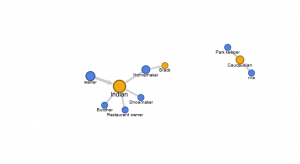
This short story deals primarily with the struggles between time and age and the differences that those factors can have on daily life. I entered the following information in the column tabs of my edge list, “name, job, ethnicity, gender, married” in order to categorize the characters. When I plugged them into the Fusion Table, I found that the graph is most illuminated when I compared ethnicity to job type. This created a more cohesive graph in which I was able to visualize the connections between ethnicity and where the characters worked. Because this short story deals with subtle, but complex, issues regarding the tensions that arise between generations the impact of this graph was greatly minimized because I could only compare two elements at a time. It would have been far more engaging to incorporate more elements or another type of software in order to create a more robust network of relations that span across multiple categories.