Blog 7 Networking Graph

This week I chose to read the short story “Julie” written by Darcy Padilla. Padilla served as the narrator and the story chronicled the life of Julie, a woman with a drug addiction and a victim of child and domestic abuse. The chapters of the short story follow her ex or current partners and the children she had with them. 

Edge graph

Before creating a network graph, I created an edge graph seen above. I decided that the “edge” between the characters would be relation by blood. There are many family members that this story follows, and I wanted to be able to visualize which characters were blood related to one another. On the right side of the network graph, there are two characters (the narrator and Paul) who do not happen to be blood related to anyone, but play a role in the story and Julie’s life. The narrator was Julie’s “rock” throughout her life, always there for here. Even though the narrator was not related to Julie by blood, she was very important and should be included in the graph.

screen-shot-2016-11-13-at-8-26-50-pm
(Click on graph to view in Google Fusion Tables)

This network graph shows that Julie is the main character and shares a blood relationship to most other characters in the story (because many of the other characters her children). The graph also illuminates who the father of her children are. It shows that she has shared many children with Jason, and one with Jack. Most of Julie’s children were taken away at birth by the government, so Jason Jr is the biological son of Julie and Jason, but also shares a connection to Karen because she is the adoptive mother who renamed him Zach. Julie’s life was very complicated and this graph shows the many people who came in and out of her life.

What this network graph fails to show is the exact relationship between the characters. The “edge” between the characters is blood relation, but the graph would be much more interactive and insightful there was a way to specify what type of relation like mother, father, uncle, etc. This graph also fails to show if the character played a positive or negative impact on Julie’s life. The narrative was all about Julie’s life and her relationships. A way to improve this graph would possibly be to give weight to some characters who made a more positive impact on Julie’s life, but that data would be extremely subjective.

Blog 6 Mapping: Digital Harlem

This week I decided to explore the Digital Harlem map. This map aims to present information about the everyday life conditions in the New York City Harlem neighborhood during the time period 1915-1930. The researchers aimed to focus on “ordinary” African New Yorkers, and not black artists and the black middle class which was unlike most other projects depicting Harlem at the time. 

The Digital Harlem map reinforces David Turnbull’s argument that all maps are perspectival and subjective because “the mapmaker determines what is, and equally importantly, what is not included in the representation” (Turnbull, Exhibit 2 , Page 1). The collaborators on this project pulled their information and sources from mainly institutionalized records such as the district attorney’s closed case files, probation department case files, newspapers, committee of fourteen papers, and the writers program collection. These sources give bias towards the government and police point of view. The data uses their standards, language, categorization, and therefore the map shows their perspective. Also, newspapers often do not include information about daily life, but newsworthy info such as crime. The map cannot claim to represent ordinary lives of African New Yorkers if the data comes from sources like newspapers and legal records.

The list of events, seen on the left side, give many options for crimes but not many for "everyday life" events.
The list of events, seen on the left side, give many options for crimes but not many for “everyday life” events.

The map allows the users to filter events based on categories, and it shows that the majority of the listed categories are related to crime. Sure, there are a few categories that depict “everyday life” such as baseball games, church services, and party, but the majority of categories depict crime such as abduction, assault, burglary, drugs, and the list goes on. If I were to just look at the list of events I could choose from, I would assume that this map aims to present information on crime in the neighborhood of Harlem.

If the collaborators of this project did indeed aim to present everyday life, an alternate map could focus on more everyday events and less crime. This map makes the audience believe that crime was a large part of the everyday life in Harlem. To make the map include more everyday events, it could include more information on everyday events like work, school, transportation, family, food, etc. This map could also be enhanced with photos and descriptions, instead of just points on a map. With these additions, users would be able to have a more holistic idea of what everyday life in Harlem was like, instead of being led to believe that Harlem was simply a crime-ridden neighborhood.

Blog 4 Data Viz: Death Data

This week, I examined the data set on Death Rates. I explored many data sets on the website and found that this data set was already easy to read in an excel sheet, so I wanted to see how a data visualization could enhance the interpretation of this information.

This data set listed all 50 states plus the District of Columbia with information regarding deaths based on various causes such as cancer, stroke, suicide, homicide, and many more. What I found a bit confusing about this data set is that there were no units for the data points. I am not sure if the numbers listed are the total deaths per state, the percent of the population who died, etc.

screen-shot-2016-10-24-at-5-32-49-pm

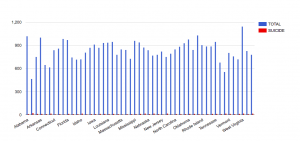
For this blog post, I focused on suicide deaths. Using Google Fusion Tables, I created a bar chart with States on the x-axis and Suicide Deaths on the y-axis. States with the highest suicide deaths include Alaska, Montana, Nebraska, and New Mexico. I tried to think about if those states had anything in common that caused them to have the highest suicide deaths, but I wasn’t able to find any obvious similarities. States with the lowest suicide deaths include D.C., New York, Massachusetts, and New Jersey. These states are all located in Northeastern United States, but I’m not sure how that might relate to lower suicide deaths.

screen-shot-2016-10-24-at-6-03-34-pm

I also created another bar graph that compared the Total deaths to Suicide deaths. Suicide in the states Alaska, Montana, Nebraska, and New Mexico had the highest amount of suicide deaths, but when compared to the total, it was not the largest cause of death which can be easily judged by the size of the red bar compared to the blue.

screen-shot-2016-10-24-at-6-08-11-pm

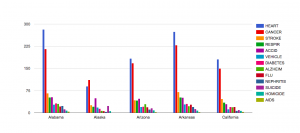
Creating another bar graph with all causes of death provided in the data set, we can clearly see that heart failures and cancer are the leading causes of death in the states.

The data set would be more helpful if there was also related information such as age and income to determine any large factors contributing to deaths. It would also be helpful to know what year this data was gathered, because it may be outdated by now. The data set in the excel sheet was easy to read and the visualizations gave me another perspective to analyze the data, but it would be more effective if the data set was more complete with units and other related information.

Blog 3: City Appropriations, Expenditures, and Revenues

I explored the Appropriations, Expenditures, and Revenues data set from the LA’s Controller’s Office. This data set includes the ledger transactions for the city’s appropriations, expenditures, and revenues. I thought this set would be a way to gain insight on where and how the city is spending money.

This data set specifies information such as the fiscal period, department, funding type and name, account name, revenue source, activity name, total expenditures, budget, and more. Each record is a specific transaction and keeps track of when money was spent, by what account/department, for what purpose, and how it alters the budget for the city.

Using Wallack’s and Srinivasan’s article to examine this dataset closely, this dataset’s meta ontology was created by the city as a way to organize and materialize information regarding expenditures that needs to be monitored by administration. This ontology makes the most sense from a policy maker and city official point of view. They would use this data set to see where the resources are being allocated and if new policies need to be enacted as a way allocating funds more effectively.

When states create these meta ontologies, it unfortunately “sheds much of the local context in order to ensure tractable management for policy purposes” (Wallack and Srinivasan 2). These data sets provide an essential form of infrastructure to the administration of the city, but the city cannot fully understand the community they are trying to represent. Ontologies “impede communities ability to impart and communicate information and states ability to fully understand the territories they govern” (1). This is problematic because this meta ontology is aiming to monitor economic activity for the city, but the way it represents information shapes how funds are being allocated to the community.

How the communities are being affected by these expenditures is being left out of the data set. This data set notes what department and activity this money went to but it does not specify how exactly the money was used or how it directly served the community. Community input could make this data set better to show the city how their expenditures and efforts may or may not be effective. Since the data is published digitally, community members and citizens can take this data and manipulate it to represent their own needs. This data could be used more effectively if this ontology was more inclusive to community attributes and if it noted how the expenditures affected community utility and wellbeing.

If I were to start over with this data set from a different person’s point of view, I would note how interesting it is that the city published their expenditure and revenue report online to the public. I would like to see a more community based ontology with descriptions on how each transaction was used to affect the citizens.

Blog 2 Finding Aid: Japanese Internment

This week I chose to explore the finding aid for the Collection of Material about Japanese American Internment, 1929-1956 bulk 1942-1946. There are four boxes of relevant material stored by the UCLA Library Department of Special Collections, and it’s open for public access upon request. (I can’t wait to check out some collections one day!) Shortly after Imperial Japan’s attack on Pearl Harbor, the government forced the internment of Japanese Americans. Materials in this collection include publications with many different perspectives such as the War Relocation Authority, Japanese American internees, and advocacy groups. Boxes include materials like published reports, pamphlets, yearbooks, speeches, and more.

Narratives

The first two boxes are publications sponsored by the War Relocation Authority (WRA). The WRA is the US government agency that handled the internment of Japanese Americans. The materials included published reports and pamphlets that detailed general aspects of life in internment camps such as education, religion, and employment through the eyes of the government. It argued and provided justification for the internment of Japanese Americans.

The next box included materials written and produced by Japanese American internees. It included their own articles depicting life at camp, such as the conditions, the barracks, sports, school, and employment. The emphasis was placed on the Manzanar and Minidoka internment camps.

The last box was described as miscellaneous and included article clippings, publications, speeches, radio broadcasts, and more. There were various sources like the Japanese American Citizens League and the American Council on Public Affairs.

What’s missing? And how can it be remedied? 

Out of the four boxes, two were sponsored by the WRA. To me, it is very problematic if the majority of the narratives are told by the government agency responsible for the internment of Japanese Americans. How can the WRA tell the story of Japanese American internment if they were not the ones to endure it themselves? In this collection, the narrator of history is the WRA. But by including more documents that detail the life of Japanese Americans by Japanese Americans, we can reconstruct the history and present different narratives. In Caswell’s article, she expresses how history becomes silenced when omitted from archives. With more records and narratives that we document from the community itself, the gaps in history will close.

Box three included materials produced by Japanese American internees, so their narratives are presented, but they are not at the forefront of this collection. Also, the emphasis was placed on the Manzanar and Minidoka internment camps. This collection could be strengthened if narratives of Japanese American internees were included from other camps because the narratives would might differ.

In addition to more community based points of view, I would also like to see their narratives on life at camp in a greater context and scope. It would be beneficial to see materials and narratives on how they prepared themselves for camp, how they kept their morale and culture during camp, or how they rebuilt life after camp. Overall, this collection could be enhanced if more materials were drawn from the community as opposed to the government agency.

Week 1 Reverse Engineering: Early African American Film

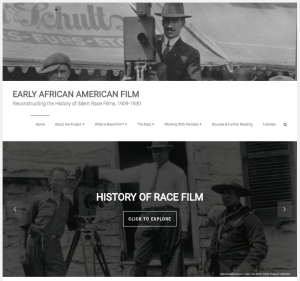
Early African American Film is a digital humanities project created by students at UCLA. The group constructed a database on African-American silent race films that focused on films created before 1930 for African-American audiences. It contained information including films, actors, and production companies and how they all are connected. Since this topic is seldom discussed, I enjoyed exploring this project and learning about film history.

homepage

Sources

The workgroup gathered information from many primary and secondary sources. One major archive used was the George P. Johnson Negro Film Collection, which can be found at UCLA’s Young E. Research Library with items such as documents and newspaper clippings related to early Black films, companies, casts, and notable figures. Another major archive was the Mayme Clayton Library and Museum, which contains collections such as manuscripts, rare books, film and recorded sound archives, photographs, and much more that document race films. An example of a secondary source used for this project is a collection of essays that examine the work of Oscar Micheaux, an influential African-American filmmaker, and the relationship his race films had with the black press. A full list of sources used can be found here

Processes

A database of information was created and presented as a spreadsheet, hosted by Airtable. The data could be sorted many different ways–by people, films, companies, and sources. Clicking on a data entry would give you information such as their full name, relevant notes, films appeared in, films worked on, sources, associated production companies, and more. The data could also be filtered and grouped for the user’s ease. Also, a glossary and many different tutorials on how to build graphs, maps, and other data visualizations were included to help users familiarize themselves with the information and to encourage users to engage with the data.

Presentations

This project presented the data in a way that allowed users to not just look at the data, but also modify and use the data. The site is very interactive and presented information in various ways.

On one page, there was a histogram (created by plot.ly) of when films were being produced, and users could highlight certain areas to zoom in on a certain area to study.

histogram

There was also a network graph that visually connected people and films. If you double clicked on a data point, it would reveal people they were connected to by working on films together. The network graph included all of the people in the database associated with films, such as actors, directors, producers, cinematographers, and others. It gave context into who the larger people were and what the larger networks were.

visual-network

To help visualize production companies, the project included a time map (created by Carto) of the location of African-American production companies throughout the year, which gave more insight on the trends of race film production.

time-map

The ways in which the data was presented visually helps users explore African-American race films in many different contexts.