DH101

Introduction to Digital Humanities

Page 29 of 38

Wage Gaps Between City of LA Workers

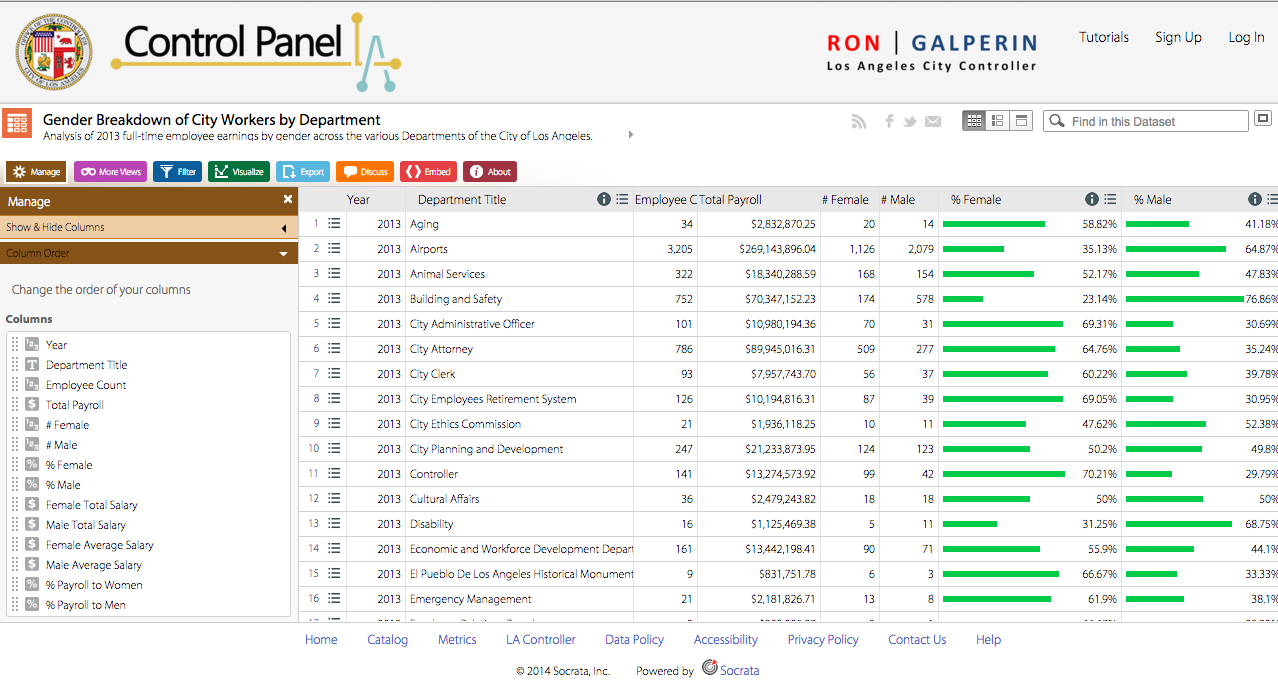
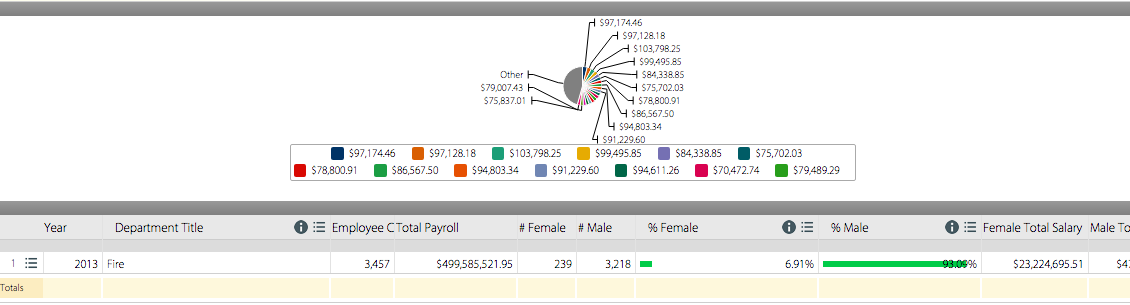
The Gender Breakdown of City Workers by Department is a dataset that has been released to the public from the L.A. Controller’s Office. More specifically, the dataset is an analysis of 2013 full-time employee earnings by gender across the various departments of the City of Los Angeles. Presented initially as a table, the site gives you other visualization options for the data, such as a bar chart, line chart, or pie chart.
Screen Shot 2015-10-19 at 1.25.24 AM

Screen Shot 2015-10-19 at 1.31.14 AM

Its data/content types include: year, department title, employee count, total payroll, number of females and number of males (in each department), the percentage of females and males, female total salary, male total salary, female average salary, male average salary, percentage of payroll to females, and percentage of payroll to males. This dataset has 41 rows, or 41 records. What constitute a record in this dataset is a particular City of LA department and its individual values for each relevant data type corresponding to that specific department.

Wallack and Srinivasan define ontologies as “systems of categories and their interrelations by which groups order and manage information about the people, places, things, and events around them” (2009: 1). In other words, ontology is the term that represents the way in which real-world matters are labeled, categorized and interpreted. This particular dataset’s ontology can be identified under multiple categories, such as economic (payroll) or more social (gender). This data has also been categorized by the LA Controller’s Office itself, as it’s been tagged under such categories as “equality”, “employees”, “demographic”, “women”, “wage gap” and more.

Those who would find this dataset the most illuminating would probably be activists for women’s rights, policymakers, and academics focusing on gender studies. More specifically, people who are interested in researching discrimination in the work place and discrimination amongst different genders. This dataset could be used as hard, statistical evidence in the fight against the wage gap, the glass ceiling, and inequality in general.

In reference to the year 2013, this particular dataset shows that female employees working in a number of departments in the City of LA earned a lower average salary than their male peers in their respective workplaces. For example, in the Department of Cultural Affairs, females had an average salary of $58,563.10 while males had an average salary of $79,172.67—a difference of a little over $20,000. Most of the records in this data set fall under this description, with females earning less then men in a high number of departments. In addition, in workplaces where females have earned a higher average salary than males, the difference is small when compared to the gap when males have higher wages than females. The dataset also shows the number of females to males in the departments, which also can have a large difference in count. This dataset definitely tells a lot about the controversial phenomenon of the wage gap between gender in this country, which exposes a type of discrimination that is still in effect in governmental departments in such an influential and progressive city as Los Angeles.

Even though the dataset is fairly complete in payroll statistics amongst females and males, there are a few data types that have been left out. For example, ages of the workers might add more valuable information to this dataset. Perhaps, seniority level/years on the job and education level of the employees would help illuminate the issue, as well.

If I were to re-do this dataset and start the data-collection all over, I would focus the ontology on age/seniority level and relevant education/experience. My data/content types would probably include age, position, number of years employed in the department, salary, and education level/relevant job experience. I would then attribute that data to the specific gender. By doing so, one can see how time and experience can affect job earnings. Changes and transitions over time, including promotions, could be interesting information to apply to the wage gap issue.
Week 3: LA Controller’s Office Payroll Top Earners

For this assignment I looked at the LA County Controller’s Office Payroll Top Earners is a dataset which shows a chart of LA city workers’ occupations and salaries recorded in 2014.

Screen Shot 2015-10-18 at 10.42.45 PM

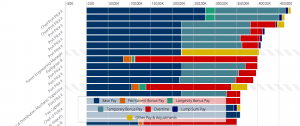
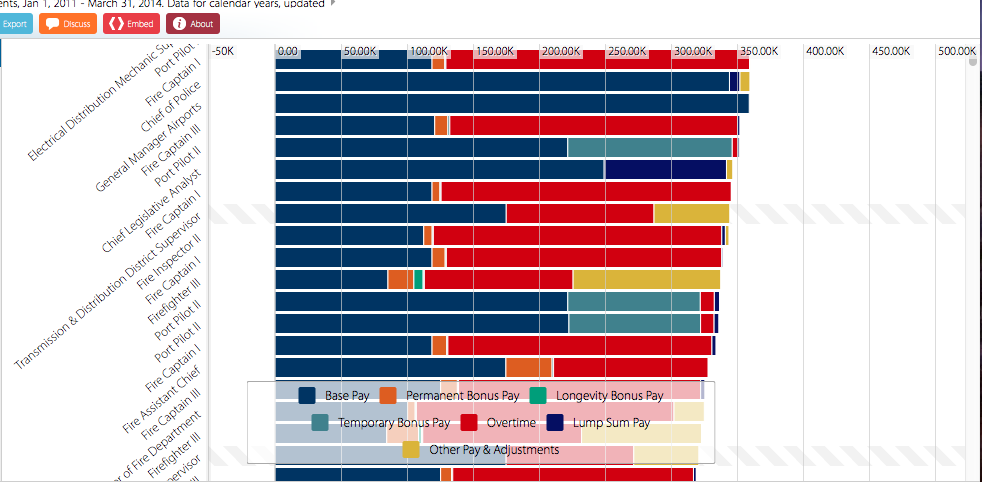
The bar chart shows the base salaries of occupations in which you  work for the city of Los Angeles in dark blue. The graph also includes permanent bonus pay, longevity bonus pay, temporary bonus pay, overtime, lump sum pay, as well as other pay & adjustments in various colors to distinguish them from each other. You can stroll down through the vast number of top earning positions employed by the city, which was pretty eye-opening for me since I was unaware that a lot of the jobs even existed let alone their earning potential. The site offers different search features in order to filter through the expansive chart which is organized with the highest possible earning value at the top and lowest at the bottom.

If according to Wallack and Srinivasan ontologies are the “systems of categories and their interrelations by which groups order and manage information about the people, places, things, and events around them” then the information here is ordered by the position and it’s ultimate earning value for the year of 2014. The graph would be probably the most useful to prospective city employees looking for the possible earning potential or city employees seeking more information on promotion pay as well as bonus pay in the future. The ability to filter through based on department is especially useful to job seekers since it allows them to focus solely on the department where there interests are.

The dataset definitely openly informs the public of the top earning salaries for various jobs employed by the city of Los Angeles. The graph fails to provide more of what you might refer to as contextual information concerning the positions. For example, though overtime is one of the color-coded categories on a graph, we are left uniformed concerning the amount of hours in each work day for each position. Users are also left without the job description of each position which is some cases most likely unnecessary like with firefighters, but with even the highest earning position, Chief Port Pilot II, it’s unclear what the job involves on a day to day basis meriting such high earnings or if it even does merit the earnings, though that might be more of a subjective interpretation. The chart also leaves out the cost of living in LA which would contribute to what some might consider inflated salaries.

If I were starting over with data collection I might look more at the employed individuals as well as their salary. I might also try to gage the community value for each position in relation to the amount they earn to search for any discrepancies and possible instances of overpay.

Los Angeles Data Set Control Panel

The absolutely fascinating though suspicious data set can be found here from the Los Angeles Data Set Control Panel. The direct link can we found here:

https://controllerdata.lacity.org/Finance/All-City-Departments-by-Payroll/f6ve-4yux


Control Panel

Data Types

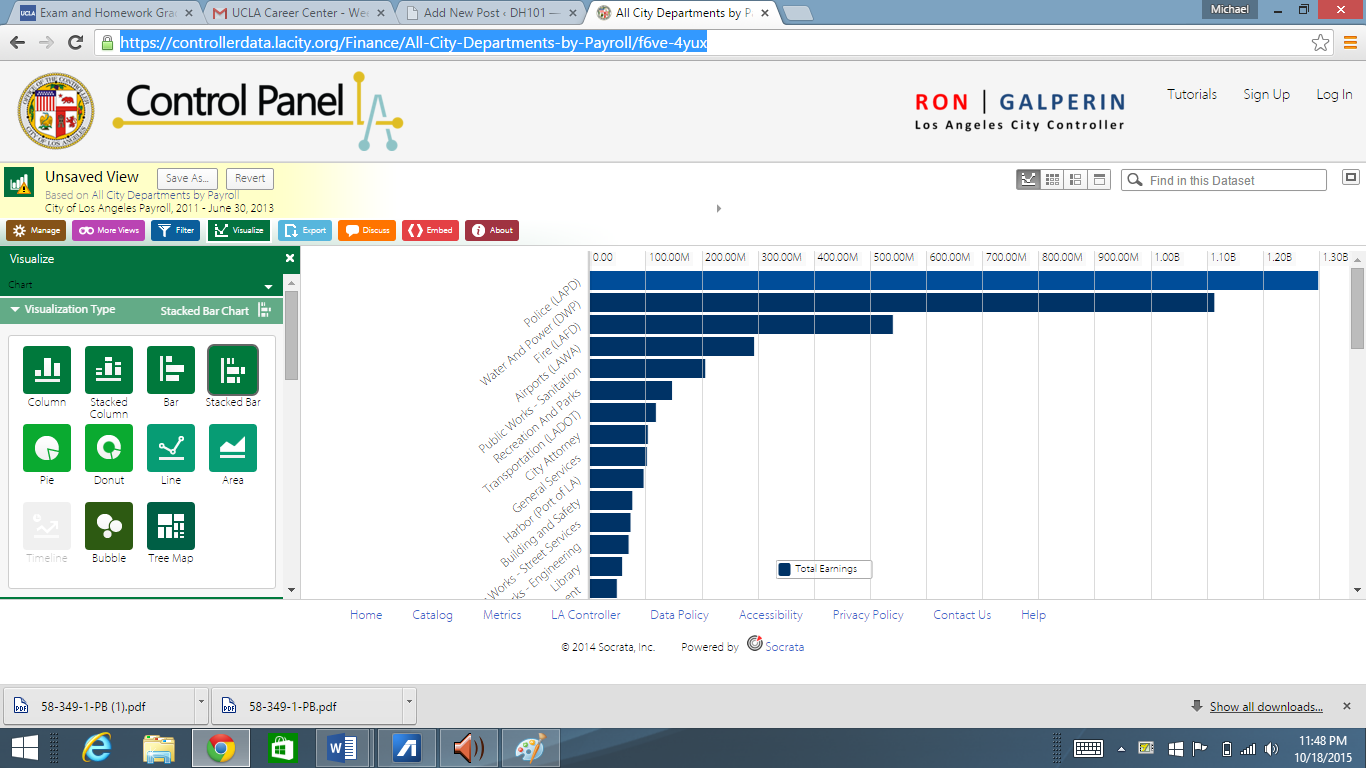
                The type of data represented in this dataset is the payroll of many of the different city departments, presumably paid for by taxes from L.A. taxpayers (the common citizen). This dataset is completely open to the public, which provides a wonderful resource for taxpayers to see exactly where there money is being distributed to. These data points take into account payrolls from 2011 to June 30 2013.  The data is represented by showing the records of how much money in total was paid to a variety of city departments; take the Los Angeles police department or the Water and Power department. Combined, these departments were paid more than the rest of the departments on the payroll put together. The data can be represented in a multitude of ways, as evidenced by the attached photograph; look at the left side of the screen. You can choose to represent the data in a pie or chart, or a bar graph, or even as bubbles. All of these methods of displaying the data help serve to illustrate the data that is accessible to the viewer, and in this regard they have done an excellent job. Have trouble conceptualizing data in a pie chart? Well the creators of this data set have been generous enough to allow the user to choose a way to examine the data in a way that makes it the most visually discernible for them. The bar graphs in particular do an excellent job of capturing the large gaps in payroll across the varying departments, as the length of the bars appear meager in comparison to that of the leading aforementioned departments.

Ontology

                Ontology is a philosophical term literally means the nature of being. In a less abstract digital humanities sense, Wallack and Srinivasan discuss ontology as multiple ways a data set can be interpreted depending on the group of individuals examining the data. Differing groups may choose to interpret the data in a way that is more compatible with the specific information they wish to acquire. There is no rigid ontology for the data set; rather each groups inherent biases will get to pick and choose the way in which they interpret their data, and how this data offers a more broad picture of the large gap between some departments and not in others.

As to who will find this ontology as making the most sense, it seems rather obvious to me that it is those who are merely slivers in the pie chart that should be most profoundly affected. It is incredible that just from bar graphs and a crunch of numbers, one can discern clear inherent gaps between various city departments. In this sense, Digital Humanities can inspire social movements in which, say, the librarians are making significantly less than other professions that are not eons more important than librarians. This may inspire the political action necessary in order for librarians to demand a more fair share of the community payroll. This is fascinating to me that merely a list of data points can reveal obvious pay gaps across different careers, and hopefully aspire to acquire more funding (it should be noted that here, I am biased. I found libraries to be an extremely important social service that seem to be slowly dying.)

Data Set

                I can infer, and am rather shocked, that so much of our tax payers money is put into LAPD. This might be a stretch, so bear with me here, but I would argue that librarians may not be quite as important as police officers in terms of protection, but is this all that matters? I would adamantly argue that the spread of knowledge is just as important as our safety. The phenomena gives me this unsettling feeling that way too much money is being put into public safety as opposed to the fostering of knowledge itself.

The main thing that gets left out is the payroll of higher state officials, and those in power. I think taxpayers would absolutely want to know how their money is being distributed, especially by those who are responsible for dishing out the payrolls. If the date set chose to include a few government officials, this may assist in taxpayers regaining a trust in their respective state officials. True, a state official is not a city department, but by including this information a common man would  be able to contrast the payroll from city departments from the state officials, which would contribute to the individuals judgment on whether these payrolls are fair and equitable.

If I were to start over I would definitely describe a different persons ontology. The ontology here, the purpose for its being, seems to merely show differences in payrolls; this is too superficial for me though. I would prefer to see an ontology that instead of showing tax payers distribution of funds, shows the inherent gaps between varying aspects across the city departments. I believe that this kind of ontology would appeal to the lower class as they are (arguably) unfairly  getting paid significantly less, and would bring attention to the disparaging gaps. This is one of the many ways digital humanities is able to inspire social reform.


City Budget Expenditures

The City Budget Expenditures Records consists of Los Angeles’s spending from the year 2012 up until 2015. There are a total of 16,001 records made since 2012 with the expenses ranging from $90.00 to $1,000,000,000.00.


Each record consists of an expenditure, including year spent, exact amount, department name, and 13 more categories. Wallack and Srinivasan’s belief that an ontology informs its community and allows individuals to work as a group. In this case, the transparency of the city’s expenditure allows individuals to account for the city’s budget and to prevent theft and corruption.


The city’s finance and treasury department would find the data sheet most useful because they help keep the city’s budget in balance. The dataset logs in detail about where the city’s budget is put. It tells the public how much money was spent, if the project needed more funding, and which department spent the money.


However, there’s no information on why the money was spent and if the project was completed. It’s definitely better if the viewer knows why the money was spent and who was in charge of the project as to protect from fraud and overspending.
If we had to create a whole new budget sheet, the budget would include date, name, expenditure, location, reason why, expected done date, and total budget of the year. This would table would be geared toward the public more, categorizing the expenses into districts, and making sure it’s reasonable.

LA Controller’s Office: What We Buy

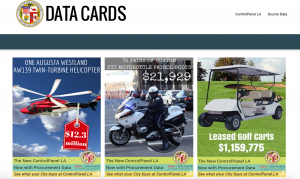
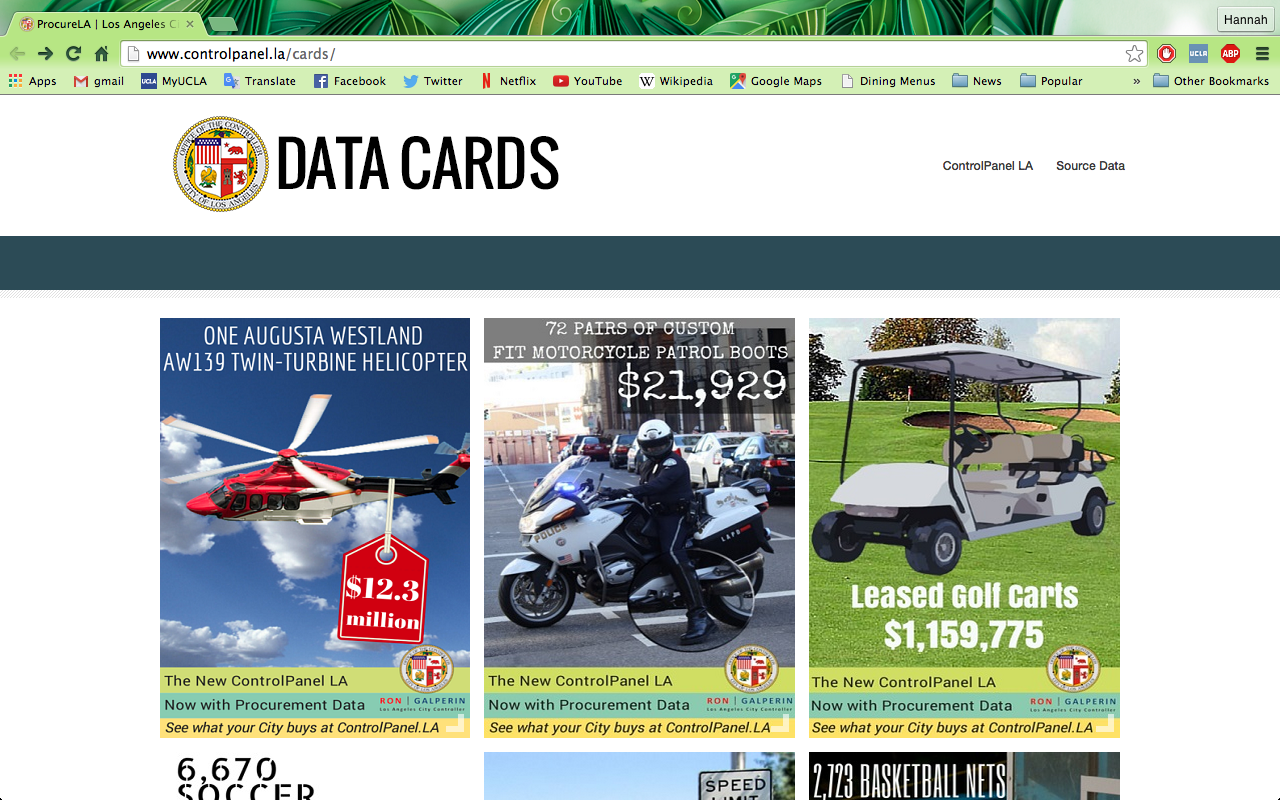
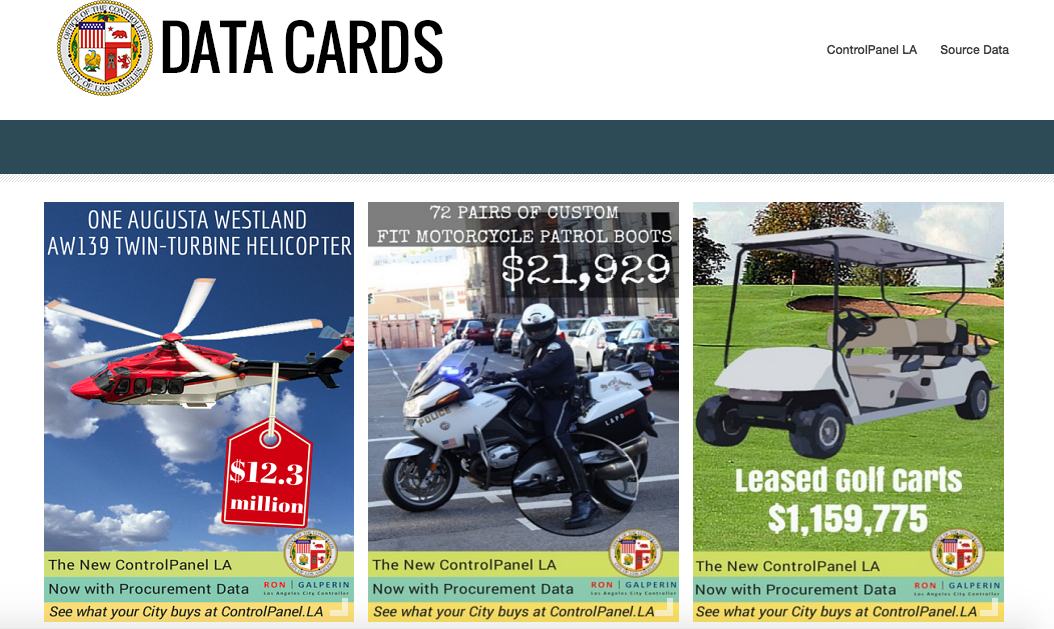
The dataset I chose to explore from the LA Controller’s Office was the What We Buy Data Cards.  The cards provide data for the 15 items that the city of Los Angeles spends the most money on.  These items are an AW139 helicopter, motorcycle patrol boots, golf carts, soccer balls, radar speed signs, basketball nets, ballots, thermoplastic paint, graffiti buster, TORO riding motors, Federal L.U.S.T. Tax, fire hoses, high visibility white traffic gloves, mops, and large frozen rats.  The data cards in this dataset constitute constitute individual records.  Each data card explains what the item is, how much they have spent on it, why they buy it, and a fun fact about the item. At the bottom of the card, there is a button that takes you to the control panel to explore the data even further. The spreadsheet provides specific data including the date the items have been purchased, how much it costs, the amount they bought, where they bought it and more.  This data can also be visualized in multiple ways such as pie charts, timelines, and bar graphs. Screen Shot 2015-10-18 at 11.17.42 PM

Wallack and Srinivasan’s definition of ontology is a “system of categories and their interrelations by which groups order and manage information about the people, places, things, and events around them.” This data set’s ontology is organized by the data cards.  The LA Controller’s Office organized the categories by the individual item itself and within each category it dives into more depth about what/how/where the money was spent on that item.  I think this ontology would be the most illuminating and useful to the curious eyes of the general public.  The data gives a brief overview of some of the most outstanding purchases of the city without going in to extraneous detail. I think what this data set lacks is background information for why it chose the items it chose.  To me, it does not seem like they are the items that LA spends the most money on because the data cards are not ordered in any numerical order. This ontology is categorized based on the view of the LA Controller’s Office, which chose to display very specific details about their expenditures.  If the data was recollected and categorized into an ontology from a different point of view, different items might have been chosen to display expenditures. 

Blog #3: LA Controller’s Office Data

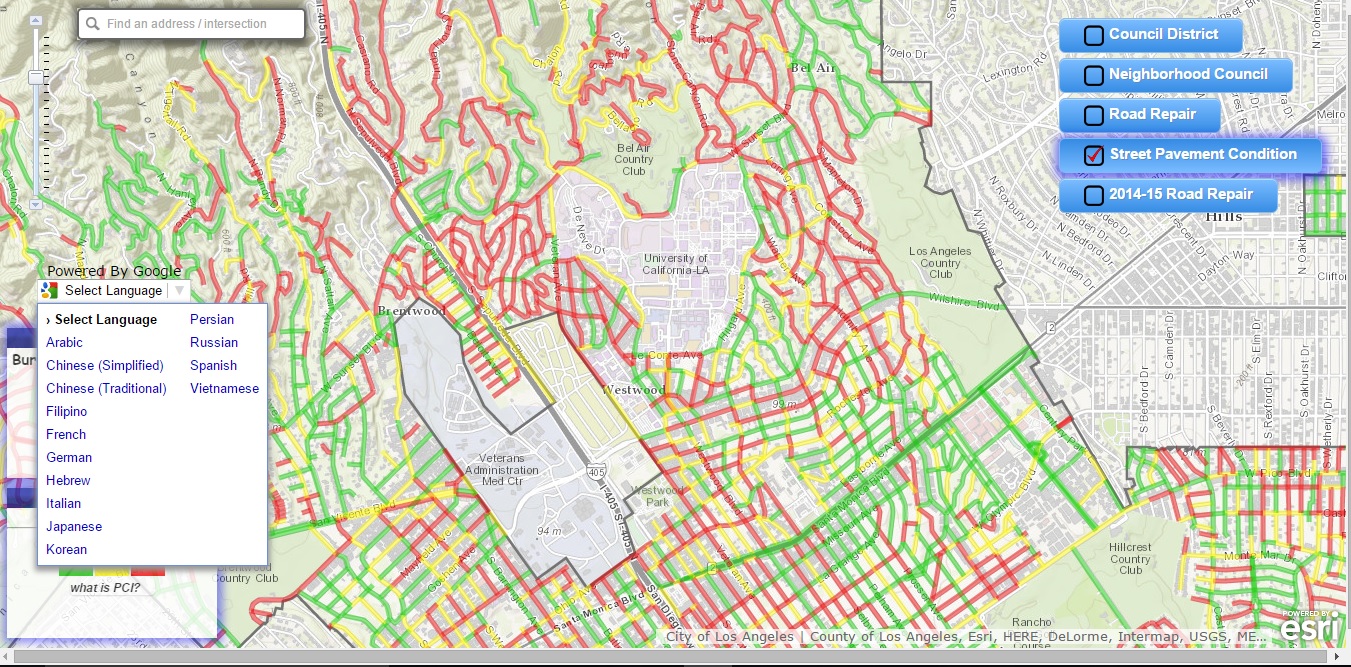
I looked into the data base of street grades from the LA controller’s office. This data base ranks all of the streets of Los Angeles based on street pavement condition.

street data

http://bss.lacity.org/NeighborhoodCouncils/Street_Assessment_Map/map.html


The data is a organized as a map that visually portrays the pavement condition  A record in this data base would be the data of a street along with a PCI (pavement condition index)  rating.  Wallack and Srinivasan define an ontology as a group of data or information. The ontology of this data is a government sponsored rating of quality of the streets in Los Angeles. A view of this ontology would make the sense to someone who is working on a city budget for the city. This way one could determine where resources should be allocated based on need. For efficiency one could also searched for contracted street cluster that the city should take care of.This data shows phenomena like what general areas have streets with better or worse street condition.

One of the major issues that I see with the chart is that it is government rated. This means that the condition of the street is biased. Also, it lacks a way to measure street usage/popularity. Without a tool like this the city might send resources to fix a street that is in poor condition even though it may not be used by anyone. That being said, another set of data that would be useful is a tally of pedestrian complaints of streets to know what streets mean most to people who use the streets. I think that  a tool like this would help the government, who are most likely the ones that are using the data to make decisions that effect an entire city, to know where resources she be relocated and the amount needed in order to improve efficiency.

I think the if I were to start over with data-collection, I would continue to survey they streets on standard that would include both the street condition . I think that way, the data would be more true to the people in terms of their point of view. That being said it would be important to survey everyone who uses the street. This way the data is altered by biased feelings.  I might also track at what times the streets are busiest so that the data might be more valuable in terms of when repair should be scheduled. In this way the data can help people by presenting information that is valuable to properly decide what the best course of action for the people who use the streets.

Payroll by Job Class on the LA Controller’s Office Website

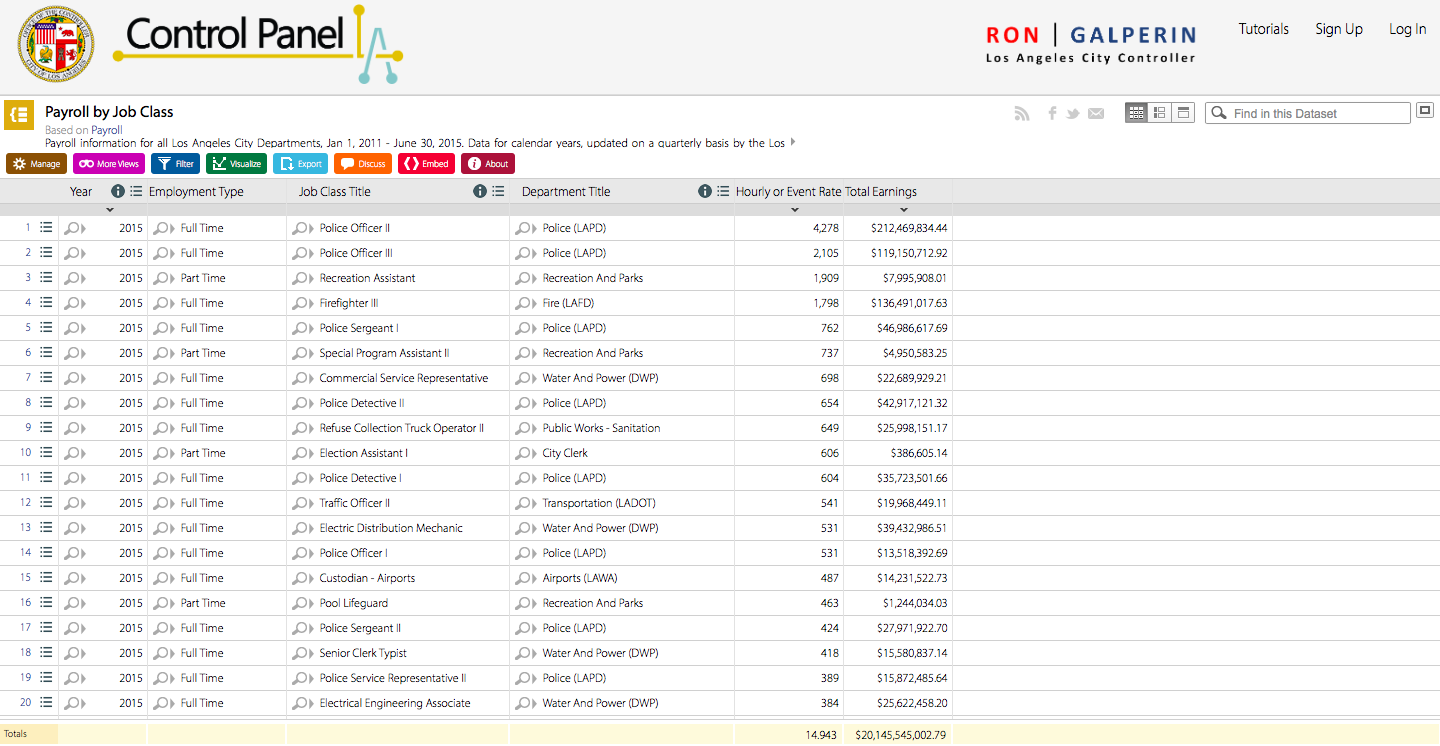
I chose to analyze the Payroll by Job Class  dataset on the Los Angeles Controller’s Office Website which offers payroll information for all Los Angeles City Departments from January 1, 2011 – June 30, 2015. The date is organized and inputted into a table format with five content types and hundreds of records to be analyzed. The dataset also offers the option to visually compare the differences in a column, bar, pie, donut or line graph format which is effective when comparing various theories of the amount a specific job class earns. Each record, for the most part, is a different job class title. Each record in the data set has a content type of the year, employment type, job class title, department title, hourly earning and the taxable income for the year.

Screen Shot 2015-10-18 at 9.09.29 PM

Wallack’s and Srinivasan’s definition of ontology applies to this dataset because it organizes earnings information about the jobs within the Los Angeles City Departments. This is particularly important and a great asset that this dataset offers because it is a public dataset which is available to any individual seeking potential earnings information. I think this dataset is very useful to the general public because it gives job seekers a chance to analyze the different job fields and earnings potential they may have when entering the task force. This is also useful for individuals who may be in the field of advising college students about their careers because it gives them a better understanding of the job fields that are thriving versus those that are not as popular, which will ultimately benefit their immediate audience or students.

The dataset states that it will provide payroll information about jobs within all Los Angeles City Departments. After analyzing the dataset, one would be able to find that Police Officer II makes the most amount of money from the list. One foreseeable problem with this dataset is that is only offers earnings information without any demographic, gender or educational information about the individuals holding the position. This poses an issue for analytics purposes because it leaves several unknown variables which could prevent a full analysis for research questions.

Although the dataset offers a lot of relevant information, if I were to start-over with the data I would attempt to include demographic information of the individuals holding the positions. For example, gender, race, age, experience and educational degrees would be some data that I would collect and put into the dataset. I feel that this information would be useful for anyone researching more in depth into who actually holds these positions so that the current information could be brought to the attention of the community. This would be great to present to high school students so that they could analyze and see if the specific field matches their interests and potential earnings after high school.

L.A. Control Panel: City Departments Payroll

Screen Shot 2015-10-18 at 8.19.59 PM

Identify its data types.

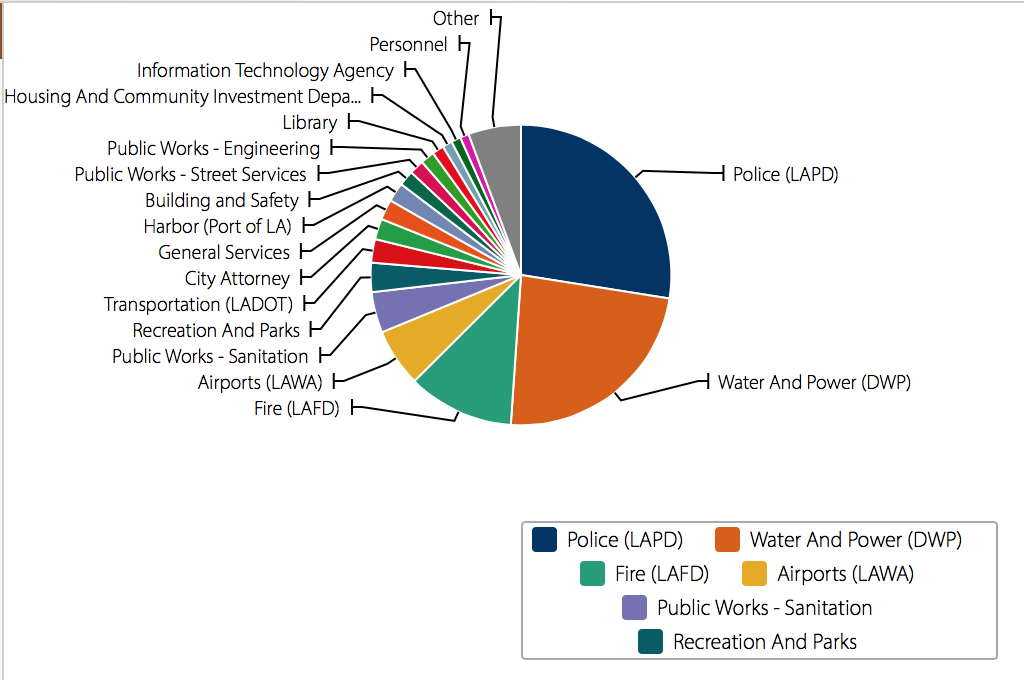
The data presented under “All City Departments Payroll” on The L.A. Control Panel is administrative data representing the total earnings of different departments in L.A. in the form of a pie graph.

What constitutes a record in this dataset?

A record in this data set consists of a department in LA that uses taxpayers money to operate, the total earnings of that department, the year, and earnings over regular pay.  Each record is shown as a different color in the pie chart in order to distinguish them, but there are also other graph visualization options in order to see the records organized differently.Screen Shot 2015-10-18 at 8.18.52 PM

Use Wallack’s and Srinivasan’s definition to identify the dataset’s ontology.

Wallack’s and Srinivasan believe ontologies “negotiate boundaries between groups” meaning that official(meta) and community ontologies can tell different stories about the same data. Since the data on the Control Panel was organized and edited by someone working for the government of L.A., this dataset’s ontology regards the states employer’s interest.

From whose point of view does this ontology make the most sense? (Another way to ask this question: Who will find this data most useful and illuminating?)

This dataset seems to be made for the public in order to see how their tax money is being used.

What can this dataset tell you about the phenomenon it claims to describe?

This dataset shows that the police (LAPD) earns the most money and that water and power earn the second most.

What gets left out?

It’s interesting that the data doesn’t show exactly where the money goes within each department. For example, a taxpayer may like to see that the police department has the greatest earnings which implies a lot of money goes into keeping the community safe, but may not like to see that a solid portion of the money that goes into the police department is used to pay firearm trainers . I’m not saying this is the case, but I’m using it as an example to show how limiting the data to showing payroll by department could be strategic by the state.

Imagine you’re starting over with data-collection and describe a completely different ontology, from someone else’s point of view.

A different ontology option for this dataset would be to  categorize payroll by job type rather than department. It would be cool to see which kinds of jobs in each department earned the most/least money rather than just by department. Organizing the dataset in this way would be more beneficial for people looking for a state job because they can identify jobs based on skill type than on department type. Screen Shot 2015-10-18 at 8.18.52 PM

LA Controller’s Office: Looking at the Top Earners

Today I had a look at the LA Controller’s Office . The great thing about this site is that it is all “Open Data”– that is, data is made accessible to the public. People are able to open, download, and shared regardless of any relationship with the LA Controller’s Office.

I chose to dig into the Top Earners category, and right off the bat, I can tell that this dataset would be an interesting one, given that the first thing I saw was a massive bar chart! The purpose of one of the data types being a bar chart is to demonstrate the maximum earnings or expected earnings of government workers, and the multiple colors denote different types of payment. A legend accompanies the chart to allow for readability of the bars while scrolling downward.

Screen Shot 2015-10-18 at 7.22.44 PM

What the bar chart looks like; you can scroll down it for miles! The breakdown of the legend is: dark blue for base pay, orange for permanent bonus pay, green for longevity bonus pay, turquoise for temporary bonus pay, red for overtime, royal blue for lump sum pay, and yellow for other pay and/or adjustments.

As one can see, it’s definitely a lot to take in, but the use of the legend definitely made this dataset a little more easy to understand. Furthermore, the estimates of pay constitute as records within this dataset; data has been arranged and categorized accordingly, such as the payment that applies to pilots, but taken farther by description such as “chief port pilots” and just “port pilots.” Interestingly, chief port pilots make the most pay out of all government jobs; their base pay alone is about $277,000! Another reason why this is a record is that the data set is supposedly counting yearly payment, so information had been researched and noted over a course of time; in this case, from the years of 2011 to 2014.

The dataset’s ontology is similar to what Wallack and Srinivasan described as “a descriptive and classifying system” which negotiate the limitations of two or more groups.  The dataset is certainly structured in a sense that allows for any sort of information to be arranged so that it is more user-friendly. The application of a bar chart only highlights the link between each group, such as the types of pay, with the type of job, falling under a total pay amount for the year.  I would say that many people would find this data most useful; however, this will absolutely come in handy for those trying to research the city’s top earners and why. Why is it that the top earner is a chief port pilot versus a firefighter? Could it be the different training needed, or employment rates for each job? Such questions like these can be something one may ask when looking for answers using this dataset. It also tells the phenomena of how a job market in a specific area is subject to change over the years. Looking at this dataset, one can tell the demand for a category from another just by pay alone.

What gets left out, however, are additional information that may be even more useful such as how the pay is for part time, or the amount of people they surveyed for one category. Why certain jobs are paid more in bonuses or base pay is also up for question.

If i was starting over with data-collection, I would want to do somewhat of the same ontology that this set has used; charts are just so great in how it visualizes data and maintains organization of it! But I will say that if I were someone else, I would probably look for another way to display the dataset, like a map of where different workers are located that might explain a difference in types of pay, or a little description beside each job that explains what they do. In general, however, the Top Earners dataset on the LA Controller’s Office site is well put together and thought out, and it’s nice to see that a set like this is available for public use.


LA Controller’s Office: What We Buy

The L.A. Controller’s Office provides data for the big purchases made by the city on its What We Buy data cards. The data shows 15 items that city spends the most money on in descending order, staring with a twin-turbine helicopter that cost $12.3 million, down to $129,218 spent on frozen rats for reptiles at the L.A. Zoo.

Screen Shot 2015-10-18 at 7.28.53 PM

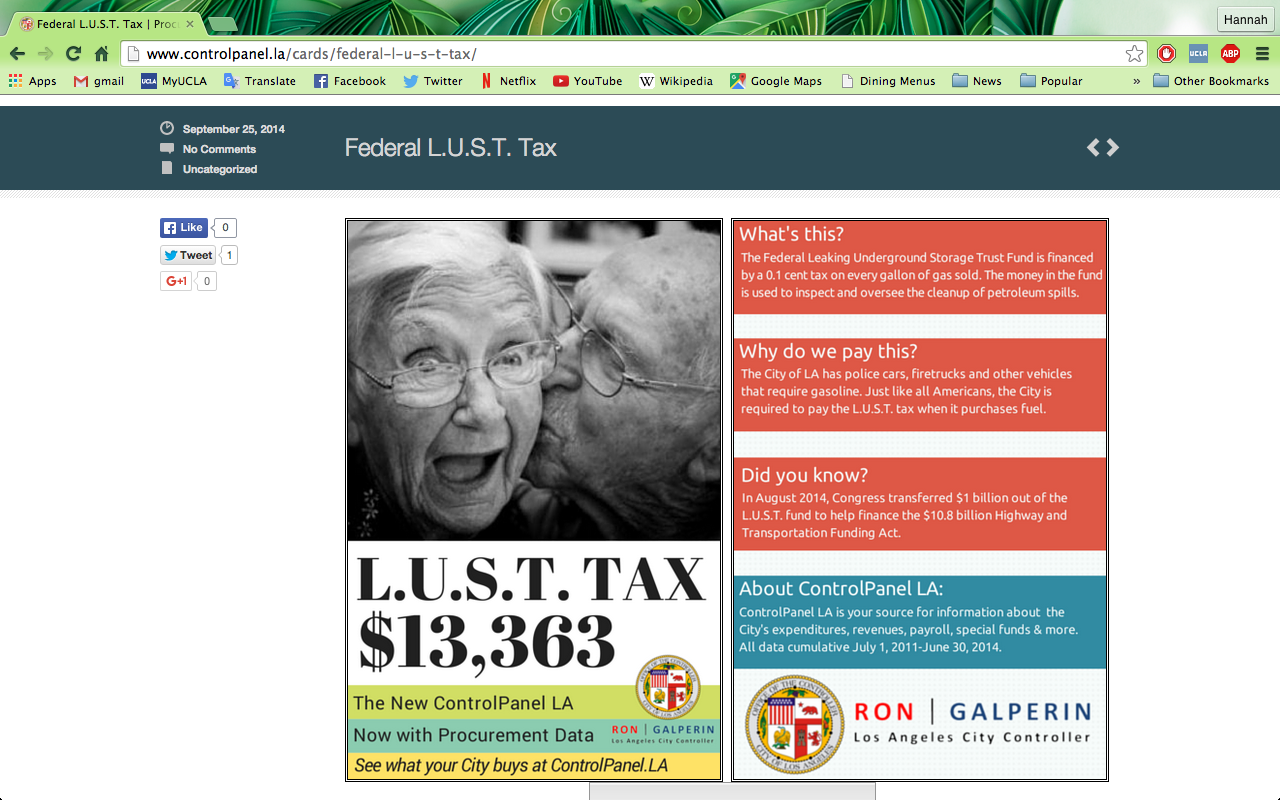
Clicking on a card provides more information – data on what the items are, why the city buys them, and a “Did you know” section for relevant facts. From these cards, you learn that the data was collected from July 1, 2011 to June 30, 2014. This was especially helpful for something like the L.U.S.T. tax, where it is not common knowledge what the category is or why spending money on it would be necessary.

Screen Shot 2015-10-18 at 7.29.13 PM


Wallack and Srinivasan define ontology as categories that groups, like a local community or a state government, use to manage and sort all of the information around them. This website uses an ontology on the front of its cards that is mostly understandable to English-speaking members of the L.A. community. Some of the categories, like thermoplastic paint or the L.U.S.T. tax that I mentioned earlier, would only be understandable to someone on the government side rather than the community side, but the details on the cards ensure that the category has an ontology that is more familiar and colloquial. Clearly, the city wants this to be understandable for its community members.

This data would be useful for anyone looking for a general overview of the city’s purchases, and its lack of detail suggests that it is for anyone in the general public who is curious. If you were looking to do an in-depth survey of how the city spends its money, you would probably need more information.

I think the biggest thing this dataset leaves out is information about the timespan. Though it says the data was collected in between 2011 and 2014, it doesn’t give the specific year that a single purchase, like the helicopter, was bought, and something like the six million ballots the city buys would have seasonal spikes, rather than continual purchases. It isn’t clear if the city bought 100 radar speed signs at once, or if they were purchased gradually over three years. For a dataset directed at the L.A. community, I think it also leaves out the city’s large population of people that don’t speak English.

If I was starting over, I could redo this dataset for an expert’s ontology who was looking for detailed information about L.A.’s spending. I might use graphs and charts to show spikes in purchasing and I would leave out the background information that an expert would already know.

« Older posts Newer posts »

© 2026 DH101

Theme by Anders NorenUp ↑