DH101

Introduction to Digital Humanities

Author: FrancescaAlbrezzi (page 33 of 38)

Aldous Huxley Archive: His Groundbreaking Recordings and More

http://digital2.library.ucla.edu/viewItem.do?ark=21198/zz00253vz2

I was absolutely delighted to find a repository of Aldous Huxley. Being the philosophy nerd that I am, I was genuinely excited to explore the content of this archive. The archive has absolutely no aesthetic appeal, but I do not think that that is the purpose of an archive in general. It is very neatly organized into four distinct categories, which include audio, videos, collections (of some of his works), and photographs.

One aspect of his philosophy that I have been especially attracted to is outlined in his novel “The Doors of Perception”, in which he details some of the more profound experiences he had taking psychedelic drugs (mescaline). During these drug trips, he recorded his experiences on an audio tape in order to give the listener insight into what it is like to have an altered state of consciousness. I have always found this topic fascinating, and the way that the repository has been able to compile these ground breaking recordings is not only convenient for easy access, but mind-blowing.

Huxley

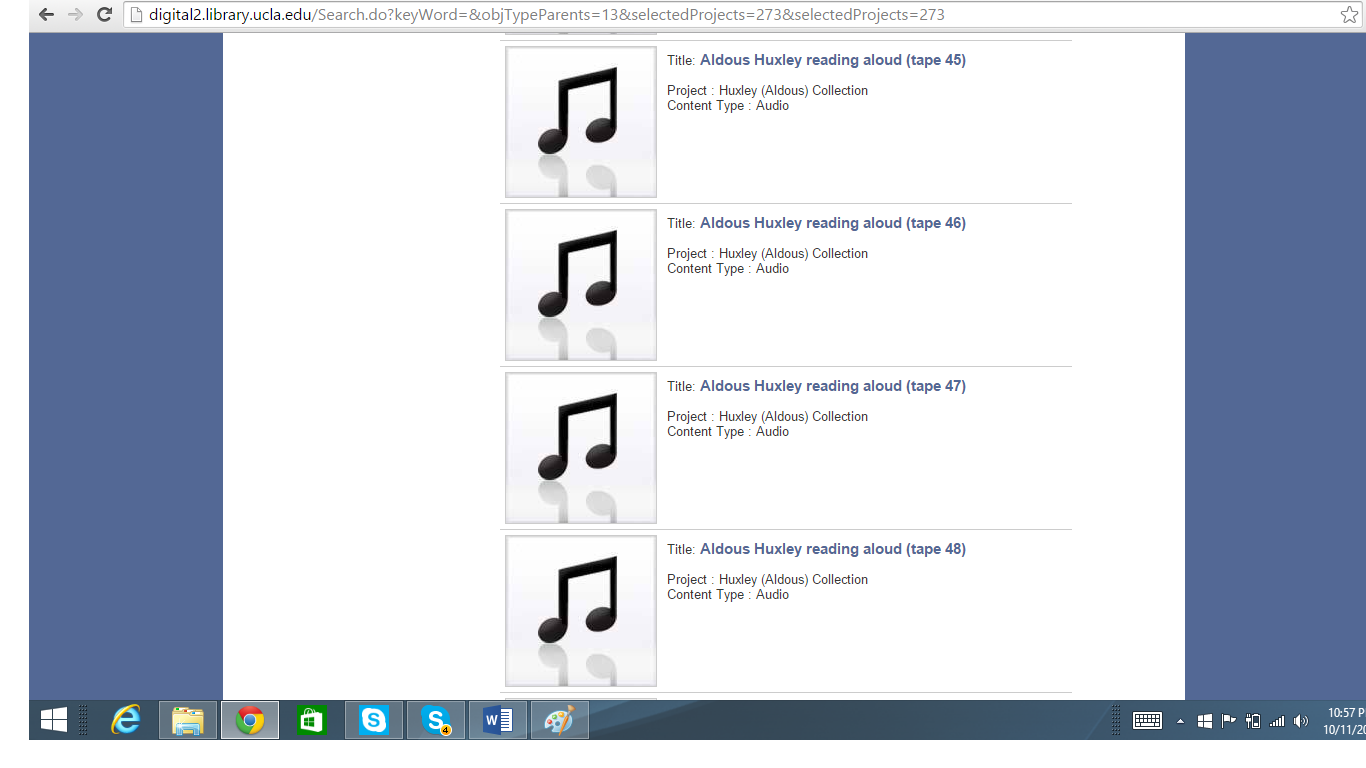
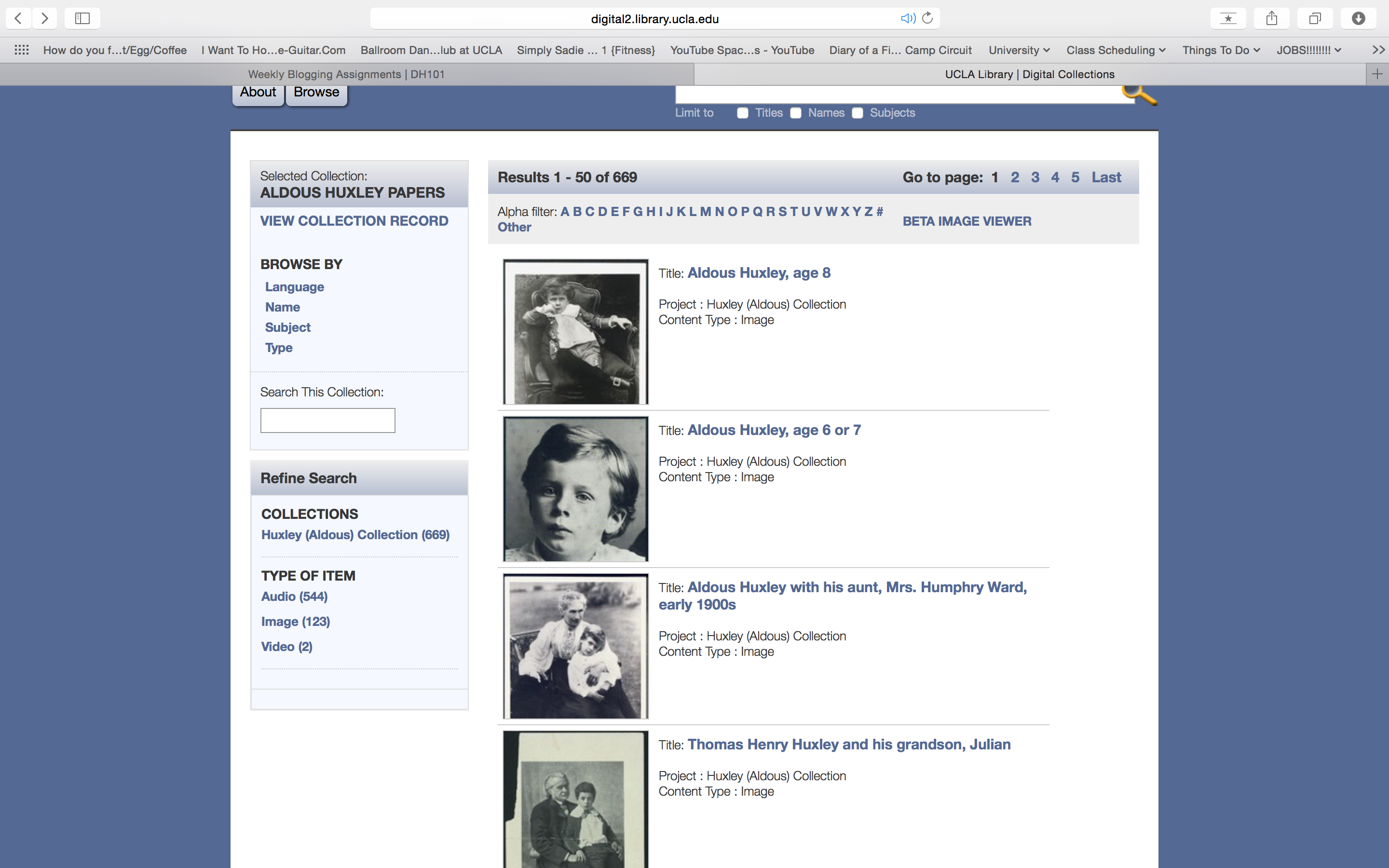
It would be very easy to tell a story about Huxley’s life, because there are 123 images of him throughout his life, from a young boy to an older man. It would be possible to fit together bits and pieces of these images in a way in order to get a more complete image of the life of this interesting man. The amount of audio recordings in this archive is massive; 544 to be exact. There are some audio files about specific details of his life in general, but, as mentioned, far more interesting are his multiple accounts on the mind. He speaks in great detail about how his mind responds in certain ways in sober states and also drug-induced states. I would write a story that would compare and contrast his varying states of mind depending on whether he is in a sober state of mind or on mescaline; this would make for a very interesting story because I would be able to uncover various contrasts in the mind of a single individual.

However, there would be a missing element to this story; I would not know when he would be experiencing this different states of consciousness and as a result it may be difficult to adequately track his progress as he delves into the mystery that is the mind. The repository does not include dates of the audio files, and to make matters worse they are not in any temporal order. If I had the ability to alter this archive, I would first include the year the audio recording was (taken to the best of my ability given available evidence). I would then give the user the ability to organize his famous recordings by years. This would give the user a more compelling, cohesive story of how Huxley’s conscious states changed over time.

Walter E. Bennett Photographic Archive

The digital archive I chose to examine is the Walter E. Bennett Photographic Collection. It consists of news photographs that Bennett took during the 60s, 70s, and 80s during the time he was employed as Time magazine’s first paid photojournalist. While it is a small collection of only 79 images, it focuses on many of the cultural phenomenons of the time, from political figures like the Kennedys to anti-war demonstrations to The Beatles.

http://digital2.library.ucla.edu/viewItem.do?ark=21198/zz00011f8m

If I were trying to write a paper on this archive, I would be able to tell a lot about the values of Time magazine and about the photojournalistic styles of the era. The site also gives a very general overarching framework of some of the major historical events and eras of that time using these original images that document and can give great insight on what many of these events were really like.

However, there are several shortcomings in this archive that would definitely hinder anyone who was trying to base a research paper off of it. For one, there aren’t many photographs, and so there are typically only a couple frames from any given event featured in the archive. It would be very difficult to write on any singular event using only this archive because of that. Additionally, there is limited information given on each photograph, usually no more than a sentence or two saying who and what it features and where and when it was taken. If I wanted to write about Bennett himself as a photographer, there is also a serious lack of biographical information about the man behind the camera. To be fair, this archive probably does not intend to be the only source on which a paper is based, but is more intended for single photos to be used as primary sources within a larger project drawing from several different archives.

If I were to work on the archive I would add more of Bennett’s photos and add a greater and more detailed description of each shot. I would also organize the photos by event and give some context in which they took place so that whoever was viewing the site would get a more comprehensive understanding of the photos. Also, I would have a section detailing Bennett’s work and experience as a photojournalist for Time. These additions would really flesh out the archive and make it much easier and more informational for any research purposes.

Week 2: Aldous Huxley Papers

Aldous Huxley is well known for the book Brave New World, written in 1931. The UCLA Library Digital Collection’s Aldous Huxley Paper, created in 2009, reveals the personal histories behind Aldous Huxley’s life, from 1894- 1963. The archive collects information between 1925 and 1963 through scanned photos of his childhood to handwritten postcards to sound recordings with his wife (Laura Huxley).

Screen Shot 2015-10-11 at 8.38.20 PM

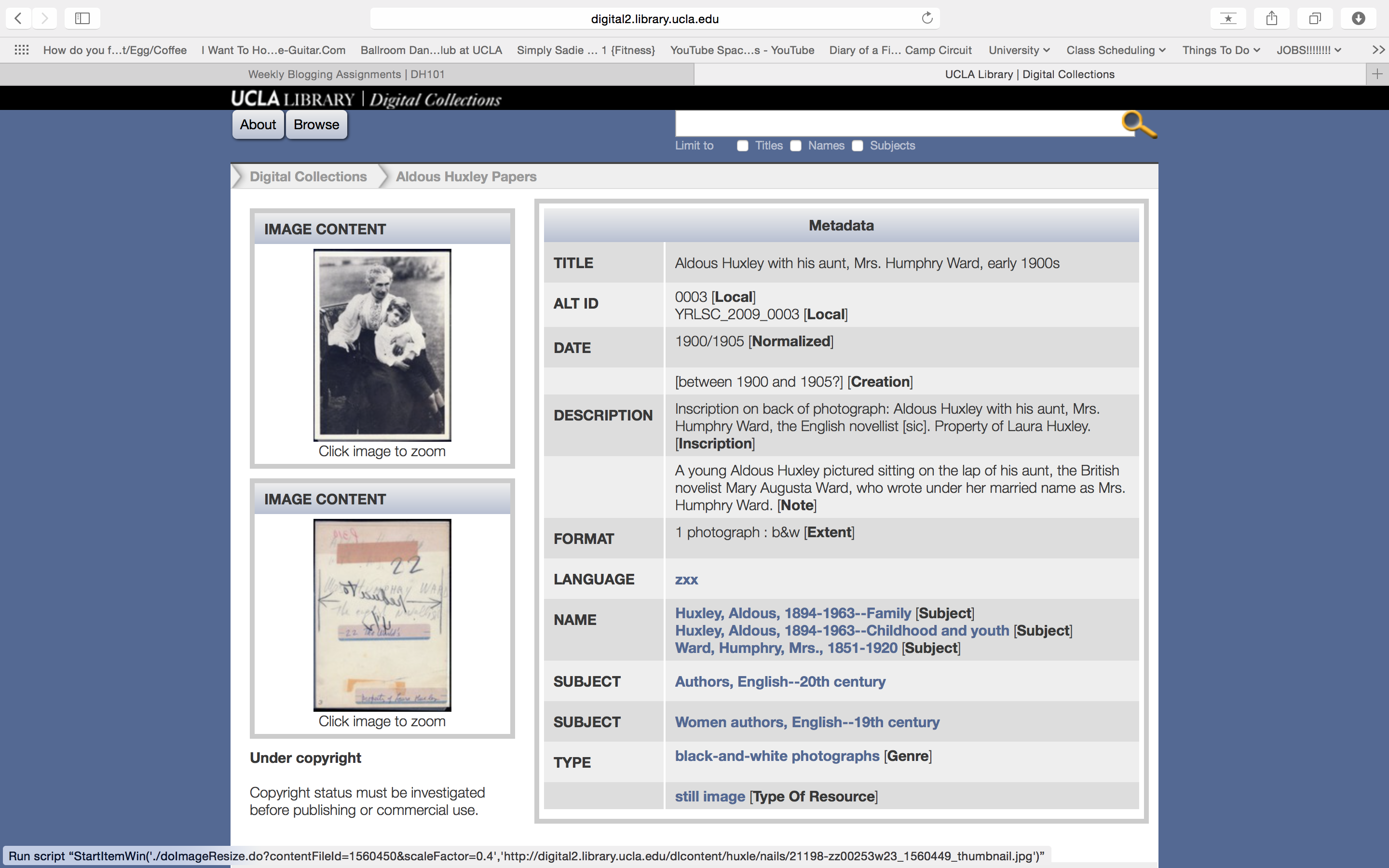
This archive lightly covers stories of Huxley’s family members, providing the audience with context of Huxley’s potential influences that promoted his writing career. For example, the archive holds a photo of Aldous Huxley with his aunt, Humphry Ward. The image alone only shows the family lineage. However, by the archive’s incorporation of metadata of dates and descriptions, the archive reveals that Humphry Ward was an English/ British novelist as well.

Screen Shot 2015-10-11 at 9.06.48 PM

Through this archive alone, I would be able to see the biographical stories narrating the relationships that Huxley maintained. There are many accounts and photographs illustrating the relationship Huxley had with his first wife, Maria Huxley, and second wife, Laura Huxley. Moreover, the archive does not only cover Huxley’s timeline, but involves many photos of the histories of others, especially Laura Huxley. The viewer can browse through Laura Huxley’s photos as a young lady, her portraiture and listen to her seminars. However, there isn’t nearly as much information or data of his first wife, Maria. There are even multiple stories revealed between the brotherly relationship that Huxley held with his brother, Matthew, through the images of the postcards they exchanged in Italy.


On the flip side, the archive does not go in depth into the personalities of each person, merely underscoring the existence of each person involved in Huxley’s life. In order to remedy the lack of information in the metadata, it would be useful to find other biographical websites of Huxley’s history that dictate the characteristics that defined Huxley, as well as the others connected with Huxley, during his time. Also, as mentioned earlier, Huxley was a writer. Yet, someone who was not aware of this detail may not have actually known that he was a writer from the archive, simply because the information presented hold a more prominent emphasis on the lifetimes and life stages of Huxley (and friends).


I find that the importance of this archive lies within its ability to, in a sense, immortalize Aldous Huxley and his work. The archive essentially enables Huxley to continue working in the lives of others and affecting others, as if he was alive, even when he is gone. Virtual tools, such as these online libraries, preserve works and images that physically deteriorate faster than that of an online presence.


Week 2: The David Livingstone Spectral Imaging Project

http://livingstone.library.ucla.edu/

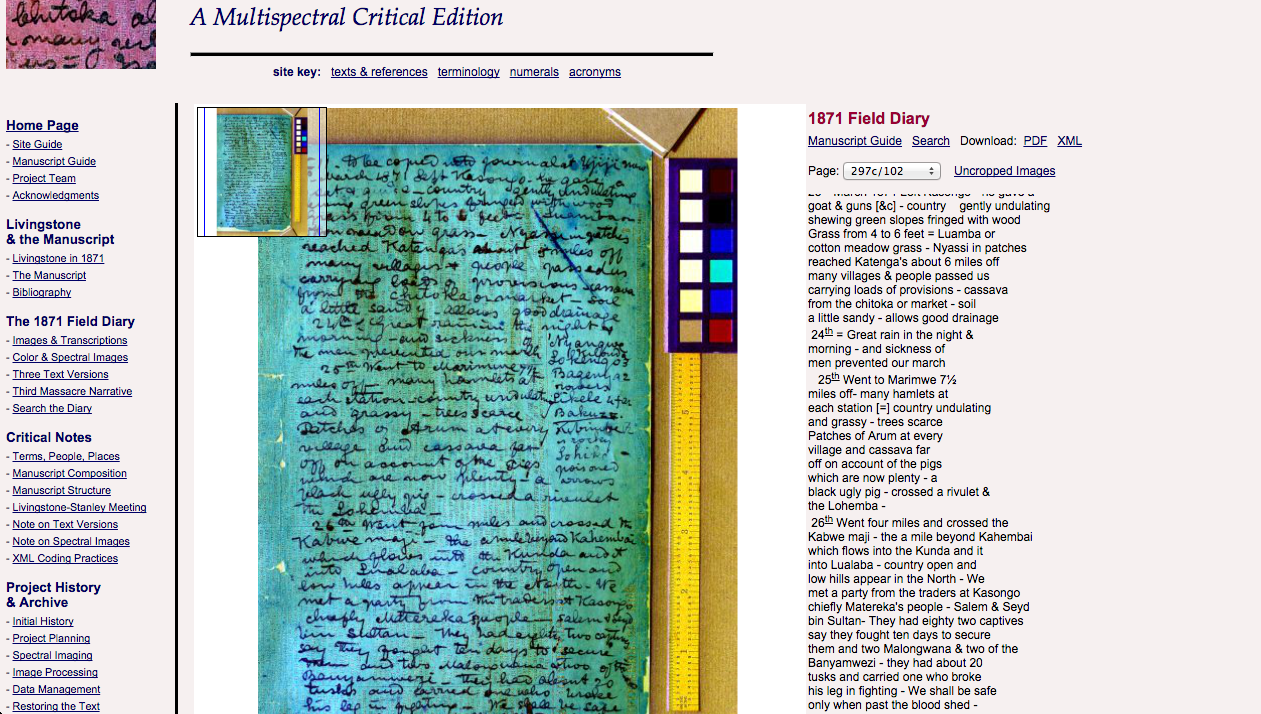
For this post I looked at the David Livingstone Spectral Imaging Project which holds a collection of enhanced photographs of Livingstone’s original 1870 and 1871 field diaries as well as 1871 letters from the explorer. The collection also provides transcriptions for the diary entries and letters since they are for the most part illegible especially given the limited materials Livingstone had when writing them.

Screen Shot 2015-10-11 at 9.23.55 PM

The 1871 field diary exposes Livingstone’s time in Central Africa that he spent stranded in a small village without proper utensils. In order to document his experiences, Livingstone was forced to get creative, but his resulting means left his original thoughts difficult to decipher. Thus the project worked to make the words clearer and then offer the collection to users. This particular period in Livingstone’s time in Africa was significant since the trauma of witnessing the massacre of nearly 500 African people was later relayed back on the continent, helping to influence the opinion towards the colonial presence in Africa.

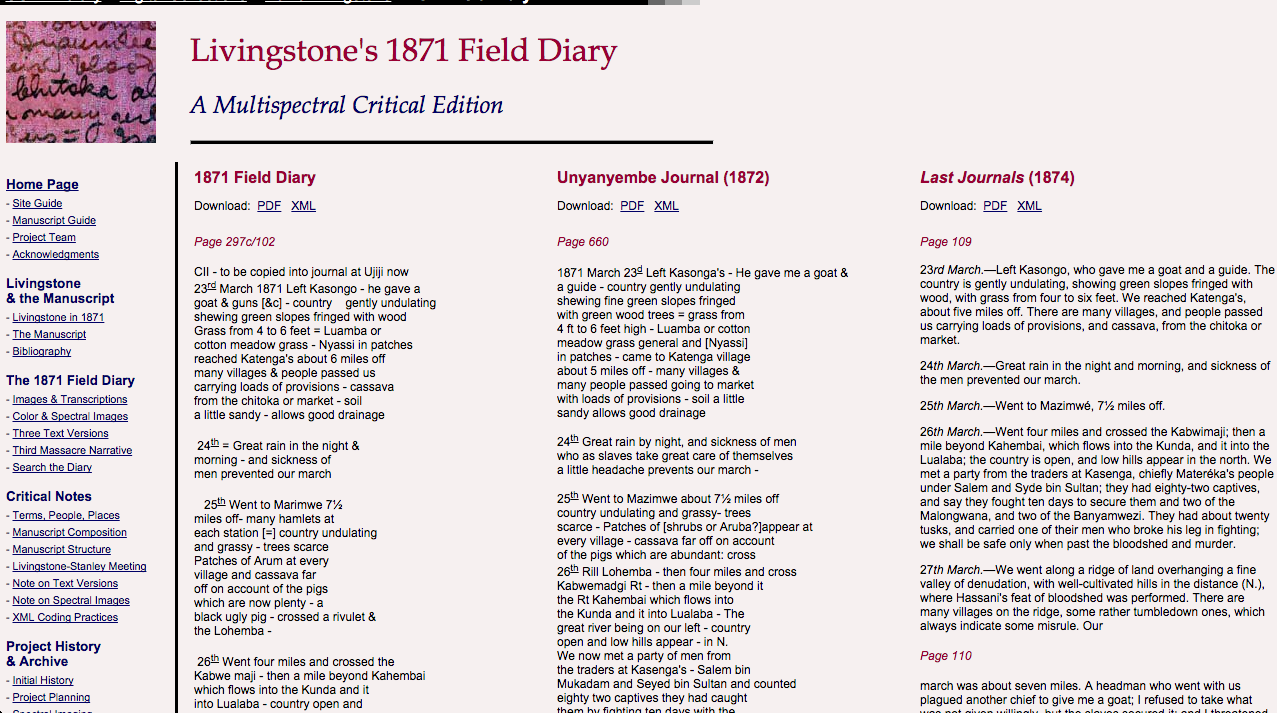
In looking critically at the project, I think an interesting paper topic might be to address the portion of the site that offers a three text view of Livingstone’s original field diary in comparison with his updated and edited version as well as a posthumously published version.

Screen Shot 2015-10-11 at 9.29.13 PM

The transcriptions of these three texts side by side offers insight into the discrepancies that occur after immediate reflection versus later recollection. Especially with Livingstone’s massacre narrative it would be interesting to take note of how his story may or may not have changed and what that says about Livingstone or his experiences. I thought perhaps the site might go into exploring that more, but given that the aim of the project was only to provide the diaries to the public I can understand why they didn’t delve into that. Given that Livingstone’s original thoughts are so disjointed it is nice to have the three text views since in the later publications he gives more complete thoughts. Still, if you’re looking at the three text view you’re still not given the complete context of each entry which would help to provide a stronger narrative, again it makes sense why that is not available. To improve the project they might offer more analysis and context of Livingstone’s entries, as well as improvements in the site’s overall layout since it isn’t particularly modern which can inhibit its accessibility in some areas.


Archive of Popular American Music

UCLA’s digital Archive of Popular American Music documents the history of music in America from as early as 1790 up until the present. Much of the music comes from films, theater, radio, and television but the archive also includes more general popular music. The archive holds almost 450,000 records of music, including sheet music, anthologies, and arrangements.

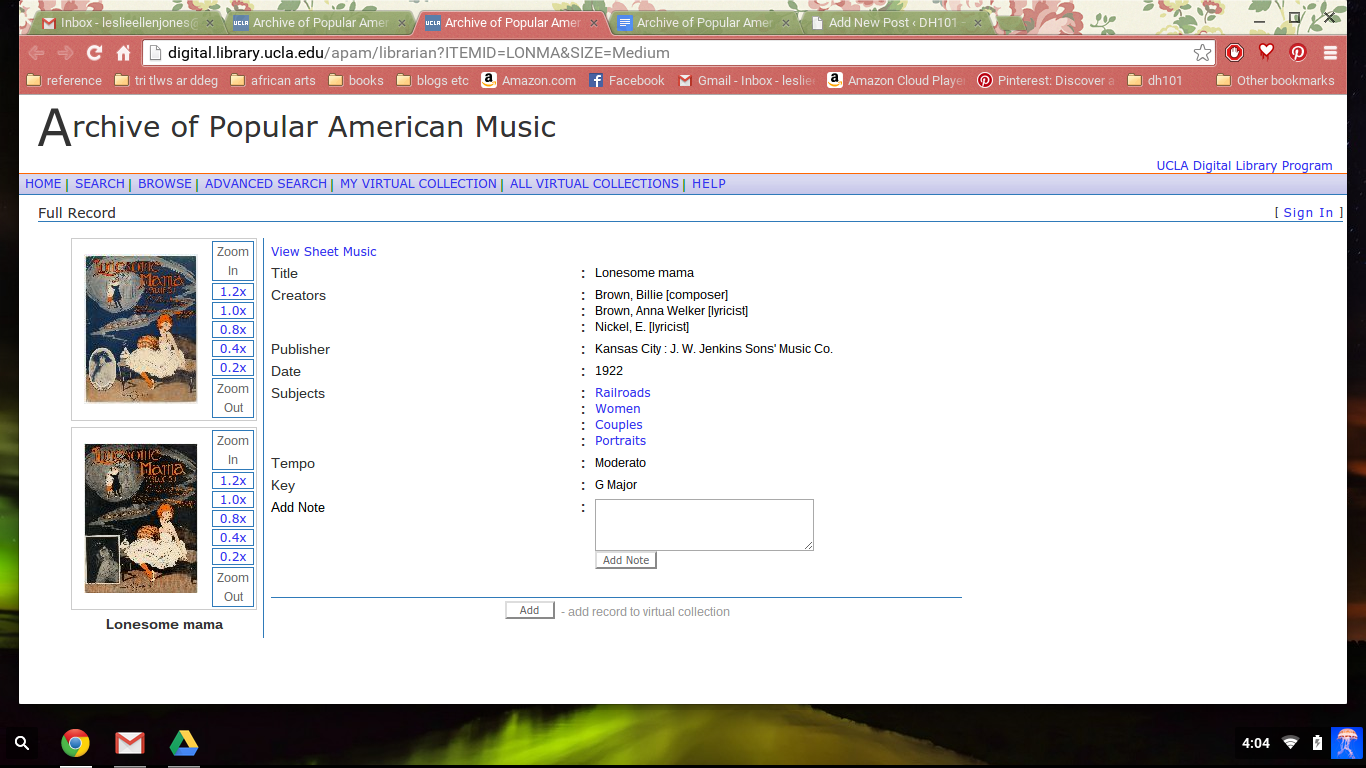
When looking at a particular piece of music, you can view and zoom in on the cover art and look at metadata such as the song’s title, composer, year, lyrics, tempo, and key. The description also has a list of subjects that you can click on and look at related titles, and some songs have links to sheet music. You can add a song to a personal virtual collection where you can write notes and retrieve bookmarked songs.

Screen Shot 2015-10-11 at 9.16.58 PM

Though the website claims to hold 62,500 recordings on disc, tape, and cylinder, it is not clear where to find these recordings. They are not hyperlinked in the information about a song, and I couldn’t find them anywhere on the website. The website has filters to search with on the “Browse” page, but the home page showcases very few records. I think this archive would be most useful if you already had some idea of the topic and were searching for specific information.

If I was to write a paper about the information in this archive, I think the most helpful feature is the subjects that group together songs with similar themes. I could tell the story of the progression of popular songs in America that deal with women, African Americans, or many other subjects. This archive seems to have the most information about songs in the early 1900s, so if I wanted to write about a larger time period I think I would need to look somewhere else, and if I wanted to listen to the songs I would need to find where they are on the website or look somewhere else. By looking at the sheet music, I could tell a story more focused on musical trends or changes in songwriting over time.

One interesting thing that the archive does not include is how the songs were received. By being included in the archive, the songs are assumed to be “popular,” but you can’t tell anything about its target audience, its sales, or for how long it was popular. You would also need more sources to see whether a song was from a play, a movie, or if it was just popular on the radio.

UCLA Preserved Silent Animation: An Examination

The UCLA Preserved Silent Animation library houses a collection of 11 silent animation films that are extremely rare to find or access online. These films stemming from the early 1930’s animation “Golden Era” are described as survivors of their time; many of the films in this project had been painstakingly recovered from neglect, mishandling, vault fires, and nitrate decomposition. The collection’s purpose is to showcase many forms of animation spanning the silent film era, using an archival website designed as a sort of play-reel that filters through all 11 silent works on a screen made to look like a theater.

Screen Shot 2015-10-11 at 6.25.14 PM

The layout of the website, with links below about the project and a slideshow-like sidebar with all the films.

The way the films are set up to be displayed on the site works in exhibiting the variety of the collection’s nature; all are animated yet can be seen to clearly have different art styles and animation and filming methods, just through the thumbnails alone. The title, creator(s), and year of release of each film appears above the respective thumbnails; I would say that this is an unconventional way to organize content, but it nonetheless works for a medium such as film. Users are also not only allowed to view the 11 films in their entirety, but may also download select preservation commentary or commissioned music, as well as read preservationist and historian notes for each one. One can also select which version(s) to play: whether the silent film by itself or with the music scores or preservationist commentaries layered over it.

Screen Shot 2015-10-11 at 6.25.47 PM

How it looks when you view a film; users can check more than one box to hear piano accompaniments, music scores, and preservationist commentaries.

The films themselves serve to demonstrate different depictions of life as it may have been during the Golden Era of the United States. Comparing the very first and earliest film, The Enchanted Drawing, to the last, Theatre De Hula Hula, users can see how much society had progressed culturally and historically through viewing one after another. Mixed into each work are hints of comedy, drama, romance, and pure fun; the essence of animated works at that time allow rather sensitive or deeper topics to be expressed through a lighter, more engaging art form during the silent era. If I were to write a paper based on this archive, I would be able to tell how the impact of these films still pose in history as extraordinary pieces from a time of artistic revival. If any one or all of these 11 films had been lost, we may very well have never known what the extent of silent animation was, how the majority of silent animation films are often unknowingly destroyed, and why it is necessary to pursue even more preservation efforts for silent animation works.

What I was not able to tell based on this archive, however, was the individual significances of these 11 films; out of all the silent films to exist, why are these the only ones that is archived in the UCLA silent animation library? Surely, if a brief description was included stating why preservationists and historians decided to archive these select films, it would help in comprehending their importance in a wider perspective. To remedy this, I would (and I did for some, just out of curiosity) have to further research each of the 11 films and find out their plot lines and characters, the method of animation and film used, who their creators were, and their final product as a film and relate them back to the social and cultural climates they emerged from.  Even better, if there were an easily accessible outside archive of all silent animated films that would make extra researching more convenient. From there, it would be more clear to understand the value of this archive in terms of a broad American history, as well.

Week 2 Blog Post: La Accion Socialist

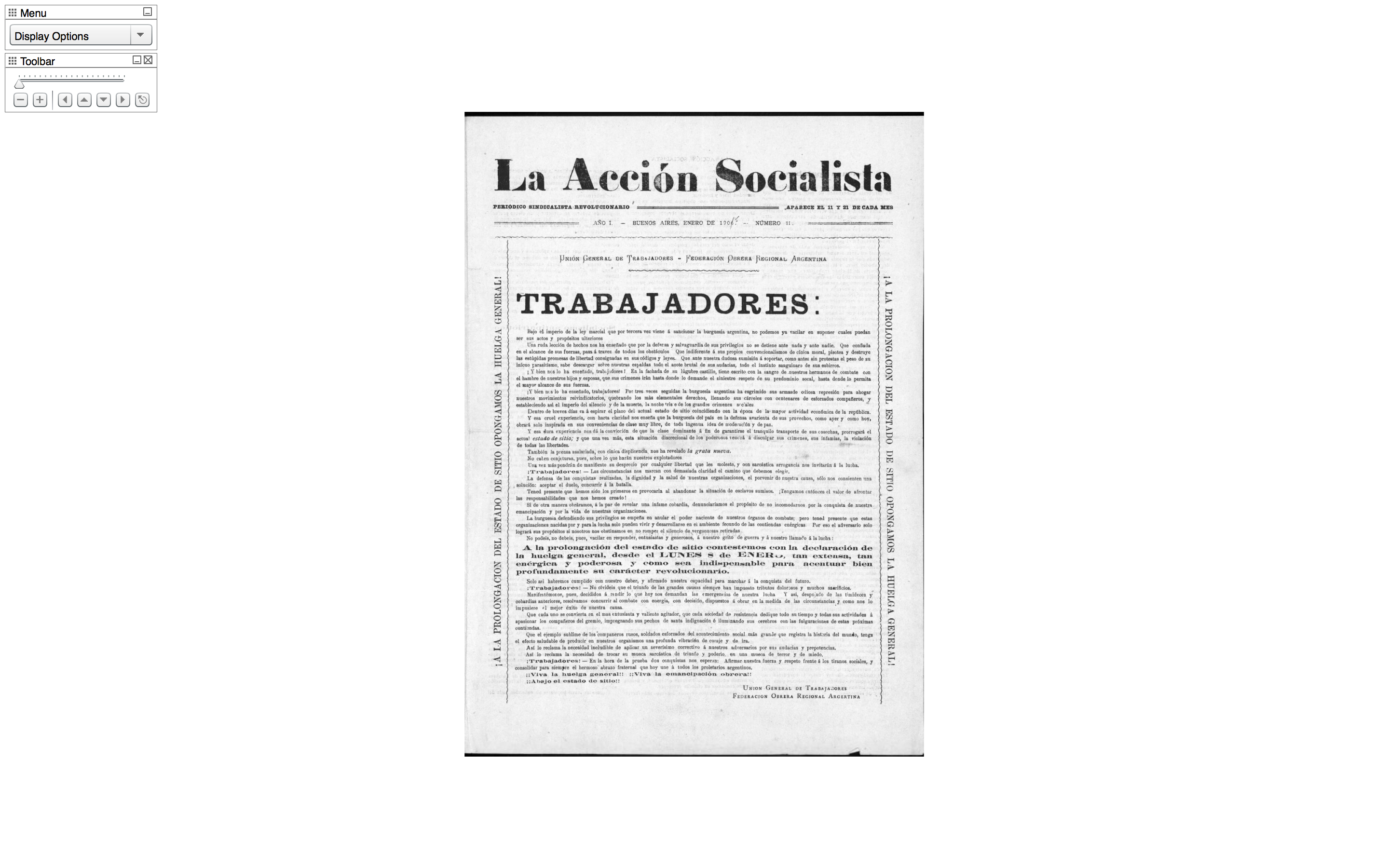
This week I decided to look at the very first archive which is title La Accion Socialista which was a socialist newspaper published in Buenos Aires, Argentina. The years in which the issues are available to be seen are from 1905-1907 and the year 1910. For an individual fluent in Spanish, they could learn about the political and social atmosphere in Argentina at the very beginning of the 20th century.  One could reiterate the stories, sentiments, and hardships of the working class by reading this left-wing newspaper. With three years of material, there is a vast collection of information that could be utilized to compose a story about the Argentine Revolution of 1905, also know as the Radical Revolution of 1905. As a predominantly English speaker with limited ability to speak or read Spanish it would be challenging for me to determine what was going on in Argentina; however, if the archive implemented a translation tool then I would be able to decipher the emotions and opinions of the large socialist movement that was going on in Argentina in the beginning of the 20th century. As you can see here the newspaper is written in Spanish and was primarily directed to the working class as the title of this piece is WORKERS in Spanish.

Screen Shot 2015-10-11 at 5.16.44 PM

This paper is inherently biased as it only really explains and documents socialist sentiment, so while it provides insight into this particular group’s feelings it most likely doesn’t acknowledge the other side of the political spectrum, the conservative side of Argentina. I think the archive could really be improved if they provided other newspaper issues with other opinions other than just the socialists just to create a bigger picture of the political and social environment in Argentine during this troubling time period where a revolution was actually happening.

In conclusion, I thought this archive was really cool because I am able to read Spanish moderately well and words I don’t know I could easily find definitions for or just figure out the meeting in context. However, I will reiterate that I think a translation tool would be very useful for those who are unable to read Spanish and who are interested in this exciting time period in Argentina. With the implementation of the translation tool this project would reach a lot more people. Anyone can look at this project here: http://digital2.library.ucla.edu/viewItem.do?ark=21198/zz0028tdsv


Patent Medicine Tradecards Collection

John Rauch

DH 101 DISC 1C

Blog Post 2


Screen Shot 2015-10-11 at 5.42.17 PM


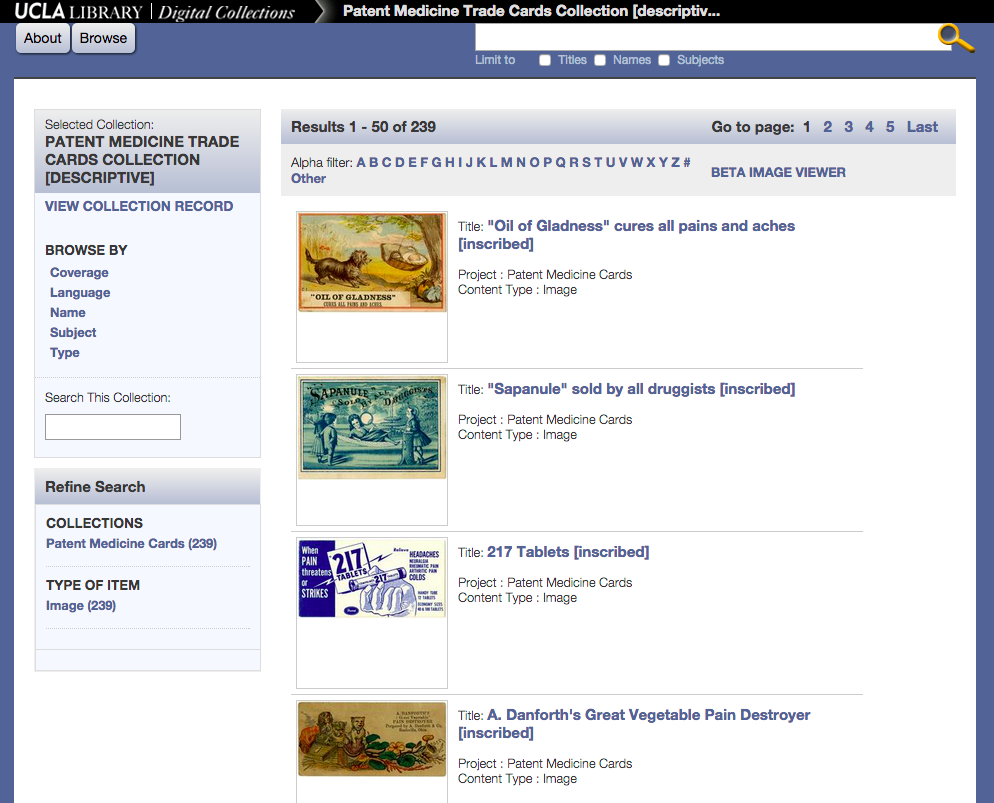
This repository holds many images of patented/trademarked medicine trade cards. These cards have been dated in a range from 1870-1906. Essentially, these cards came in a form similar to a baseball trading cards; I assume so they could be passed out to others, which advertised a particular medicine, pill, or elixer that would heal some kind of condition. According to the metadata available for this repository, the patenting of medicine became popular in the United States when the ‘Pure Food and Drug Act’ was passed in 1906. The metadata also shows that cards were either in French, German, or English, meaning that some kind of translation or transcribing may have been necessary to organize the data.


Screen Shot 2015-10-11 at 5.48.01 PMScreen Shot 2015-10-11 at 5.47.10 PM

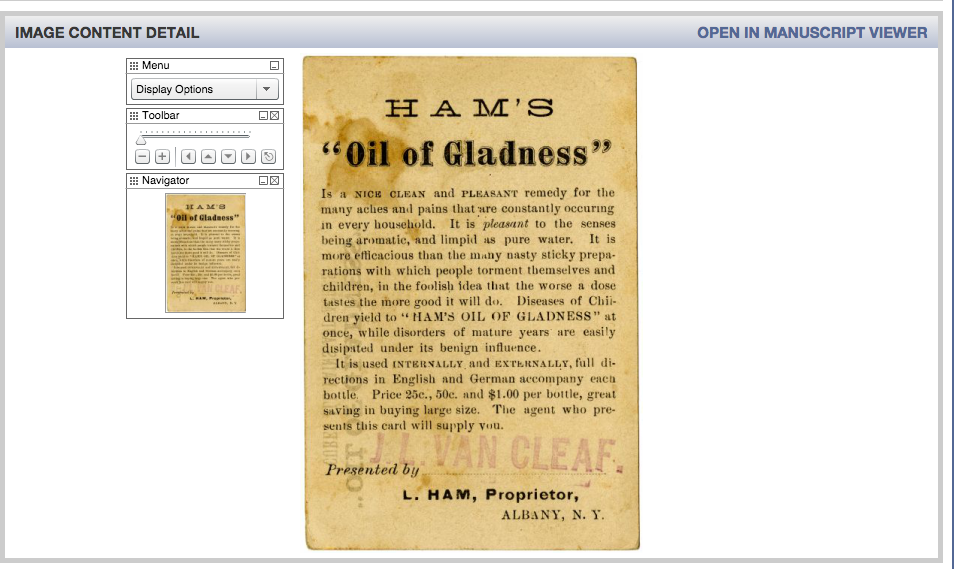
An example of a trade card, description, and web tools for analysis


Based on this archive, I would be able to tell a historical narrative on how modern medicine has evolved from the 20th – 21st Century, and also show the kinds of diseases people were most vulnerable to, and willing to pay money to cure. An investigative aspect could be applied to this narrative paper, by researching if these diseases in the tradecards even existed, and if the cure was more than just ‘snake oil’. I believe an artist could also examine these cards to understand how mainstream art looked during this time, in this category, and in that country. A publicist or media design student may look at these cards to understand the types of advertisement strategies used and bring that into a story about how our values have changed and what society finds appealing now versus then.

You would not be able to tell a detailed story about the medical practices of a region or time. So any kind of instructional or encyclopedia writing would be very difficult to accomplish given this archive. This is because many of the documents and images scanned are in another language, and only contain a snippet of medical information from the specific time and place. While the metadata for each image is impressive and informative in describing that particular document, there is not enough information to go on to provide a systematic and detailed description of the overall state of a health care.

I believe this archive could remedy this inability of detailed writings by providing links to other websites or books that talk about this particular document in more detail. By this I mean linking names to wikipedia articles about that person, or linking locations to maps. If a disease or cure is the focus of the tradecard, they could be linked to other resources that talk more specifically about them. Overall, I think the website does its purpose very well, which is why I recommend that they only link this metadata to other places that have more expertise in that field, instead of trying to incorporate this information in their archive and risk providing an ‘information overload’ to its viewers.

Week 2: The UCLA in history digital archive

I chose to examine the UCLA Historic Photographs digital archive. It is filled with aerial photos of the campus and events occurring throughout the university starting in the mid 1920s and going all the way up to the mid 1960s. The photos emphasized the 1930s time period. While looking at theses photos, the normal everyday life of a UCLA student can be envisioned. From photos of sorority women dressed up for a skit to photos of commencement with students dressed in graduation robes, student life is captured in these photos. The culture of the UCLA community could be examined through this digital archive.

The stories that would be told would surround the student body at UCLA as it grew to become the great university that it is today. As buildings were added, and the school grew, more students and a larger campus were shown in the pictures. The different chancellors and speakers at graduations and students in general fluctuate throughout the years. This is documented in the digital archive. Along with the photographs, there is a short description of the people and event pictured. Stories of UCLA covered in snowfall are brought to life through these descriptions in the meta data. A paper would in detail describe all these events and student life, especially how it has changed throughout the years. Tags are even in the description, making each photograph easy to link to one another and to search for.

However, there are not more than 300 photos in the archive; this means that the whole campus culture could not be photographed. More importantly, if an idea or mindset filled the campus at the time, that did not have an event or rally, it would not have been photographed or discussed in the archive. Moods of the campus can shift when different national events occur, that may not be photographed on campus because they do not relate only to UCLA.

In order to overcome this, you would need to look at a national newspaper archive, such as the LA Times, in order to understand the full picture of life at UCLA during the 1920s to 1960s. Since the 1930s were most often photographed, it would be better to specifically look at the changes occurring within these years both on and off campus. With this information, a full understanding of the campus life and culture of UCLA throughout history could be examined and written about.

Digital Archive of Popular American Music

The Digital Archive of Popular American Music  is a project of the larger Archive of Popular American Music at UCLA’s Music Library. The main archive contains almost 450,000 pieces of printed material–sheet music, arrangements, etc.–and 62,500 recordings on disc, tape, and cylinder, of music popular in the United States from 1790 to the present. The digital archive, according to the About page , is “an initiative designed to provide access to digital versions of sheet music, and performances of songs now in the public domain.” (However, on searching the archive, I found no performance recordings, and no way to search for records that had recordings–I suspect there are none.)
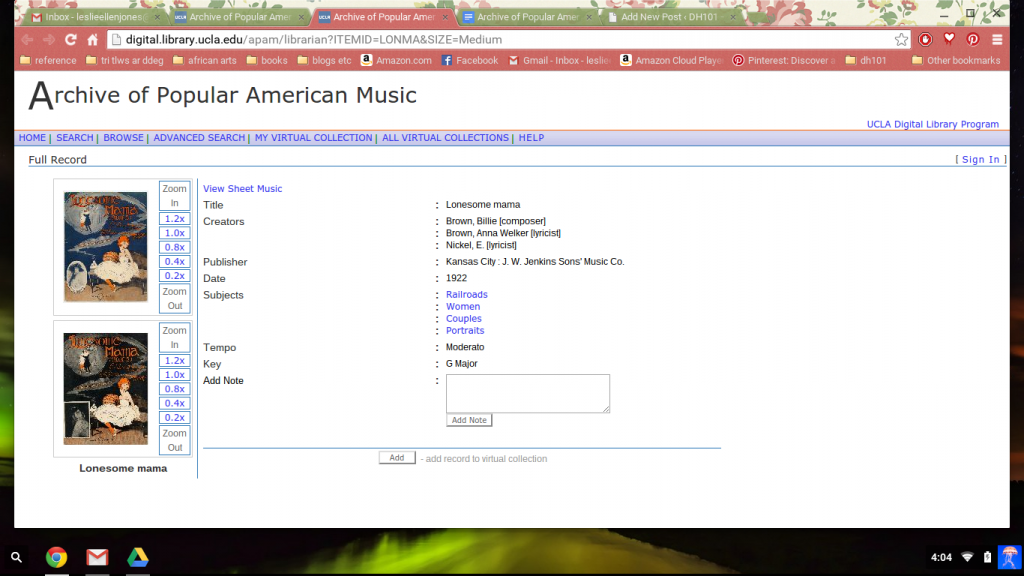
A full record on the Digital Archive of Popular American Music contains both general and music-specific metadata, enlargeable thumbnails of cover art, and space for registered users to make notes and save to a personal collection.

A full record on the Digital Archive of Popular American Music contains both general and music-specific metadata, enlargeable thumbnails of cover art, and space for registered users to make notes and save to a personal collection.

The digital archive offers both basic and advanced search options, as well as allowing you to browse by name (of the composer or lyricist), song title, cover art subject, and date. Search results come up as a series of thumbnails of the cover art, and when the thumbnail is clicked, the full record appears with metadata about the song (including the first lines of the song and of the chorus, the musical tempo and key, as well as alternate titles, in addition to the usual information about composer, lyricist, publication data, and date) and another thumbnail of the cover art, which can now be viewed at larger sizes. Where it’s available, you can also click on a link for the sheet music itself, which opens in a separate window as a pdf. Registered users can save records to a virtual collection and annotate for their own research purposes.
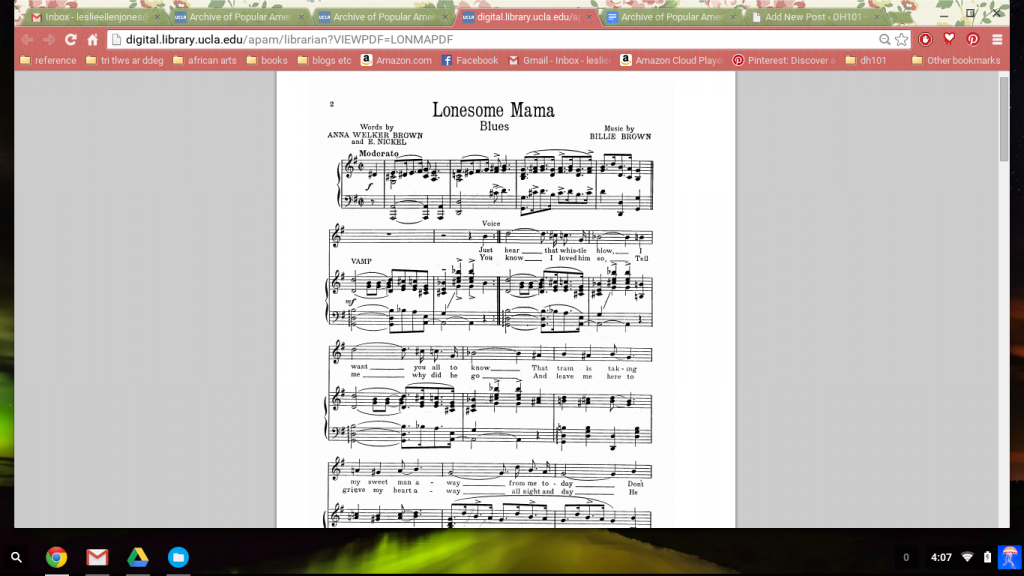
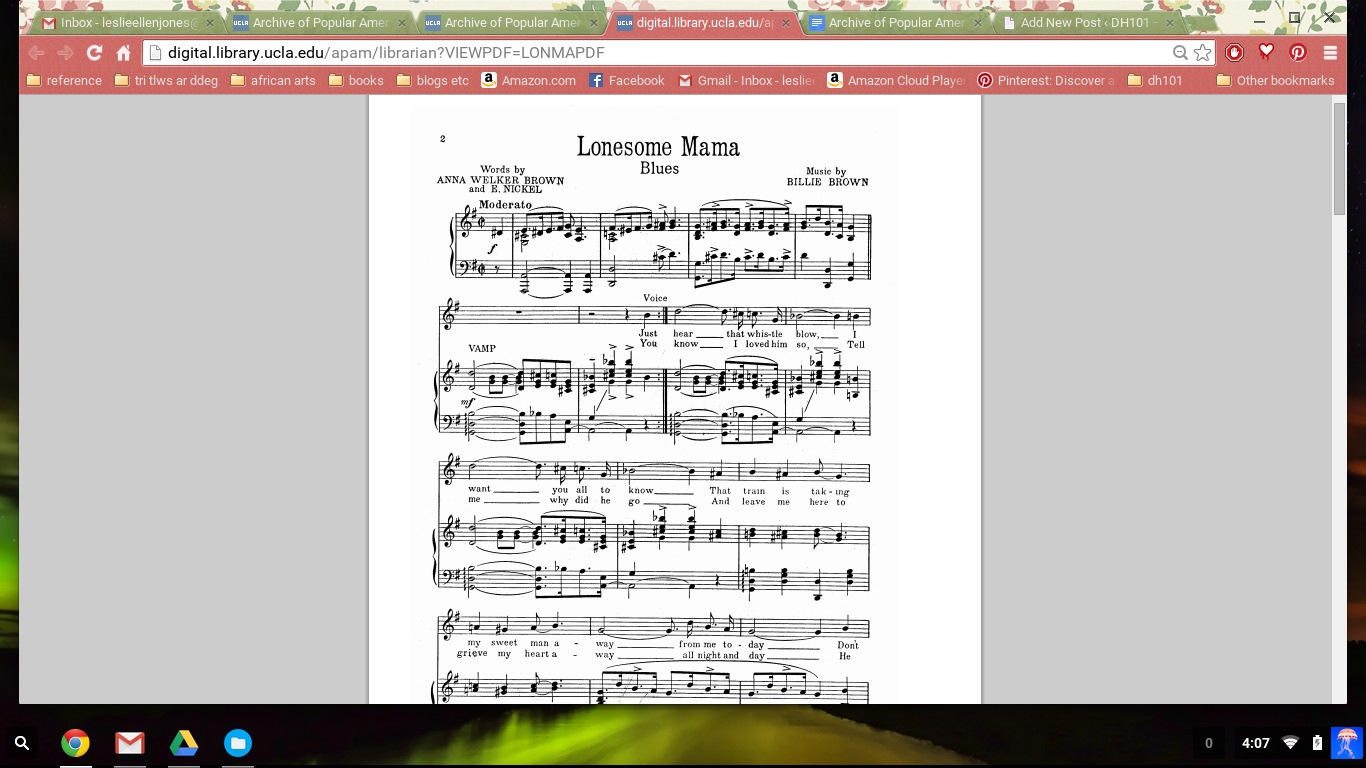
PDFs of the original sheet music allow the user to read the lyrics and, if able, to play the songs themselves.

PDFs of the original sheet music allow the user to read the lyrics and, if able, to play the songs themselves.

Under current copyright law, material prior to 1923 is in the public domain, and although this fact is not referenced in the archive, it seems no coincidence that the majority of the music dates from about 1900-1922, so that it a) burgeons with the heyday of popular sheet music in America and b) stops just when the archive can safely post printed material without worrying about copyright infringement. Although there are no audio files attached to these records, anyone who can sight read music can “hear” the songs, and anyone who can play the piano could download the pdf and play the song. Even those without musical skill can read the lyrics, possibly getting a sense of the rhythm from the notation, and then there is the cover art …

I’m not a musicologist, so I can’t begin to guess what could be done with the material from a musical standpoint. I’m sure that there are people writing dissertations on the development of American popular music, jazz, ragtime, and dance music, musical theater, etc., based in this archive. But there is plenty of grist for the visual scholar’s mill here as well: Art Nouveau and Art Deco illustration, early photography, Orientalism and images of various Others, immigrant nostalgia for the Old Country, patriotism, and more. The lyrics, too, offer plenty to dig into, especially in revealing shifts in popular ideas about gender roles and sexual relations. What is also interesting is seeing how popular music provides contemporary evidence that may contradict current generalizations about the past. For instance, it’s a truism today that Egyptomania swept the West following Howard Carter’s discovery of King Tut’s tomb in 1922, but “Arabian” themed popular music from the late 1910s shows that the image of the Exotic Egyptian was already well planted before that (and I’d like to know why so many of these songs seem to be fox trots. Was this considered an especially exotic rhythm?)
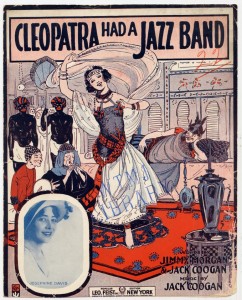
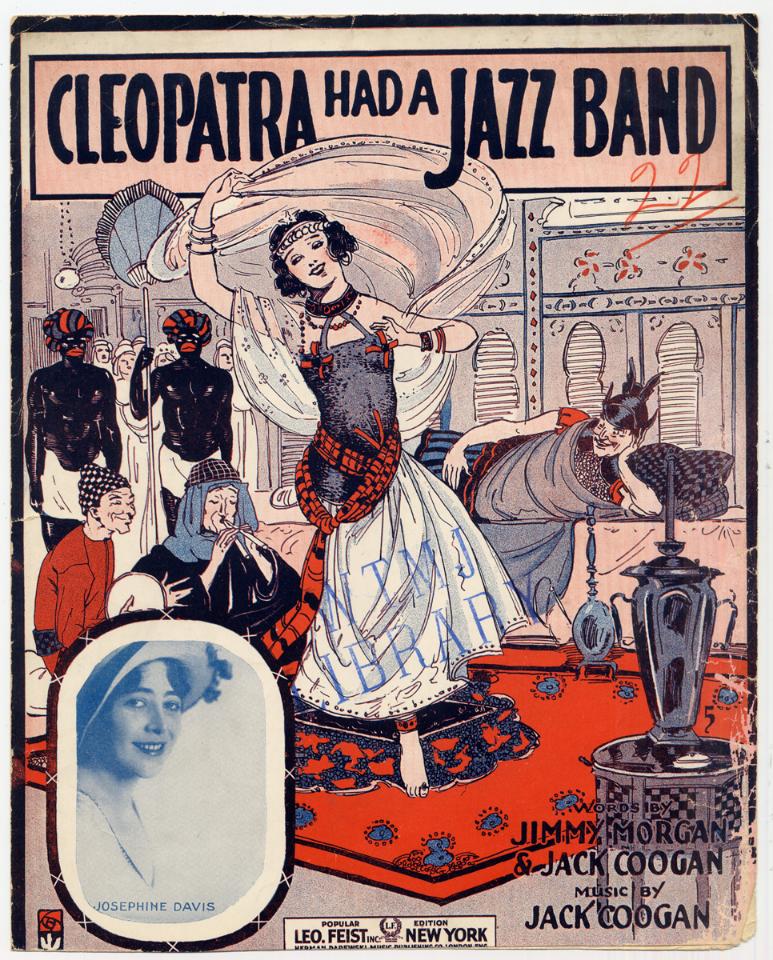
A typical Orientalist representation of a Middle Eastern dancer: suspiciously white-skinned, wearing a quasi-Egyptian tunic that nonetheless reads like a stylish contemporary dress, and dancing to jazz--simultaneously African and American.

A typical Orientalist representation of a Middle Eastern dancer: suspiciously white-skinned, wearing a quasi-Egyptian tunic that nonetheless reads like a stylish contemporary dress, and dancing to jazz–simultaneously African and American.


Once you get beyond the actual music, lyrics, and cover art, however, the archive has run its course. For instance, I am interested in the Orientalism and the Middle East, so I could easily use the archive to amass a set of songs with Middle East themes, references, and art in the early twentieth century and look at how both the lyrics and the cover art present images of the exotic Other (who nonetheless both looks uncannily white and has all the romantic tendencies of a nascent flapper), but it would be necessary to also research outside the archive for historical and cultural context–what made the Middle East interesting at this period? How does the entanglement of the Middle East and dance music relate to the introduction of “belly dance” to Western audiences at the 1893 World’s Fair? How does the music relate to the experiences of immigrants to the US from Ottoman and, later, formerly Ottoman territories? Similar themes could be explored looking at music with Asian–especially Chinese and Japanese–settings, and, in sharp contrast, the depictions of Africans and African Americans, especially as jazz becomes popular.


Another interesting story to tell with this archive would deal with immigration to the US during the late nineteenth and early twentieth centuries and how popular music expresses both nostalgia for the Old Country (particularly in sentimental Irish songs) and also the generation gap growing between immigrant parents and their first-generation children, who aren’t interested in the old ways and want to listen to new, American music and dance new, American dances.  

Although the songs are presented individually within the archive, it’s clear that many of them are numbers from musicals. It’s annoying that you can’t browse or search by show name; the best you can manage is, if the cover art lists other songs from the show, to search each of those songs individually. Still, it would be interesting to use the songs in the archive to find, elsewhere, the plays they come from and look at the development of the American musical comedy from its vaudeville and revue roots through the material here.

The lack of audio is the major drawback to the database–it would be wonderful to be able to hear the arrangements presented in the sheet music, especially when getting into the early jazz era. But the combination of original sheet music and the visual element provided by the cover art offers thousands of directions that can be taken from primary source research here. It’s hard to tell whether the database is being updated or if everything was put up in 2007 (the copyright date on the site) and let be. I would hope there’s more work being done and that eventually the promised audio component will be added.
Older posts Newer posts

© 2026 DH101

Theme by Anders NorenUp ↑