The Digital Archive of Popular American Music is a project of the larger Archive of Popular American Music at UCLA’s Music Library. The main archive contains almost 450,000 pieces of printed material–sheet music, arrangements, etc.–and 62,500 recordings on disc, tape, and cylinder, of music popular in the United States from 1790 to the present. The digital archive, according to the About page , is “an initiative designed to provide access to digital versions of sheet music, and performances of songs now in the public domain.” (However, on searching the archive, I found no performance recordings, and no way to search for records that had recordings–I suspect there are none.)
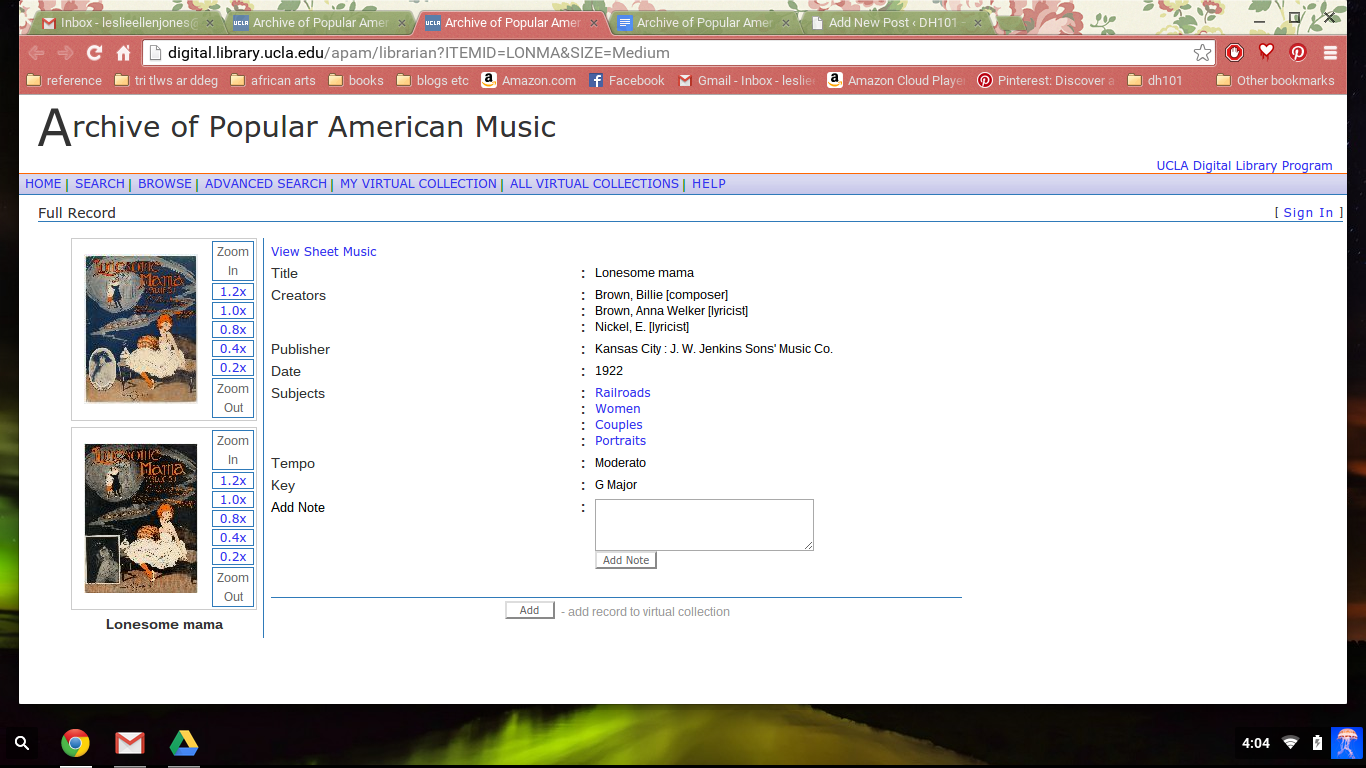
A full record on the Digital Archive of Popular American Music contains both general and music-specific metadata, enlargeable thumbnails of cover art, and space for registered users to make notes and save to a personal collection.
The digital archive offers both basic and advanced search options, as well as allowing you to browse by name (of the composer or lyricist), song title, cover art subject, and date. Search results come up as a series of thumbnails of the cover art, and when the thumbnail is clicked, the full record appears with metadata about the song (including the first lines of the song and of the chorus, the musical tempo and key, as well as alternate titles, in addition to the usual information about composer, lyricist, publication data, and date) and another thumbnail of the cover art, which can now be viewed at larger sizes. Where it’s available, you can also click on a link for the sheet music itself, which opens in a separate window as a pdf. Registered users can save records to a virtual collection and annotate for their own research purposes.
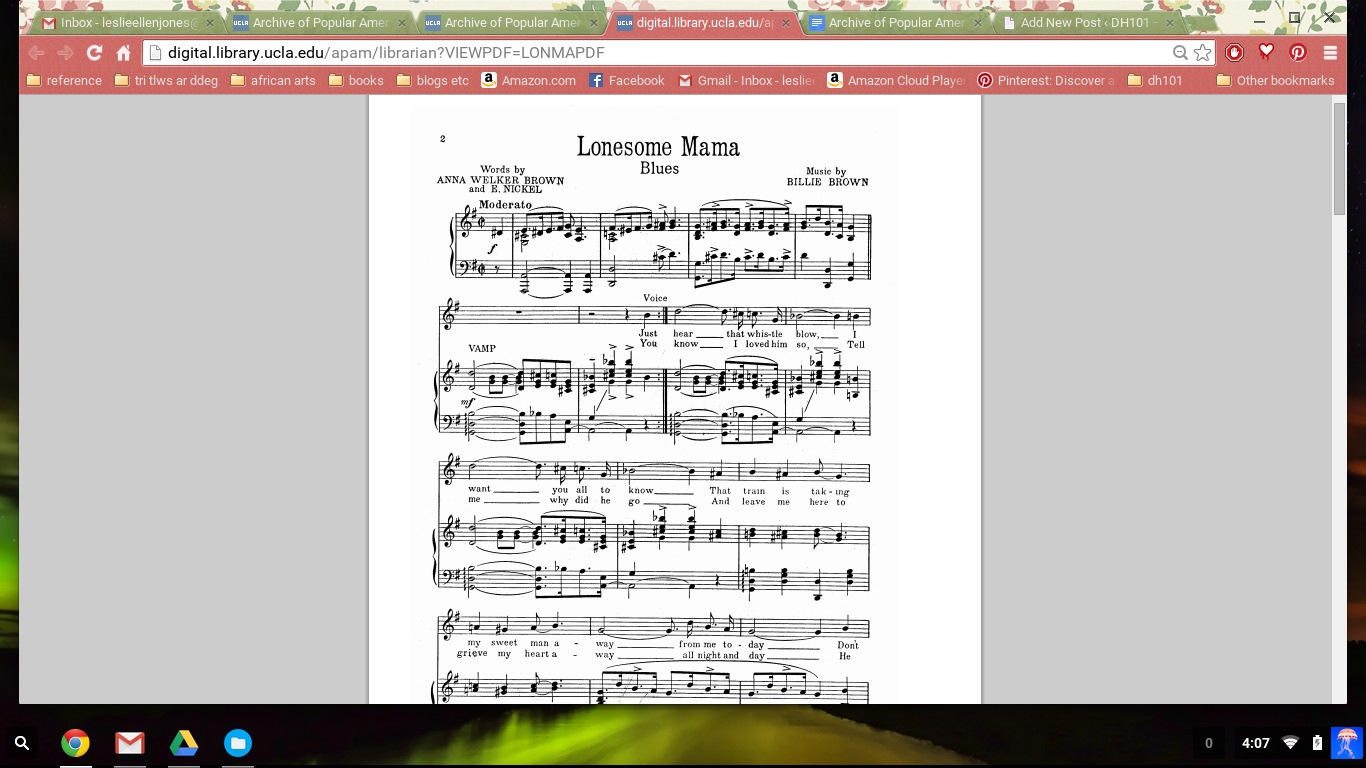
PDFs of the original sheet music allow the user to read the lyrics and, if able, to play the songs themselves.
Under current copyright law, material prior to 1923 is in the public domain, and although this fact is not referenced in the archive, it seems no coincidence that the majority of the music dates from about 1900-1922, so that it a) burgeons with the heyday of popular sheet music in America and b) stops just when the archive can safely post printed material without worrying about copyright infringement. Although there are no audio files attached to these records, anyone who can sight read music can “hear” the songs, and anyone who can play the piano could download the pdf and play the song. Even those without musical skill can read the lyrics, possibly getting a sense of the rhythm from the notation, and then there is the cover art …
I’m not a musicologist, so I can’t begin to guess what could be done with the material from a musical standpoint. I’m sure that there are people writing dissertations on the development of American popular music, jazz, ragtime, and dance music, musical theater, etc., based in this archive. But there is plenty of grist for the visual scholar’s mill here as well: Art Nouveau and Art Deco illustration, early photography, Orientalism and images of various Others, immigrant nostalgia for the Old Country, patriotism, and more. The lyrics, too, offer plenty to dig into, especially in revealing shifts in popular ideas about gender roles and sexual relations. What is also interesting is seeing how popular music provides contemporary evidence that may contradict current generalizations about the past. For instance, it’s a truism today that Egyptomania swept the West following Howard Carter’s discovery of King Tut’s tomb in 1922, but “Arabian” themed popular music from the late 1910s shows that the image of the Exotic Egyptian was already well planted before that (and I’d like to know why so many of these songs seem to be fox trots. Was this considered an especially exotic rhythm?)
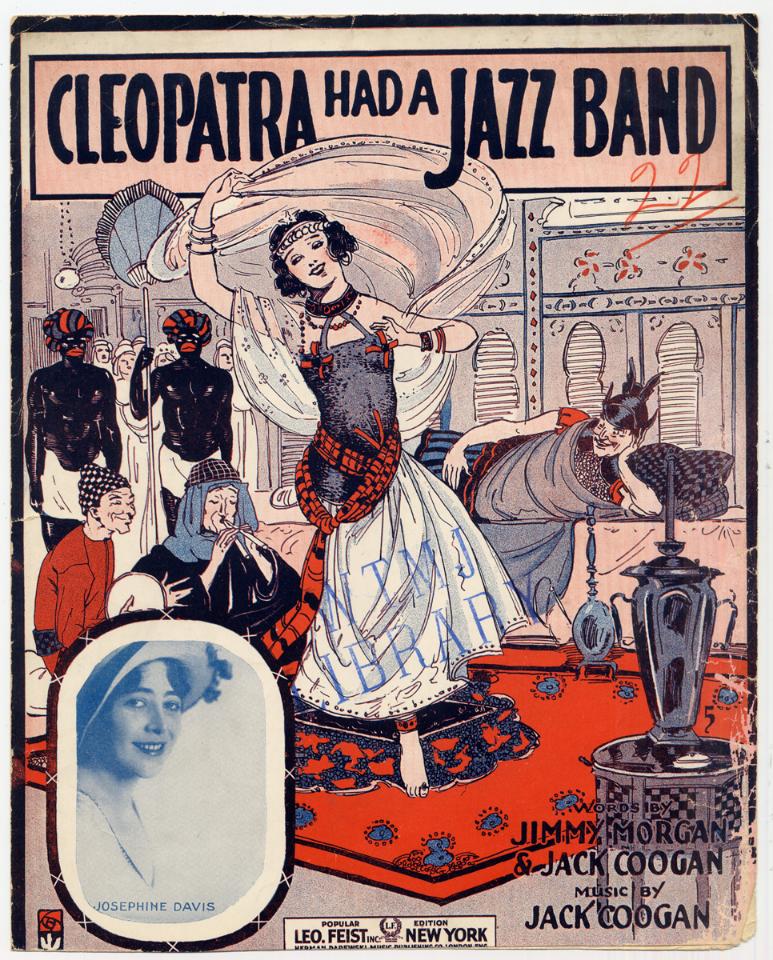
A typical Orientalist representation of a Middle Eastern dancer: suspiciously white-skinned, wearing a quasi-Egyptian tunic that nonetheless reads like a stylish contemporary dress, and dancing to jazz–simultaneously African and American.
Once you get beyond the actual music, lyrics, and cover art, however, the archive has run its course. For instance, I am interested in the Orientalism and the Middle East, so I could easily use the archive to amass a set of songs with Middle East themes, references, and art in the early twentieth century and look at how both the lyrics and the cover art present images of the exotic Other (who nonetheless both looks uncannily white and has all the romantic tendencies of a nascent flapper), but it would be necessary to also research outside the archive for historical and cultural context–what made the Middle East interesting at this period? How does the entanglement of the Middle East and dance music relate to the introduction of “belly dance” to Western audiences at the 1893 World’s Fair? How does the music relate to the experiences of immigrants to the US from Ottoman and, later, formerly Ottoman territories? Similar themes could be explored looking at music with Asian–especially Chinese and Japanese–settings, and, in sharp contrast, the depictions of Africans and African Americans, especially as jazz becomes popular.
Another interesting story to tell with this archive would deal with immigration to the US during the late nineteenth and early twentieth centuries and how popular music expresses both nostalgia for the Old Country (particularly in sentimental Irish songs) and also the generation gap growing between immigrant parents and their first-generation children, who aren’t interested in the old ways and want to listen to new, American music and dance new, American dances.
Although the songs are presented individually within the archive, it’s clear that many of them are numbers from musicals. It’s annoying that you can’t browse or search by show name; the best you can manage is, if the cover art lists other songs from the show, to search each of those songs individually. Still, it would be interesting to use the songs in the archive to find, elsewhere, the plays they come from and look at the development of the American musical comedy from its vaudeville and revue roots through the material here.
The lack of audio is the major drawback to the database–it would be wonderful to be able to hear the arrangements presented in the sheet music, especially when getting into the early jazz era. But the combination of original sheet music and the visual element provided by the cover art offers thousands of directions that can be taken from primary source research here. It’s hard to tell whether the database is being updated or if everything was put up in 2007 (the copyright date on the site) and let be. I would hope there’s more work being done and that eventually the promised audio component will be added.