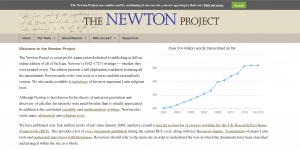
In this digital age, history is no longer only defined by paper documents or books confined in the basement of an archive, but brought beyond the walls to be made more accessible by all. The Newton Project is a online collection of Sir Isaac Newton’s published and unpublished writings on alchemical, mathematical, scientific, and religious subjects. Not only does it catalog his writing, but also provides a look into his personal life, views of him, controversies, and other historical background on this famous figure.
The project’s sources are mainly from the National Library of Isreal (NLI) and Cambridge Digital Library; other donors in the effort include the Science Museum Library and Newton Project Canada, the Jewish and National University Library (Hebrew University), and King’s College Cambridge, who also allowed the Newton Project team access to microfilms of Newton’s work. The data obtained from these sources are then processed based on the Text Encoding Initiative, and provides translated and transcribed versions of Newton’s text, as well as a scan of his original manuscript. The team utilized a combination of MathML and TEI-P5 encoding to transcribe the documents that were shared. Furthermore, there are documents from Newton’s files called the “Waste Basket,” for those documents whose text was far too faded to be seen with the naked eye; these are processed and enhanced to become more visible.
Altogether, these elements are then presented to the audience in a clean, easy-to-navigate form. Newton’s texts are not only divided by the type of writing it is (ie “Works,” “Notebooks,” “Correspondence,” etc), but also by the subjects on which he wrote about–from mathematical to religious. By having different versions of the manuscripts (diplomatic and normalized), the audience can compare the works side by side. While the diplomatic version of the text is closer to the actual transcription of Newton’s work, since its goal is to have the least number of edits, the normalized version provides an edited version of the transcript, where abbreviations are specified and textual mistakes made by Newton are edited. While the diplomatic version may be of more importance to an experienced user/historian, the normalized version is for those who are looking for a more readable script–perhaps for the less experienced or students. The original manuscript also is provided and is linked to the University of Cambridge Digital Library and commentary, allowing the audience to be even more informed on each individual manuscript; this option is best for those who are browsing because it offers quick and easy access to a summary about Newton’s work. For more advanced users, the site also presents downloadable files such as an XML file and Schema, which are the underlying computer code and design of the documents. In addition, the site also has a search tab, which will allow for those who are looking for a specific text to search quickly and efficiently. Overall, the appearance and presentation is much like an online library–a digital library–in which it is well-organized and accessible. Even though it may lack the interactivity and flowery visual appeal of other sites, it serves its archival purpose well.