Virtual Paul’s Cross Project is a multimedia narrative combining timeline, 3D imaging, and acoustic engineering in order to provide a virtual experience of a two-hour sermon given by John Donne on November the 5th, 1622.
vpcp.chass.ncsu.edu
The project’s intent was to digitally recreate an event that occurred in a place in time and space that is no longer exists. It does so by providing a cross-media experience including visual models, interactive artifacts, acoustic recreations, and text. These individual components intend to combine in the users mind to experience John Donne’s two-hour sermon. A multidisciplinary team was involved to achieve this goal.
Sources: Although there was scant evidence of the time of Old Saint Paul’s Church because it burned down, a team of experts nonetheless drew from archaeological surveys, engravings, old paintings, manuscripts and published works in effort to provide an accurate representation of the event and environment down to the detail of its acoustics. Sound seems to have been a key Source component to the success of this digital humanities project. Images were also an integral part of the experience since they provided a detailed and realistic digital representation of the setting, namely the Old Saint Paul’s Church. Text providing context and documentation provides a body of knowledge that has been gathered from both deduction and records. In addition, an advisory committee provided depth and authority to the virtual content.
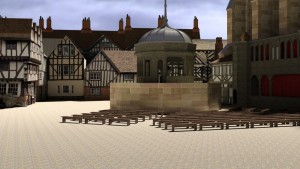
“Figure 2: Paul’s Churchyard, looking east, from the west. From the Visual Model, constructed by Joshua Stephens. “
Process: Content and information was curated, organized, photographed, quantified, and digitized to provide accuracy and sense of realism. Software was used to process images into a 3D imaging experience of the church. Sound was recreated and processed by acoustic engineers to provide the ambient sound of the church. The sermon, which was re-recorded separately, was later combined digitally in order to have accurate acoustics. A multi-disciplinary team of experts processed what that they had available to present a virtual experience of John Donne’s two-hour survey.
youtu.be/rdt0yCbvyHg
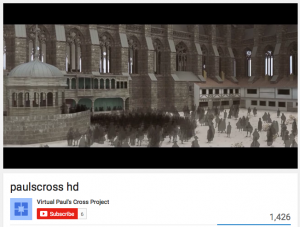
Presentation: The deliverable product is a visualized, web-accessible, searchable, and highly interactive experience. Users can explore the visual church model as they peruse through various images with different angles, lighting conditions and close ups of the structure. There is a featured YouTube video of 3D imaging representation of the church providing a fly-over experience.
The digital humanities project is web accessible and searchable providing the user with the ability to access the site via multiple internet-capable devices. The experience, however, is probably best appreciated on larger screens as images reveal more detail and content is easier to interact with. The website has a clean design and simple navigation using main and hidden menus below a hero image.
However, from an User Experience point of view, it is not very responsive. The navigation does not provide you with a sense of where you are at all times. It appears to be highly static in that the navigation menu does not dock above but rather goes off screen when scrolling down, as if it were one large poster. There is a lot of “chrome” which is to say that the hero image takes up quite a bit of space where content could replace it. It is not clear that when you click on individual images that a carousel of images will be provided, in fact if feels like it is just an individual copy of an image.
Overall Virtual Paul’s Cross Project does have amazing documentation of John Donne’s sermon for Gunpowder Day and one can appreciate the engineering that went into creating it and the effort that was put into it. The only improvement I could see is updating it with newer more responsive technology in order to make it smoother and easier to use and navigate.