PURPOSE
The Virtual Paul’s Cross Project, created by North Carolina State University, aims to help its audience relive the experience of attending John Donne’s sermon at Paul’s St. Paul’s Churchyard for Gunpowder Day. John Donne, an Anglican priest and also, dean of St. Paul’s Cathedral in 1622, delivered a sermon on November 25, 1622 at the request of King James I, to defend the king’s decisions on national politics and religious policies — in particular, the “Spanish Match,” or the marriage arrangement between his son Charles and the Spanish princess, Maria Anna. Recognizing the political significance of the sermon and the array of social and cultural insight the actual occasion — both its physical and social environment — has to offer, the team recreated the sermon through multimedia mediums and text.
The purpose of the website is two-fold: technical and historical. First, it offers visual and audio models of the sermon, which serve to demonstrate how digital tools can be utilized to recreate the look and feel of a historical occasion based on archaeological and visual evidence. Second, the project provides textual descriptions of the preacher, occasion and sermon, giving insight into the social assumptions and conventions underlying the event.
SOURCES
Visual Model
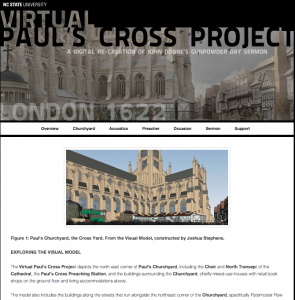
The visual model is a digital recreation of St. Paul’s Cathedral and its surrounding environment. The team gathered data about the dimensions of the churchyard and its environment from surveys of existing records. They also referred to visual records such as old drawings and sketches of St. Paul’s Cathedral and surrounding buildings from art institutions like Sotheby’s and the Art Museum of London, to get an idea of the look and feel of the area.
Audio Model
The audio model includes a recording of an actor reading the sermon manuscripts, which are from the British Library and Guildhall Library in London. The team referred to architectural drawings and archeological studies to understand how the physical space might have affected the reverberation of sound. They also simulated the ambient noise — birds fluttering, crowds whispering, church bells chiming, etc. — based on published works about the historical background of the era.
Textual Descriptions
For the textual descriptions about John Donne, the occasion and the sermon, the team got their information from published works of various universities including Johns Hopkins University, University of Cambridge and Oxford University.
PROCESSES
The team created a visual model of Paul’s Churchyard and its surrounding area through Google SketchUp based on data from surveys of existing structures and surviving visual records, such as drawings and sketches. Later, they added details and shading to the visual model using Photoshop. The team also created an audio simulation of the sermon including ambient noise of the crowd talking, birds chirping, horses galloping, etc. They referred to paintings and other visual records to see how many people were present at the sermon and what other objects might have contributed to the ambient noise. Taking into account various factors that affect the audibility of outdoor noise, such as the distance of the speaker, size of the crowd and the size of open field, the team recreated the audio of the sermon from eight different locations in the Courtyard and with four different sizes of crowd.
PRESENTATIONS
There are three major components to this project: visual and audio recreations of the sermon as well as the textual descriptions. The team breaks down the visual component of the sermon in the section “Churchyard,” using both text, images and fly-around videos of the sermon to provide the audience with a “look and feel” of the sermons at Paul’s Cross. Users simply have to scroll down the section to get through the content. Throughout the text, certain words are hyperlinked to external sites providing further explanation. The audio model is analyzed in the “Acoustics” section in a similar fashion.
The next three sections – “Preacher,” “Occasion,” and “Sermon” explain the social assumptions and significance of the sermon. While the first two sections target the senses, the latter three sections focus on providing the audience with a historical background.