Class Blog

Walt Disney Productions Publicity Ephemera – Blog Post 2

Because the Walt Disney Productions Publicity Ephemera, 1938-198x span a more than forty-year period, I assumed that the finding aid would allow me to draw conclusions about the evolution of Disney’s publicity materials during that time. I expected some changes, such as the kinds of films produced or the kinds of materials used to advertise them, to become clearly visible as I perused the finding aid.

However, as seems to be the case with other finding aids, I found that the publicity ephemera were organized alphabetically rather than chronologically (the physical collection itself seems to be scattered neither chronologically nor alphabetically throughout the 12 boxes). The alphabetical organization would be helpful if I were searching for a particular title among the list, and did not know which year it was released. For instance, while it might be easy for me to locate the Mary Poppins photographic highlights from 1964, I would struggle to find the more obscure Melody Time preview program from 1948.

Yet if I were trying to construct a narrative out of these materials, the alphabetical ordering would seem to obstruct my aim. Though Melody Time appears directly below Mary Poppins because of their alphabetical similarity, the two programs were released nearly twenty years apart and seem to have little thematic similarity. In order to discover which films were advertised before and after Mary Poppins, I would need to manually put the publicity ephemera in chronological order. Only then would I have a structure resembling the kind of annals that Hayden White discusses in “The Value of Narrativity in the Representation of Reality.”

Even in annals form, though, White does not believe that a collection of data forms a complete narrative (9). From there, I would need to add additional commentary to each entry to form something closer to a chronicle. For instance, even after I link Mary Poppins to Emil and the Detectives or one of the other films produced in 1964, I must still consider why they might have been marketed in such close succession. I could ask whether their subject matter is related, whether there is similarity in the materials used to advertise them, or whether these advertisement materials have similar styles. Yet according to White, the short chronicle I have just described only “aspires to narrativity” (9) because it does not provide any kind of moralizing conclusion—it simply drops off with my observation of how Mary Poppins’ publicity materials may have influenced the development of the Emil and the Detectives publicity materials.

It would be difficult even to draw enough conclusions to create a chronicle, because the finding aid excludes contextual explanations for each item. Prior knowledge informs me that not all of the Disney releases detailed in the finding aid were popular successes, and thus were not all equally impactful on audiences. Yet each publicity material appears in the finding aid as if on equal ground, having accomplished its advertisement goals to equal success. In this way, the finding aid includes materials that may not always be viewed as “important” in the arc of Disney’s history. While this may present some difficulty in determining how all these films relate to each other and how their publicity materials affect those following them, it also leads me to a sort of moralizing conclusion. Because all these publicity materials must have affected some people, and their impact may have been great on those individuals, perhaps it is not the archivist’s intention to decide which ephemera had the most lasting impact. Perhaps in organizing the materials alphabetically, but also in including the lesser-known materials at all, the archivist invites the viewer to construct new narratives concerning how a work like Mary Poppins could possibly be related to a work like Emil and the Detectives.

Week 2 – Walt Disney Productions Publicity Ephemera

For this assignment I looked at the finding aid for Walt Disney Productions Publicity Ephemera, 1938-198x. The finding aid basically acted like a general manual for all the artifacts in the collection. Rather than giving the specifics of each piece, we were given the general break down of the pieces and an a brief overview of the Walt Disney company. Through these information we would probably be only able to write an essay regarding the creation of the company and the famous works it created rather than the details of the artifacts itself. The only thing that we could discuss relating to the artifacts would be what the artifacts contains, the names of the different films that Disney created and where these artifacts are currently located. Other than these facts which were explicitly written in the “Scope and Content” and “Physical Location,” one thing that we could put together is the order in which each of the films were created. Another potentially interesting topic we could discuss is how the artifacts were organized. It was pretty interesting to see that all the files relating to the film “Big Red” was not organized into one box. To me it would make more sense to keep all of the materials with the same topic together in one box and then organize it by different folder numbers, however it seemed that this archive didn’t really organize it in this manner. The files could be found all over the place – box 1, 10, 11. Even though the finding aid does not mention as to why they ordered it this way, it would still be interesting to analyze this and see if there was any patterns to how they organized their files.

Considering that the finding aid only elaborated on the company history and the overall contents of the artifacts, there are many parts of the archive that remains unknown. One of the biggest issue for me was that I was barely able to get any information about the individual artifacts itself. I’m not sure if this is because finding aid is supposed to only give a brief run-down of the archive, but it was still bit disappointing to not learn much about the artifacts itself. It would have been nice to know at least why the archive only contained some of the movies created by Disney, why they only collected artifacts until the 1980’s and why the files that referred to one movie weren’t all located in the same box. It would also have been interesting to read about why they began creating this collection. I don’t think it would have been too difficult to address these questions, just adding a couple of more section in the finding aid would have sufficed- however, I’m not sure if that would have violated the traditional finding aid format.

Week 2 Blog Post- Bonnie Cashin

The relationship between recorded events and historical stories has been extensively studied. Hayden White presents an interesting standpoint of what this relationship actually is. He begins by defining events. From all the things that happen throughout history, an event is defined by what the narrator seems to be significant and chooses to remember. Events only become history with the presence of narrative, which is formed by the stringing events together. These events are strung together through the notion of cause and effect. In other words, narrative is created given the notion of what is important to us and how the world works. One event causes another effect, which causes another event, and so on. Because we need to have some idea of how the world works to use this cause and effect, we have to lean on our notion of how the world works to connect facts together.

This concept can be applied to all historical events and narratives. I chose to discuss the Bonnie Cashin collection of fashion, theatre, and film costume design (1913-2000). The finding aid for this collection describes and details the organization and contents of this collection and helps establish a historical context for this collection. This specific collection includes Cashin’s design illustrations, writings on design, contractual paperwork, photographs of her designs, press materials, and personal photos and letters.

If I were to write a historical narrative based on materials in this collection, I would begin with a story of the biography of Bonnie Cashin. Bonnie Cashin was born in Fresno, CA in 1908. She was interested in fashion and costumes beginning in her teen years. She briefly studied drawing in Los Angeles. Bonnie then moved to New York in 1933 to design costumes for the Roxyette dance-line, while also studying drawing in New York. She then quit both these jobs and began designing film costumes for Fox. Cashin eventually left Fox and began designing clothes and accessories for a popular clothing brand. She eventually gained public fame during this time through her efficient use of technology within the fashion industry and was considered a pioneer of sportswear. She then began working with another clothing brand until the launch of the Coach handbag company. She designed for Coach for 13 years and her designs are currently still in production. After her Coach years, she continued designing for other companies, and created another company of her own, The Knittery. She didn’t have any design assistants and received numerous awards for her work. She also founded a non-profit organization to provide funding for design prototypes.

The materials present in the archival collection reflect this biography. The collection is organized chronologically and includes design sketches from all the companies she worked for, as well as some of her personal items. For example, the collection begins with early costumes, then dance- wear costumes, then film costumes, etc.

Based on this information, I could create a narrative of the professional life of Bonnie Cashin. I could speculate that the time period she was designing for had no other influential sportswear designers and had little access to technology. Perhaps her sportswear was so influential because she lived during the post- war era, following World War II. Her designs may have appealed and catered to the women of this era through the practicality and comfort of sportswear. I could describe Cashin’s legacy as one of the most influential designers in history because her designs strongly influence and are present in mainstream fashion today.

Based on the information in the finding aid, I could also describe Cashin herself. First, she seemed to get bored of companies easily and enjoyed changing directions in her career. This is obvious because she had a multitude of employers. She also seemed to have a variety of interests from basic drawing, to sportswear, to clothing, to accessories. She was also very technology oriented, which shows that she was future- driven and attempted to change the way things were done. Finally, she was generous and sought to help future designers through her non-profit organization.

My narrative would have a few pieces missing if it were based entirely on this collection. First, it is unclear what kind of drawing Bonnie studied at art school. Perhaps Bonnie may have wanted to be a different kind of artist at one point in her life, but something pushed her into fashion specifically. Exactly what pushed her into fashion over other types of drawing is not included in this finding aid and would be missing from my narrative. I might remedy this by offering my own opinions of why she pursued fashion, or finding other resources to examine.

Next, something missing from my narrative is why Cashin left her job designing dance wear and began working at Fox. Something must have spurred her to leave dance- wear and begin creating film costumes. Because narrative is based so strongly on cause and effect, as White explained, my narrative would be incomplete without knowing the cause which effected her to begin designing at Fox. Furthermore, it is unclear why she then chose to leave Fox and began designing ready to wear clothes for other companies. I also don’t know why she stopped designing for her own first company, Coach, and went back to designing for other companies. This seems strange because she went from being the Creative Head of her Coach to designing for other people again.

Next, it is unclear what kind of technology she used within fashion. I would do more research on technology within fashion to accurately portray her narrative.

Finally, within the arrangement of documents of the collection, I noticed something called “Ford Foundation trip to India.” This trip was not included in the biography of the finding aid and it would be missing from my narrative because there is no context or information about it.


Walt Disney Productions Publicity Ephemera

I chose to examine The Walt Disney Productions Publicity Ephemera collection from 1938-198x. I chose this because it seemed like the most enjoyable website to comb through while gaining a better understanding of the publicity materials used by the Walt Disney Company in its early years and through its massive expansion as a leader in the entertainment industry. This collection of publicity ephemera is an archived resource provided by the UCLA Special Collections Library that indexes the company various projects alphabetically. This collection of ephemera consists on photographs, press materials, such as press kits and books, stills, and other unique printed publications related to the film projects during this time. Based on this website, the historical narrative that is presented is one that is purely based on physical documents that are kept at an off-site location. Unfortunately, this site does not allow for any deeper understanding of the collection as it does not provide images or even descriptions of the content listed.


Due to the list of contents arranged alphabetically, the dates of each of the projects jumps around and it is hard to place which project may have been associated with which film. The descriptions are vague such as “Peter Pan – press kit material and still 1952”. Without images or descriptions of the images, it is hard to understand the full narrative of the collection. As Disney deals in visual representation primarily through animation, an imageless website does the collection a severe injustice. It would provide the viewer of the site more entertainment to see documents pertaining to this material in order to understand the marketing initiatives of the company, the changing visual representations of characters. This type of content does more than simply make a website more enjoyable to look at and explore, it provide the viewer with vital information.


Seeing art and materials is more than just ars gratia artis for the viewer. It provides a vital narrative of the historical time period and objectives of the company itself. It would be interesting to see if changes in press kit and character designed changed and how it did so through the time period of 50 years. Perhaps if the documents listed on the website were categorized by date, substance (press kits, photographs etc.), or project the overall data would be more easily read and therefore better understood. It would be very difficult to conduct thorough research based on this website alone.

Exploring the Finding Aid for Walt Disney Productions Publicity Ephemera

I chose to explore the Finding Aid for the Walt Disney Productions Publicity Ephemera, 1938-198x. Right off the bat, I was able to tell from the title that I would be introduced to the era of publicity for the Walt Disney films (more specifically from 1938 to the 1980s). The abstract ensured me that I could expect to see things in the collection such as press books, press kits, and photographs, among other publicity related materials. In addition, I found out that the collection was housed at UCLA and that one could only access the collection with advance notice to the UCLA Library, Performing Arts Special Collections Reference Desk.

The Finding Aid also gives a brief biography of the Walt Disney company as well as the content of the collection, stating that the collection contains publicity for over 150 Disney titles. As noted, this collection is organized alphabetically by project title.

However, I was extremely disappointed to find that the “container list” which listed the title of a Disney production, what item of publicity it was, and which box and folder the particular item was in, did not give any additional description of the item or how the production was received by audiences. Therefore, the only true narrative that I was able to pull from this Finding Aid was derived from the biography that gave a brief history of the Walt Disney Productions. Based entirely on the records of this collection, my narrative of this collection is missing key history tied to each particular film/short animation and the effect that the press had on each of these (i.e. how it was received by audiences and its success in the theatres). Most importantly, because the biography states that the company reputation suffered after Walt Disney’s death in 1966, I would have liked to know how this affected the production company’s efforts to publicize its animations. Overall, I did not find the Finding Aid for the Walt Disney Productions Publicity Ephemera very informative. However, it did convince me to go see the collection for myself in the near future.

Japanese American Internment Finding Aid

I chose to take a look at the “Finding Aid for the Collection of Material bout Japanese American Internment, 1929- 1956 bulk 1942-1956”. By first looking at the descriptive summary, I am able to get an idea of the kinds of historical narratives that comprise the collection. For example, from the title I know I will encounter narratives about Japanese relocation, specifically those publications released by the War Relocation authority, Japanese American internees and advocacy groups. I know that there are 4 boxes and a folder in English at UCLA, where I can visit with an advanced notice. Once I begin reading, the descriptive summary also tells me there is a placed emphasis on the Manzanar and the Minidoka internment camps.
Looking at the Container list, I see that the first two boxes contain documents, such as speeches, pamphlets, and annual and semi-annual reports of the years. Continuing on, the finding aid tells me exactly what I can expect to find in every folder in that box, whether it is a report or a speech. Through reading descriptions of each folder, I have concluded that the narratives include a lot of information on life in the camps, as well as speakers of the WRA using racial prejudice to justify reasons for the camp and explain how they would be beneficial to America. The second box focuses on the two camps mentioned above, with more detail on life, sports, entertainment, and even yearbooks of the graduating classes while in the camps. The final box has a more diverse array of documents, such as outside analysis of Japanese life and advocacy groups. The last box, also being from later times, depicts documents from people opposed and for the internment whom were “on the outside looking in”.
If I were to base my research only on the information I found inside these boxes, I think it would be incomplete. Yes, there are documents explaining the history, detailed account of life inside the camps, and the lives of people outside, but a greater scope is missing. Because the archive is mainly focused on two camps, I cannot assume that all Japanese American internees experienced the same life inside the camps. It could be that these camps were a lot different than the others, whether being better or worse. Additionally, I do not believe there is enough historical background, only minimal information on World War II and the bombing of Pearl Harbor. Lastly, I believe the archive would benefit from more documents on life after the camp. To remedy this, I would recommend using this archive as a helpful aid, but finding a bigger and more diverse archive to facilitate one’s research.

Photgrammar Deconstruction

Photogrammar is a web-based data visualization of 170,000 photographs from 1935 to 1945 found at http://photogrammar.yale.edu/. It allows not only for visualizing, but also organizing and searching these photographs. This website was created by the United States Farm Security Administration and Office of War Information (FSA-OWI).

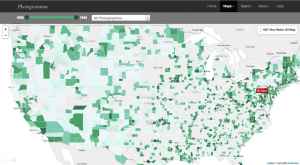
The photogrammar map showing photograph density by county

The sources for this project come from the FSA-OWI File collection of images. Sponsored by the federal government, the Farm Security Administration — Office of War Information was given the task of documenting America, which produced a plethora of photographs from many well known photographers. The negatives were sent to Washington, DC where they were stored in a collection that eventually came to be known as the FSA-OWI File.

The processing for this project began with the cataloguing of the collection. Paul Vanderbilt joined the fSA-OWI in 1942 and created an organizing system for the collection that included the Lot Number system and Classification Tags system for the photographs. The lot numbers  signify a set of photographs organized around a shooting assignment, so they usually feature one photographs photos in a single place, and the classification tags have headings and subheadings that describe the subject matter of the photograph. This metadata allows users in Photogrammar to search through the collection. Apart from this, the Photogrammar team had to quantify the number of photos taken in each location and group them together by photographer, location, date, and classification in order to visualize it on their maps.

The presentation of this information is mainly done through maps. One of these maps shows the photographs by county, where the shade of color of the county represents the amount of photographs taken there. There is also a dot map that has different color dots for every different photographer. On these maps, you can zoom in and out, filter for a specific photographer, or adjust the time period that is shown. When you click on a county, it tells you the location and links to all the pictures taken in that county. It is important to note that the map only plots the approximately 90,000 photographs that have geographical information, whereas there is about 170,000 photographs total on record. These maps were created using leaflet, an open-source JavaScript library for mobile-friendly interactive maps, and CARTO, an open platform for location data.

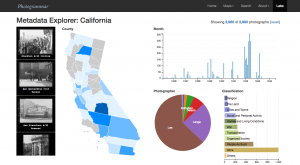
There is also a section of the project called Photogrammar Labs where experimental visualization techniques are being used to represent these photographs, such as a treemap that traverses through the headings and sub-headings of the images, a metadata dashboard that represents the photographs in California with different charts and visualizations, and colorspace that allows the user to explore the photographs based on hue, saturation, and lightness.

Written by Risha Sanikommu

Mapping Indigenous Los Angeles

A collaboration between the Digital Humanities department, faculty, and students at UCLA and community researchers and leaders, Mapping Indigenous Los Angeles is a website that makes visible and interactive through maps, images, relevant documents, videos and other visualizations the many Indigenous histories of Southern California including those of the Gabrielino Tongva, the Latin American diaspora, and Pacific Islander communities— people that have been displaced by processes such as neo-liberal economic policies, and intersecting colonial histories— that are often obscured yet deeply rooted in Los Angeles history, culture and geography.

Sources: Because this project relies on story-telling through interactive digital maps, and community-based research collaboration, it draws from multiple sources across the digital and physical landscape. It lists teaching and reading materials such as texts ranging from federal documents to oral history projects as well as interviews with community leaders. Videos, links within the text, scanned artworks, and other sources are used consistently throughout the available and interactive maps for Los Angeles waterways, American Indian Health and Education Resources and Latin American Indigenous diaspora.

Processes: The primary processing tool used is the ESRI Story Maps program through Arcgis, which is a geographic information mapping system available online for public use.

Presentations: Each storymap includes accompanying text embedded with links to documents and terms referenced, further expanding the field of information made immediately web-accessible. One of the websites featured links available on the dashboard is “Create your own storymap” where the hugely collaborative element of this project is encouraged all the more.

milascreenshot

Deconstruction of Early African American Film

This week, I chose to deconstruct the DH project, Early African American Film. The database describes and discusses the history of silent race films from a vast gathering of information drawn from both primary and secondary sources. The team defined a silent race film as one that was made up of African America cast members, was produced by an independent, African American owned production company, and was advertised as a race film in the press. The project details information not only on the films, but also on the actors, directors, production companies, and paraphernalia created by the race film industry, including posters and theater programs. The team that worked on this database intended to demonstrate the craft behind African American silent filmmaking while also providing insight into the community as a whole in order to promote awareness on this era of film history.

The project only included data on films created between 1909 and 1930 and that were intended for African American audiences. The data was gathered from various African American film collections and archives located in the United States that both documented the history and culture of African American film traditions and contained rare moving images and recordings of silent reels. Additionally, the team also amassed data from scholarly essays and texts that traced the emergence of African American filmmaking and analyzed the filmography and role of race films in the early 1900s.

The team assembled a database of all of the people that were associated with the silent race film industry. As the connections between the people grew stronger and more complex, the team began to process the data using visualizations that (1) exhibited the number of silent race films and the year that they premiered, (2) showed a network of people associated with the films, including actors, directors, writers, and others that were somehow involved in the industry, and (3) displayed the locations of African American production companies and the year in which they were founded.

screen-shot-2016-10-03-at-1-40-33-pm
The data that detailed the number of race films was presented as a histogram chart, showing that the peak of race film production (51 documented premieres) took place in 1921.

screen-shot-2016-10-03-at-1-43-39-pm

The network of people in the silent race film industry was displayed in two different diagrams. Connections were shown by an edge if two people worked together on at least one film, and were darker if they worked together more than once. Nodes, which signified individual people, were larger if one person had many connections with other people in the industry. The second diagram indicated the ways in which people were connected, displaying which film connected any two people together.

screen-shot-2016-10-03-at-1-44-17-pm

screen-shot-2016-10-03-at-1-44-23-pm

The data that presented the locations of the African American production companies was exhibited in one moving and one still time map. In the moving time map, production companies appear as pulsing dots as the time key moves year-by-year in their geographical location on a map of the United States, while the still map is one image that shows the expansions of the companies.

eaa-time-map-768x566


Reverse Engineering Photogrammar

A team of seven professionals and scholars hailing from Yale University contributed to compiling hundreds of thousands of photographs dating back to World War II and the Great Depression into a project titled Photogrammar. Having originated from such a serious period of time, these iconic photographs vividly depict the poor living conditions, effects of the war, and hardships that Americans endured during the 1930’s and 1940’s.

photogrammar-map

Photogrammar, as seen above, organizes, details, and visualizes information collected from the United States Farm Security Administration and Office of War Information in the form of an interactive, well-organized (thanks to the cataloguing system created by Peter Vanderbilt) map made web-accessible (and therefore publicly-accessible). From this map, we see regions in the United States with varying shades of green; a dark forest green color indicates that a high volume of photos was taken in that county in that state while areas with a mint green color are counties in which a small amount of photos were captured. Furthermore, based on what areas of the United States have the darkest shades or lightest tints of green, we can extrapolate what parts of the country experienced the most or the least events and, by using the cataloguing system (essentially filters such as “Lot Number” and “Photographer”) created by Peter Vanderbilt, we can determine whether these photographs captured moments that were related to war, the social lives of Americans, or the development of land.

photogrammar-metadata-explorer

This project also provides this interactive dashboard showing what photographs were taken during which year, in what county of California, and by what photographer as well as what classification tag they fall under. Even though this feature is only available for photographs taken in California, I like the way data is visualized here better than in the United States map above. On this page, you can clearly see who the prominent photographer was (Russell Lee, according to the pie chart), what the most common subject of the photos was (work, according to the horizontal bar graph), what year the most photos were taken (early 1942, according to the vertical bar graph), and what region of California had the highest volume of photos (Tulare, according to the map). I personally like seeing what the significant contributors are in any set of data, so how these scholars highlighted these features of what they were inspecting (essentially by laying it out on a neat and colorful dashboard) really appealed to me.

(Also, I’m just throwing this out there for anyone else who’s interested: There’s an online album composed of similar photos from this time period captioned: “These vivid color photos from the Great Depression and World War II capture an era generally seen only in black-and-white.”)