Martha, Martha – Blog Post 7

I created a network graph based on the short story “Martha, Martha” by Zadie Smith. In the story, a real estate agent named Pam Roberts shows a client, Martha Penk, two properties before Martha decides not to purchase either of them. Pam Roberts is a middle-aged woman from the Midwest who is generally good-natured, but is fond of gossip and sometimes expresses xenophobic sentiments. Having arrived in Massachusetts a week ago, Martha has unrealistic notions about the kinds of properties she can afford. She appears to have been part of the working class in England, but hopes to attend a university and to cultivate cultural knowledge. She continually exhibits abrupt and rude behavior, leading Pam to conclude that she is odd and somewhat uncivil. By the end of the story, however, it appears that Martha’s behavior is the result of emotional turmoil. She seems to have left her son and his father in order to chase her academic dreams, and her anguish at this seems to explain why she abruptly declines to purchase and leaves the second property.

screen-shot-2016-11-13-at-8-51-04-pm

There are 22 nodes on my network graph, each signifying a character in the story. I considered a connection between characters to constitute whether one character had spoken to, or about, another character. For instance, while Pam Roberts speaks to Martha, Amelia, and “Middle-Easterny” Man 1, she does not interact directly with most of the characters during the story. While it is implied that she has spoken to each of the people she mentions at some point, she demonstrates most of her relationships to people by sharing gossip about these people rather than actually interacting with them.

The way I formatted this graph is somewhat confusing in that there is no visual distinction between relationships demonstrated by direct interactions and relationships that a character only claims to exist. In one sense, I view this as a limitation of this network graph. However, it can also become an aid to understanding the story in that the same kind of confusion between knowing a person and knowing about a person occurs in the story. It is clear that whether Pam Roberts interacts with a person, or only describes a previous interaction, she views everyone she interacts with as little more than a source of gossip. Though Pam speaks with Yousef’s wife, Amelia, and only describes the Professor’s wife, both wives appear equally two-dimensional because Pam’s assumptions entirely define them. Pam’s assumptions about Martha, though unfounded, even begin to affect how Yousef and Amelia view her.

No one truly knows anyone in this story, and so every relationship’s value is limited. For this reason, this network graph is deceptive in another key way. Although Pam Roberts has the most connections, none of them are particularly deep or meaningful. She deems a man she meets to sound “Middle-Easterny” and does not even ask him his name (she applies the same assumption to his three companions). Even when Pam mentions her three daughters, the reference is fleeting and not necessarily fond. Yet Martha, who has fewer connections and seems disagreeable for most of the story, actually has two very deep connections in Ben and Jamal. The number of connections is not at all indicative of their depth—in fact, this seems to be an inverse relationship.

Note: though not technically a “character,” I included the Snowman as a node because it is a helpful focal point for viewing the relationships between the four men.
ReVilna – Blog Post 6

reVilna,” or “Exploring the Vilnius Ghetto: A Digital Monument,” maps the Vilnius Ghetto in Lithuania, which Nazi officials forced Jewish Lithuanians to inhabit beginning in 1941. The interactive digital map allows the viewer to click on over two hundred geographically tagged points of historical significance and to apply filters to find certain places or events.

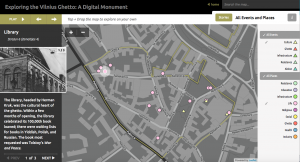
After clicking on “Explore on your own,” all events and places appear on the map. The viewer can then click on each point for more information, or subtract certain categories of events or places from view in order to focus on other categories. For instance, the viewer might choose to remove all categories except “Culture” for events and “Life” for places, in which case an almost idyllic picture of the ghetto appears:

screen-shot-2016-11-06-at-11-28-06-pm

These filters exclude the places and instances of oppression that permeate the ghetto, and even imply access to high culture among ghetto residents through events like a theater show and places like the library. While viewing these factors in isolation paints a two-dimensional and inaccurate picture of life in the ghetto, the viewer is able to create this narrative from a larger set of data, rather than passively receiving it from a storyteller with an ulterior motive (perhaps a Nazi enthusiast).

However, the category names indicate the role that the map’s creators still play in shaping its narrative, even when the viewer uses the “explore on your own” function. Names like “Life” and “Culture” are vague enough to encompass a variety of meanings and implications for ghetto residents, yet they seem to designate specific kinds of experiences. For instance, while I would anticipate some negative associations with life in a ghetto, the places under the “Life” category seem to refer to locations where cultural or leisure events occur. The kinds of narratives the viewer can create through this map thus depend on the creators’ ideas about what the category names mean. Though this is the least unbiased section of the site, the creators’ ontology the map’s subjectivity are visible even here.

The site also provides story maps, which help the viewer to track certain narratives like “Formation of Ghetto,” “Art & Culture,” and “Resistance & the FPO.” These stories are helpful for viewers unfamiliar with the Vilnius Ghetto, who would find it difficult to create a narrative out of events for which they have no context. Stories like “Life in the Ghetto” provide cohesive and relatively unbiased accounts of life in the ghetto, jumping from point to point on the map and providing written descriptions and photographs for each place or event. The stories are organized either chronologically or by topic, depending on how subjective the narrative is. For instance, “Resistance & the FPO” follows a very specific chronology, and multiple points on the map sometimes occur on the same day. By contrast, “Life in the Ghetto” jumps from location to location and does not need to follow a certain sequence. Though the latter story gives the viewer more control over how to interpret the narrative, there are still a limited number of sequences built into the story.

Because the geographically tagged events and places are taken from “memoirs, archives, original Ghetto documents and artifacts, and oral and historical accounts,” the site’s narrative is told at least ostensibly from the perspective of those living contemporaneously with the Ghetto. However, it remains unclear whether those providing the sources were Jewish people living in the Ghetto, other Lithuanians, German officials, or others. Those providing the sources likely imbue them with certain perspectives, and perhaps biases, which may change the meaning of the digital map we see. Yet notably, the website claims that the project is “dedicated to understanding how the residents of the Ghetto lived… using geographical science and technology.” In this way, the project presents itself as an attempt to understand the Ghetto factually rather than to make an ethical or political statement.

Regardless, I would interpret this map as sympathetic to the suffering of the Jews who lived in the Ghetto. The same paragraph that describes the project’s factual nature also reveals its subjectivity: “how the ghetto functioned – even, given the circumstances, flourished.” The reader is likely to interpret “circumstances” in this context as implicitly negative, and thus to view the Ghetto residents’ achievements as remarkable. While I agree with this view and am less inclined to question it, any subjectivity in a map’s design is worth considering.

Best City in Florida – Blog Post 4

The “Best City in Florida” data provides 13 “quality-of-life variables” for 20 cities in Florida, including income, commute, job growth, physicians, murder rate, rape rate, golf, restaurants, housing, median age, literacy, household income, and recreation. No data type specifies the unit it uses, and while I can assume that income is measured in dollars per year, I am less certain about data types like recreation—does this refer to the number of recreational facilities in each city? In this case, some metadata would be helpful.

In spite of my uncertainty about some of the data types, I created several data visualizations using Google Fusion Tables. I found that bar charts were the most direct way to visualize the data (since I had a relatively large number of data sets, I chose the bar chart over the bar column chart). A scatter chart would have also been effective, but I found it more difficult to keep track of data points and to compare different data types in this format. Since I did not observe any change over time reflected in the data, I did not use a line chart.

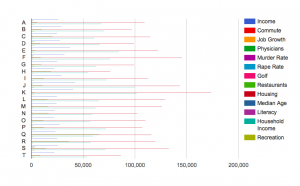
As an experiment, I began by creating a bar chart that included every data type. The city “names,” designated by the letters A-T, appear on the x-axis, while the measurement for each data type appears on the y-axis. As you can see, the resulting bar chart is flawed in several ways:screen-shot-2016-10-23-at-5-19-00-pm

First, the bar chart appears very crowded. It is difficult to interpret all the data at the same time, and thus to effectively compare them. Also, the units of measurement differ for each data type, which also complicates comparison—average housing prices may seem extremely high in comparison to number of restaurants, but it is not necessarily relevant or helpful to compare these things. Finally, the scale differs for each data type, rendering some bars scarcely visible. Because housing prices are so much larger than murder rates, the latter data type appears tiny on the bar chart, when in reality murder rate has a large influence in a much different way than a housing price. While it is interesting to view all the data in one visualization, it is hardly more illuminating than viewing the data in Excel.

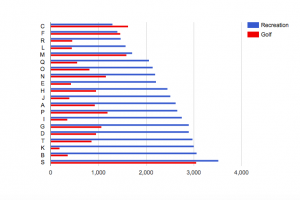
At this point, I started to create bar charts incorporating only a few data types. I realized that it was most effective to compare data types with the same units of measurement, or at least those with similar scales. For instance, since the numbers of golf courses and recreation facilities, respectively, are on a similar scale, a bar chart comparing them is easier to interpret than my first bar chart. best-city-in-florida-recreation-and-golf

It becomes clear that, in general, there are more recreation facilities than golf courses, and that the number of golf courses seems to vary more from city to city than does the number of recreation facilities. However, despite the similarity of units and scale in these data types, comparing them does not necessarily illuminate anything significant about relative quality of life in each city. The fact that one city may have significantly more recreation facilities than golf courses may not affect every city resident equally, or even factor into quality of life much at all.

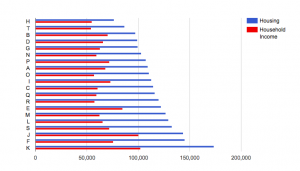
It is only when you can see a correlation between variations in each data type that comparing data begins to illuminate something about quality of life. In comparing housing prices to household incomes, I adhere to my notion that the units and scales of each data type should be similar while also tracing a thematic similarity between the two data types. For instance, I would expect household income to generally increase with housing prices in each city. Yet the bar chart reveals that this is not always the case:

screen-shot-2016-10-23-at-5-15-41-pm

While the city with the highest housing price has a greater household income than the city with the lowest housing price, this is not the result of a consistent trend. As a result, I am able to conclude that while overall quality of life may not be lower where there is a greater disparity between household income and housing price, another factor (for instance, a lower murder rate) may have to improve quality of life in order to compensate for this discrepancy.

Finally, it is probably simpler to view a data visualization that features only one data type. Separating household income and housing price into separate bar charts allows you to notice differences within one particular data type, allowing for a more in-depth understanding of each. However, while the bar chart with two data types is perhaps more difficult to interpret, it allows for more direct comparison of each than if I were to simply compare two different bar charts.

Since I am new to creating data visualizations, I was a little confused by the data summarization function. Though the tutorial recommended using it, the “summarize data” button did not seem to make any difference in how the data appeared on the charts, other than requiring me to specify minimum, maximum, average, or sum for each value.  I am wondering if summarization makes more of a difference with more complicated datasets, or if I am just missing something.

Payroll by Job Class – Blog Post 3

The Payroll by Job Class dataset from the L.A. Controller’s Office includes 34 different data types: Year, Department Title, Payroll Department, Record Number, Job Class Title, Employment Type, Hourly or Event Rate, Projected Annual Salary, Q1 Payments, Q2 Payments, Q3 Payments, Q4 Payments, Payments Over Base Pay, % Over Base Pay, Total Payments, Base Pay, Permanent Bonus Pay, Longevity Bonus Pay, Temporary Bonus Pay, Lump Sum Pay, Overtime Pay, Other Pay & Adjustments, Other Pay (Payroll Explorer), MOU, MOU Title, FMS Department, Job Class, Pay Grade, Average Health Cost, Average Dental Cost, Average Basic Life, Average Benefit Cost, Benefits Plan, and Job Class Link. A record in this dataset consists of a row in the spreadsheet, which shows every data type for one individual employee of a Los Angeles City Department.

Wallack and Srinivasan differentiate between the ontologies of “state-created information systems,” or meta ontologies, and local communities’ ontologies. Because the Payroll by Job Class dataset does not appear to take local contexts into account in organizing and presenting the data, it seems to be a meta ontology. The data is organized alphabetically by Department Title, but the data within each department does not seem to be in any particular order. This makes it difficult to compare the data within each department in order to discover differences among those with the same or different Job Class Titles. For instance, the first record in the dataset has the job class title, General Manager of Aging Department. The twelfth record has the same job class title and appears identical to the first record in several of the data types, but differs in data types like Q2 Payments and Base Pay.

The difference between the first and twelfth records likely has a clear explanation for officials at the L.A. Controller’s Office. The dataset is probably most intelligible to city employees, as it incorporates department and job titles, as well as financial terms, which they encounter on a daily basis. Someone who works for the city government likely approaches the dataset in pursuit of very particular information that they already understand on a basic level, such as the projected salary of the General Manager of the Aging Department. Even though there is such a great quantity of data and it is organized alphabetically, a city employee knows the context well enough to find the information.

However, it seems more difficult for those outside the city government to place the data in the context of their daily lives. For instance, how are L.A. residents supposed to discern the difference between the first and twelfth records when they are so similar to the untrained eye? How can they decide if the hourly rate for each position is adequate compensation for the work, or if a certain supervisor is justified in earning twice his/her subordinate’s salary? Are they likely to look through the entire dataset, or will they accept the first set of records (for the Aging Department) as representative of the following records? Even though the dataset claims to lend insight into payroll by job class, it is surprisingly difficult to discern the cause or meaning of the salary differences. It might help community members to interpret the data in social terms if information like the race or gender of the city employees were included with their financial information.

I think many L.A. residents might find this data interesting because it provides information about which city employees earn the most and the least. This in turn provides insight into the distribution of taxpayers’ contributions to various departments and individuals within those departments, which could prove controversial. If I were organizing the data around this ontology, I would reorganize the hourly rates and projected salaries so that they appeared in descending order, from highest to lowest. During data collection, I would also attempt to trace where the funds for each salary were obtained and to determine who decided which funds would be diverted to each department. This might allow an L.A. resident to determine whether the funds are distributed fairly or whether they believe some departments or individuals are unfairly favored over others.

Walt Disney Productions Publicity Ephemera – Blog Post 2

Because the Walt Disney Productions Publicity Ephemera, 1938-198x span a more than forty-year period, I assumed that the finding aid would allow me to draw conclusions about the evolution of Disney’s publicity materials during that time. I expected some changes, such as the kinds of films produced or the kinds of materials used to advertise them, to become clearly visible as I perused the finding aid.

However, as seems to be the case with other finding aids, I found that the publicity ephemera were organized alphabetically rather than chronologically (the physical collection itself seems to be scattered neither chronologically nor alphabetically throughout the 12 boxes). The alphabetical organization would be helpful if I were searching for a particular title among the list, and did not know which year it was released. For instance, while it might be easy for me to locate the Mary Poppins photographic highlights from 1964, I would struggle to find the more obscure Melody Time preview program from 1948.

Yet if I were trying to construct a narrative out of these materials, the alphabetical ordering would seem to obstruct my aim. Though Melody Time appears directly below Mary Poppins because of their alphabetical similarity, the two programs were released nearly twenty years apart and seem to have little thematic similarity. In order to discover which films were advertised before and after Mary Poppins, I would need to manually put the publicity ephemera in chronological order. Only then would I have a structure resembling the kind of annals that Hayden White discusses in “The Value of Narrativity in the Representation of Reality.”

Even in annals form, though, White does not believe that a collection of data forms a complete narrative (9). From there, I would need to add additional commentary to each entry to form something closer to a chronicle. For instance, even after I link Mary Poppins to Emil and the Detectives or one of the other films produced in 1964, I must still consider why they might have been marketed in such close succession. I could ask whether their subject matter is related, whether there is similarity in the materials used to advertise them, or whether these advertisement materials have similar styles. Yet according to White, the short chronicle I have just described only “aspires to narrativity” (9) because it does not provide any kind of moralizing conclusion—it simply drops off with my observation of how Mary Poppins’ publicity materials may have influenced the development of the Emil and the Detectives publicity materials.

It would be difficult even to draw enough conclusions to create a chronicle, because the finding aid excludes contextual explanations for each item. Prior knowledge informs me that not all of the Disney releases detailed in the finding aid were popular successes, and thus were not all equally impactful on audiences. Yet each publicity material appears in the finding aid as if on equal ground, having accomplished its advertisement goals to equal success. In this way, the finding aid includes materials that may not always be viewed as “important” in the arc of Disney’s history. While this may present some difficulty in determining how all these films relate to each other and how their publicity materials affect those following them, it also leads me to a sort of moralizing conclusion. Because all these publicity materials must have affected some people, and their impact may have been great on those individuals, perhaps it is not the archivist’s intention to decide which ephemera had the most lasting impact. Perhaps in organizing the materials alphabetically, but also in including the lesser-known materials at all, the archivist invites the viewer to construct new narratives concerning how a work like Mary Poppins could possibly be related to a work like Emil and the Detectives.

Mapping Indigenous LA – Blog Post 1

Mapping Indigenous LA

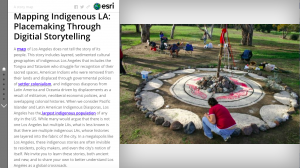
The Mapping Indigenous LA project seeks to create digital story maps that help to chart the geographies and sacred places of peoples indigenous to Los Angeles. With emphasis on the Gabrielino/Tongva and Tataviam, American Indians, and the indigenous diasporas from Latin America and Oceania, this project incorporates community-based research collaboration in order to tell the ongoing stories of indigenous peoples. The project seeks to counteract the notion that settler colonialism entirely eliminated native inhabitants, or that we should study the Tongva only in the way that Christian missions have affected them. The project’s story maps intend to document a more complex and inclusive version of indigenous peoples’ experiences throughout their continuing presence in the Los Angeles basin and surrounding islands.

The project’s website provides several story maps which document indigenous people’s experiences. These story maps incorporate photographs, videos, and maps as source materials in order to convey complex cultural geographies. For instance, late nineteenth century maps of Los Angeles that are used in the story map Mapping Indigenous LA were taken from UCLA Library Special Collections. Other sources come from books that are listed in the Resources section at the end of each story map. Because the project relies on community-based research, some materials also come from individual indigenous community members, as well as groups such as the Gabrielino/Tongva Springs Foundation.

The project creators combined all these sources into interactive narratives in the form of story maps. To create the story maps, they used esri’s mapping software ArcGIS. More specifically, the creators used one of esri’s Story Map application templates: the Story Map Journal app. In the Story Map Journal format, someone viewing the Mapping Indigenous LA story map, for instance, can scroll through written descriptions appearing in the left panel, while corresponding images, videos, and maps appear in the right panel. Some images, like maps, are interactive and allow the viewer to click on certain parts of the map to learn about the indigenous history of each. Also, when the viewer clicks on links within the written descriptions, different images appear on the right panel, thus allowing the viewer to see different parts of the narrative at will.

The Mapping Indigenous LA website itself matches the format of other websites associated with UCLA, with the same blue navigation bar that you find on MyUCLA. The homepage incorporates images that link to the story maps and other materials hosted on the site. There is also a brief description of the project’s aims, though the “Research Scope” section provides a more thorough explanation as to the project’s goals and parameters. In addition to providing several story maps, the website also contains a “Create Your Own Story Map” section, which provides thorough instructions for anyone who would like to contribute a story map to the project. This section details the process that the project creators used in order to create their story maps, but it also defines the nature of the project as ongoing and inclusive of many members of LA indigenous communities.

The website is presented clearly and is not difficult to navigate, though I found it necessary to read several sections of the website before I could grasp the purpose and scope of the project. The story maps are similarly easy to navigate, but require the viewer to interact extensively in order to extract all parts of the narratives.