“reVilna,” or “Exploring the Vilnius Ghetto: A Digital Monument,” maps the Vilnius Ghetto in Lithuania, which Nazi officials forced Jewish Lithuanians to inhabit beginning in 1941. The interactive digital map allows the viewer to click on over two hundred geographically tagged points of historical significance and to apply filters to find certain places or events.
After clicking on “Explore on your own,” all events and places appear on the map. The viewer can then click on each point for more information, or subtract certain categories of events or places from view in order to focus on other categories. For instance, the viewer might choose to remove all categories except “Culture” for events and “Life” for places, in which case an almost idyllic picture of the ghetto appears:
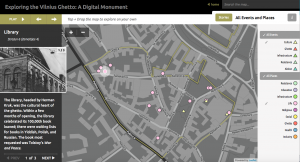
These filters exclude the places and instances of oppression that permeate the ghetto, and even imply access to high culture among ghetto residents through events like a theater show and places like the library. While viewing these factors in isolation paints a two-dimensional and inaccurate picture of life in the ghetto, the viewer is able to create this narrative from a larger set of data, rather than passively receiving it from a storyteller with an ulterior motive (perhaps a Nazi enthusiast).
However, the category names indicate the role that the map’s creators still play in shaping its narrative, even when the viewer uses the “explore on your own” function. Names like “Life” and “Culture” are vague enough to encompass a variety of meanings and implications for ghetto residents, yet they seem to designate specific kinds of experiences. For instance, while I would anticipate some negative associations with life in a ghetto, the places under the “Life” category seem to refer to locations where cultural or leisure events occur. The kinds of narratives the viewer can create through this map thus depend on the creators’ ideas about what the category names mean. Though this is the least unbiased section of the site, the creators’ ontology the map’s subjectivity are visible even here.
The site also provides story maps, which help the viewer to track certain narratives like “Formation of Ghetto,” “Art & Culture,” and “Resistance & the FPO.” These stories are helpful for viewers unfamiliar with the Vilnius Ghetto, who would find it difficult to create a narrative out of events for which they have no context. Stories like “Life in the Ghetto” provide cohesive and relatively unbiased accounts of life in the ghetto, jumping from point to point on the map and providing written descriptions and photographs for each place or event. The stories are organized either chronologically or by topic, depending on how subjective the narrative is. For instance, “Resistance & the FPO” follows a very specific chronology, and multiple points on the map sometimes occur on the same day. By contrast, “Life in the Ghetto” jumps from location to location and does not need to follow a certain sequence. Though the latter story gives the viewer more control over how to interpret the narrative, there are still a limited number of sequences built into the story.
Because the geographically tagged events and places are taken from “memoirs, archives, original Ghetto documents and artifacts, and oral and historical accounts,” the site’s narrative is told at least ostensibly from the perspective of those living contemporaneously with the Ghetto. However, it remains unclear whether those providing the sources were Jewish people living in the Ghetto, other Lithuanians, German officials, or others. Those providing the sources likely imbue them with certain perspectives, and perhaps biases, which may change the meaning of the digital map we see. Yet notably, the website claims that the project is “dedicated to understanding how the residents of the Ghetto lived… using geographical science and technology.” In this way, the project presents itself as an attempt to understand the Ghetto factually rather than to make an ethical or political statement.
Regardless, I would interpret this map as sympathetic to the suffering of the Jews who lived in the Ghetto. The same paragraph that describes the project’s factual nature also reveals its subjectivity: “how the ghetto functioned – even, given the circumstances, flourished.” The reader is likely to interpret “circumstances” in this context as implicitly negative, and thus to view the Ghetto residents’ achievements as remarkable. While I agree with this view and am less inclined to question it, any subjectivity in a map’s design is worth considering.