Class Blog

Week 2: Finding Aid for Sterilization Records

The finding aid for “Virgina Espino and Renee Tajima-Pena Collection of Sterilization Records” describes the physical records of court records from the Madrigal v. Quilligan lawsuit. The Madrigal v. Quilligan court case involved ten Latina women suing E.J Quilligan and his colleagues at the University of Southern California medical center for coercing the women to be sterilized in the mid to late 1970’s.

The archive is divided into two series with the first being court documents in the Madrigal v. Quilligan case. The second series consists of ten cassette tape interviews of multiple people including those involved in Latina rights movement during this time period, people involved in helping the women during the court case, and a resident at the hospital where and during the time the women were coerced into the sterilization. Based on the materials in this collection, readers are able to figure out the details of the court case narrative as well as get an understanding on how serious the case was for furthering fighting for Latina and minority women’s rights in the United States.

However, while the records help give readers a sense of the court case and the importance it had on the minority women rights movement, what the archive cannot provide to the narrative are the personal feelings of the women who were sterilized and how it had an impact on their future. The court documents give a technicality to these women’s’ cases, but not a full understanding of the long lasting psychological effects this forced medical procedure had on their well being. The records also cannot fully illustrate the prejudice in the mind of the doctors who sterilized these women. The court documents can display justifications the doctors used as excuses, but justifications are only the words the doctors want the public to hear. Through selective wording, the defendants and their lawyers were able to twist the case’s narrative in their favor, as the Latina women lost the case.

In order to remedy the missing information, interviewing the women or the women’s family involved in the cases would help readers understand the pain. In the finding aid, it was mentioned how the documents were used in the documentary No Más Bebés. With further research, I was able to find out that Renee Tajima-Pena not only used the documents to illustrate the court case and its effects on the Latina rights movement, she also interviewed some of the women in the court case and how it had an effect on their personal lives. However, even if someone were to interview the doctors, they could still deny they had any prejudice against the women and continue on with their narrative of the story. Thus, it is nearly impossible to fully illustrate this narrative, as it is so easy for these doctors to keep up their innocent image.
Week 2: Finding Aid for SLDC

I chose to investigate the finding aid for the Sleepy Lagoon Defense Committee Records, 1942-1945. The finding aid follows a traditional format, and I am immediately drawn to the abstract, a summary of the research the records follow. The abstract, in addition to the “history” section of the finding aid, outlines the purpose of the committee, and the context in which the committee existed.

The Sleepy Lagoon Defense Committee was a group organized in 1942 as a reaction to the unlawful murder conviction of 22 Angelenos; all but one were Mexican-American. The committee promoted public awareness of the injustice through publications and education programs, and raised funds to appeal the verdict. In a response to t public outcry, the conviction was overturned in 1944.

The finding aid informs me that all the materials are available on microfilm at the Department of Special Collections at the Young Research Library, yet the physical collection is stored off site, unavailable due to its fragile condition.

Based on the materials in the collection, I can tell the main historical narrative presented is the story of the 22 wrongfully convicted boys, and how their trial plays a role in racism in Los Angeles. The collection includes the transcript of the trial, a primary source that provides deep insight into the murder and conviction. Other primary sources like publications and petitions provide a context for what was going on outside the lives of the suspects.

The collection presents a historical narrativevin an incredibly deep and illuminating way. The sheer amount of sources and evidence provide an accurate picture of the time, as well as humanizes the defendants. For example, an excerpt from a letter written by Manuel Reyes (one of the defendants) outlines how even while he was in jail, a victim of a failed criminal justice system, he still loved his country and joined the navy to fight in the war.

The collection also includes content from after the trial. For example, an article written by Alice Greenfield called “What comes next for the Sleepy Lagoon boys?” provides a more forward looking outlook and a sense of future relevance for the historical collection.

Even though this collection is very thorough and does provide a very good picture of the trial and the defendants, I think additional data to put this trial in the context of other failed trials at the time would expand the scope of the research and leave a more lasting impact on the reader. I think this collection serves its purpose well: to outline the history of the Sleepy Lagoon trial. The collection also does a striking job of outlining the intersection of the government, media (Hollywood, celebrities included), and public at the time of the trial, how they all influenced one another. However, if they included some more hard data like how many wrongful convictions of Mexican-Americans were overturned at the time, or how many Mexican-American enlisted in the military (like Reyes), it could provide a more detailed picture of racism at the time, with numbers saying even more than words.
Viewing the narrative in terms of cause and effect too shows where this research is lacking. The effect is clear: the injustice of the trial, the public outcry (as seen through publications and photos), the impact on the lives of the 22 men (as seen through letters of correspondence). However, the causes are lacking, there could be more info on racism at the time, life in Los Angeles for those of Mexican descent. Adding some form of data (a census, racist propaganda, etc.) could solidify the causes further, expanding the narrative.

Week 2: Bonnie Cashin

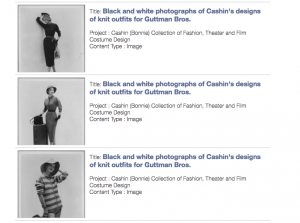
The Bonnie Cashin archival collection is a personal collection of illustrations, concept art, writings, etc about her work in fashion and design throughout her lifetime. It covers her work in fashion, theater, and film costume design, while also including press releases about her collections. There is 440 pieces in the collection, that includes 318 boxes and 4 garment racks, gifted from Bonnie Cashin’s estate in 2003. However, there is also a limited number of examples of her fashion and accessory designs that had been anonymously gifted to UCLA in 2005.

If one were to solely look at this archive, the historical narrative that emerges would be one of her personal development as an artist practicing her craft, beginning from her youth and initial interest in fashion, to the rest of her adult life and career in the industry. A timeline emerges from this vast collection due to the variability the collection has, and it paints the narrative of a young, Fresno native whose dreams of working in the fashion industry eventually became a reality. It also shows a period of time in which she was working almost exclusively in the film industry, providing costume designs for different studios in Hollywood (1943-1949), which occurred after leaving her jobs designing for ballet and theater.

Another part of the archive, aside from her illustrations, photographs, and actual pieces, are the writings. There are personal letters and essays pinned by Cashin, as well as press releases from her/her studio, which gives an idea of how her personal ideology on fashion and the fashion world changed over time. The press releases indicate more about how she presented herself and her collections to the world (similar to the photos of her that are in the archive), while the essays, letters, and personal photos let us see Cashin on a more personal, intimate level, although it is still largely about her professional life and involvement in fashion.

On the other hand, there are things that the archive most notably lacks: pieces on Cashin’s private life, away from her position as a notable designer (especially for Coach). While the archive contains pictures and letters of Cashin from a personal setting (not taken professionally), the majority were still of her in her professional environment, or talking about work. The archived correspondence was mostly about her designs and the general state of the fashion world, but leaves much to be desired when you start wondering about her personal life.

Week 2 Post– Japanese American Internment

The finding aid I looked at was the “Collection of Material about Japanese American Internment, 1929-1956 bulk 1942-1946”. This collection contains material and information about Japanese American relocation, particularly after the Pearl Harbor attack during WWII. There are publications, press releases, articles, speeches, yearbooks and pamphlets, most of which can be accessed at the UCLA Library–Department of Special Collections (I find that amazing!) Many of these publications came from the War Relocation Authority and by Japanese American internees and advocacy groups. Based on the materials in this collection, you can see the narrative of Japanese Americans’ relocation and struggle after the attack, and how intensely the U.S. government sought to ensure that another attack would not happen again. Unfortunately we know these efforts led to discrimination against U.S. citizens who had a Japanese heritage.

From this finding aid, I can see there are three series: War Relocation Authority, Internment Camps, and Miscellaneous. The container list describes how many boxes there are for each series and the context/note for the items in a particular series. Each box has different folders which are organized chronologically over a span of a few months, and additionally gives the scope and content note for each item. There are statistics on the Japanese American internees, such as their marriage and divorce rates, population in a certain location, and age of those relocated. There are pamphlets persuading Japanese Americans to relocate, and even yearbooks of those who were relocated and attended a different school.

There is only one item which mentions the bombing of Pearl Harbor. And although one can assume that a major event had happened to sour the relationship between Japanese people and the U.S., we would be missing the whole story of the war, a list of every country involved, and the details of the Pearl Harbor attack if we based the narrative entirely on the records in this collection. We could remedy this lack of information by including a context near the beginning of the finding aid. They could describe the impact and effect that relocation had on not only Japanese-Americans, but the way in which the U.S. government has made efforts not to let history repeat itself. However the scope and content note for each box and folder is a great start and is a much better description than just “press releases” and “reports”. There is definitely already a lot of information and I think just having a brief introduction in the beginning would tie the finding aid together very well.


Archives: The Glen Keiser Collection

The Glen Keiser Collection of Comic Books, Fantasy Drawings, and Realia, 1940s-1980s consists of comic books, fantasy drawings from various publishers such as Marvel, DC Comics and other independent publishers between a span of 40 years. It also includes books about comics, oversize comics, paperback books, realia, mounted pictures and items labeled as “Other”. Each of these items are listed under these individual subcategories in alphabetical order. The finding aid gives an overview and scope of the collection, specifies the contents of the collection (however, it does not list each item individually) as well as its arrangement, where the location is stored and notes on restrictions on its use and reproduction.

Based on this archive, I would not be able to tell much besides the collector’s interest in comics and related items. Glenn Keiser was drawn to Marvel Comics and DC Comics as this is a majority of his collection. Because of the manner in which it is listed, it is difficult to come up with a narrative or context in which he collected these items. He collected items related to the comic series such as tee shirts, cards, 3-D glasses, Cerebrus medals and mounted pictures which indicate his desire to collect more than the stories but the material culture that is associated with the fan following of these different comics. Unfortunately, these are not specified on its relation to a certain comic or character.

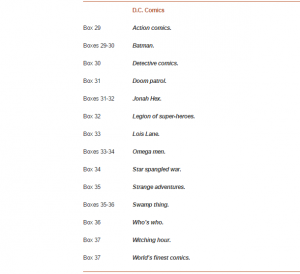
It would be beneficial to have the exact dates and a brief synopsis of each of the comics. This would allow people that are unfamiliar with the titles to analyze and understand the collection: similarities, differences, etc. Also listing these by date would make it easier to understand the collection as a whole much better. Currently, the collection is listed by category or publisher and then alphabetically (see image below). I suppose the number and size of the boxes labeled with each of these comics would indicate the size of the collection and be helpful in finding the exact location of an item you are looking for. This is helpful when looking up a specific title but not so much when coming up with a narrative or context for the contents.

2016-10-09-2


A description of the owner/ collector may give us a better picture on the kind of person that collected these items and the thought process behind it. Images of the covers and items would make it easier for someone to confirm it is the correct item. Images can also give more information on a lot of other factors like the condition of the items and the style of artwork, color, etc. that may indicate something of the time.

Blog 1 Mapping Indigenous LA

Mapping indigenous LA

This project was created to help show reminisce and history of indigenous people like the Tongva and Tataviam in the LA area by the use of images, videos, interactive maps, etc. It uses digital story telling to show the displacement of such indigenous people by government policies.

Sources: This project used a lot of archival material and teaching material from historical documents such as images, videos, maps, etc. It uses these documents to show the waterways, educational timeline, and to create a story map that tells you a brief history of the indigenous people who were displaced in LA area.

Process: The story maps are created by ESRI, which helped to create interactive story maps to illustrate the data in a more visually stimulating and easy to follow manner.

Presentation: The presentation is very fluid and easily navigational. The website provides story maps which provides images and timelines of indigenous people like the Gabrielino/Tongva, pacific islanders, Latin American indigenous diaspora. Each story map includes links, videos, pictures, maps, etc.

screen-shot-2016-10-09-at-11-38-57-pm

Bonnie Cashin Collection

The Bonnie Cashin Collection of Fashion, Theater, and Film Costume Design is an extensive archive of the renowned designer’s work, personal papers, illustrations and more.  This archive, personally collected by Bonnie Cashin herself, documents her long and influential design career.  The photographs, letters, designs and other materials are enough to fill 318 boxes and 4 garment racks.  However, as detailed and inclusive as this Cashin collection truly is, there exists a limit the kinds of stories that it can tell.  As comprehensive as any historical catalog can be, there are always the stories told and those lost in the past.  In “The Narrativization of Real Events”, Hayden White discusses the process of turning real events into remembered narratives, and states that “every narrative, however seemingly “full,” is constructed on the basis of a set of events which might have been included but were left out” (White 14).  This concept can be seen in any collection, but I will be looking at it specifically with the Bonnie Cashin Collection.

screen-shot-2016-10-09-at-11-09-22-pm

Since Bonnie Cashin’s archive includes both a large number and large variety of records, it has the potential to tell many stories.  If based solely on the files in this collection, the historical narratives that could be told would center on Cashin’s design work.  We could see the progression of Cashin’s fashion style changed from when she began designing, around the 1920s, to the later part of her career, around the 1960s.  We could also study the similarities and differences between Cashin’s designs for different purposes.  She produced pieces for chorus girls costumes, film, ready-to-wear, WWII women’s civilian defense uniforms, rainwear, and more.  Each of these designs had to take into account different needs for functionality and glamour-appeal.  Scholars could research her designs for different brands, and consider how they appealed to different consumer audiences.  The archives also provide a glimpse into Cashin’s personal life, since it includes vacation photos, travel journals, personal letters and more.  Although none of these narratives could be a holistic depiction of Cashin’s extensive work and life, they could serve as representations and examples of the whole. 

In contrast, narratives that could not be told singularly through this collection include anything related to the fashion industry overall. Cashin’s personal archive could not tell her lasting influence on the industry, or specifically, how her original design for the Coach handbag may have influenced its later and current designs.  This could be remedied if designs from contemporary society were compared, and analyzed to find similarities.  Also, it may not be able to accurately depict the popular fashion style during her time.  Although it likely could give a general idea, we would not be able to conclude that Cashin’s designs reflected all of the time’s trends.  This could be changed if other high-end design archives from the mid 1900s were used to recognize the most popular styles.  It is true, historical documents- no matter how “full”- are crucial to remembering the past, but we must understand that they can not and do not represent all stories.

Sleepy Lagoon Defense Committee – Weekly Blog 2

The Sleepy Lagoon Defense Committee Records 1942-1945 focus on media and PR materials created and/or gathered by the group of the same name in their efforts to rouse and sway public opinion in the indictment of 22 young Hispanic men on trial for murder. After 12 of the defendants were convicted 1st degree murder in 1942, the committee’s efforts garnered celebrity attention and backing and was successful in changing public opinion – which eventually led to the reversal of the murder convictions in 1944. It is a collection of 11 boxes of archived material, available through the UCLA Library Special Collections with advance notice. The archival collection ranges from biographies, press releases, petitions and correspondence all the way up to a copy of the transcript of the appeals trial.
The Sleepy Lagoon Murder of Jose Diaz predates the Zoot Suit Riots in Los Angeles but the crime and the subsequent trials and media campaigns figure into the political and cultural climate in which the riots occurred, and are often mentioned in histories as a direct precursor to those events. This collection’s extensive documentation of institutional and cultural prejudice against the Latino population of Los Angeles could prove useful to scholars seeking to understand the cultural context of the Zoot Suit Riots and the changing face of Los Angeles during World War 2. However, more interesting would be using the records to delve into the relationship between celebrity, Hollywood and social activism.
The story told by these records details the waging of an aggressive public relations campaign by the committee on behalf of the defendants, enlisting the aid of Hollywood influencers whose efforts are documented therein. The first item in Box 1 of the collection is a letter from Orson Welles written directly to the parole board overseeing the cases of the defendants. The letter articulates his concerns regarding the role of prejudice against the Mexican-American community may have led to an unjust conviction, and pleads for their release. The breadth of the records cover a flurry of media activity over a three-year period that demonstrate public relations and social activism best practices. A media scholar looking for a deeper understanding of public relations practices before the advent of television would find this material rich and rewarding. Being able to place the media campaign in a specific space and place would make cross-referencing other local collections that tackle Mexican-American history in Los Angeles possible. However, one might not necessarily be able to access the contextual information needed to understand the leveraging of relationships and professional networks in place that made the waging of the campaign possible. To remedy that shortcoming, it would be helpful to locate a separate archive detailing the professional lives and connections of press members also working in Los Angeles during the early to mid-1940’s.

Blog Post 2

I chose to look at Walt Disney Productions Ephemera. This collection includes the different printed materials and photographs related to Walt Disney Productions films. The collection includes paraphernalia associated  with 150 distinct films and is organized in alphabetical order based off of film title. The materials included in the collection are press books, press kits, publicity stills, lobby cards, and publicity biographies.

The container list provided gives very little information about the digitized items. Other than the box number, folder number, title of piece, and date, nothing else of value is provided. Additionally, since the titles are listed in alphabetical order, it is very difficult to piece together information about time period and any relevant trends regarding dates.

There are, however, a few narratives that can be gleaned from the collection list. Since the list is ordered alphabetically by film title, all the ephemera surrounding a given film is grouped together. This makes it easy to see which films were publicized heavily and which films were not as heavily or prominently publicized. Of course, these conclusions could be heavily biased given that the selection of digitized items available may not be a random sample. Another thing which can be understood from this finding aid, after a little organization of the data, is what publishing techniques were used during what years. If one were to sort the listings based on date, one could also examine the tendencies of film subjects across the time period.

If my narrative was to be entirely based off of the container list, there would be several aspects left out of it. First of all, the list provides no context on why a particular film title was used or what the methodology in choosing advertising material was . There is no data about the public reception of movies and the effectiveness of the different printed materials. It would also be helpful to know what kind of marketing techniques were used in which geographical regions and what demographics the techniques had as their target audiences.  The fact that the even a few sample materials cannot be viewed online further frustrates researchers who are trying to get an understanding of this collection for their narrative.

There are several ways of remedying this missing information. One thing that can immediately be done is that there can be a option added that would allow people to view the listings sorted by date. Additionally, a small description can be added to each listing to provide some context. Outside of the collection itself, researches can look at other sources of information on Walt Disney Productions. This could be done by taking interviews of people who were involved with the films and by looking through other documented transcripts. Additionally, there may be records of film attendance in theaters, which would provide some insight into public reception of different films.

Overall, Walt Disney Productions is a very interesting topic and is something that played a part in so many kids’ childhoods. This collection list provides some details to create a narrative. But by supplementing this collection with other records, a really powerful and meaningful revelation could result.

Week 2 Blog Post: George Meyer Simpsons Script Files

The collection presented on writer and producer George Meyer consists of script files for his long-running animated television show, The Simpsons. The script files consist of story notes, outlines, and/or various drafts for seasons two to six of the show dated from 1990 to 2004, as written or co-authored by Meyer.

The container list begins with Censor Notes which provides context and narrative into some of the free speech restrictions and limitations Meyer and his fellow writers had to work around. However, the notes are based from 1989-1996, and many policy and legal changes have occurred since the time, especially due to the dot-com bubble and Internet revolution. To create an effective narrative, these notes would need to be cross analyzed with the scripts both before and after this time frame to discuss any significant changes in content due to censorship.

Next, the Character Design Guide provides animation design guidelines including drawings of characters, situations, objects and logos, along with copyright information. Based on this, one can write an interesting narrative on the number and variety of styles and tools used in creating the animations per category along with whether others can copy the same techniques. However, one cannot conjecture any sort of background as to how these designs were chosen, such as the meaning behind the unique yellow caricatures and who all were involved in this creation (Was Meyer’s?).

The third additional file is the Episode Guide and Storylines reference for seasons 1-9 which includes a general character fact sheet and synopses of each episode along with a character cast list. Since the rest of the script files are focused around Meyer’s time from seasons 2 to 6, this reference guide is particularly important in creating a narrative of how Meyer’s focus for the show was similar or different than the rest. One can point out the general plotline and themes discussed and specific characters introduced or eliminated during seasons 2 to 6, then comparing these to the other seasons not written by Meyer. It’d be interesting to note the transition and change in the plot story throughout the years as different producers and writers are involved. However, in doing so, one will have to look to outside sources to Meyer’s background to understand motivations and inspirations behind Meyer’s plot and character choices as compared to the others.

Lastly, the rest and the bulk of the collection includes the script files, including story notes, outlines, and/or various drafts of scripts for seasons two through six, written or co-authored by Meyer. These files are crucial in creating a narrative highlighting the collaborative and working process of writing a tv show from its first draft to final draft. Story notes and outlines allow a narrator to delve into the authors’ thought process as well as help identify which ideas in particular were by Meyer as opposed to the other collaborators. Additionally, a narrator can mark any significant contributions, tones and themes presented overall throughout the scripts. However, the notes I assume are brief and insufficient evidence to create a full narrative on the motivations and influences behind the plotlines- crucial aspects to consider when evaluating Meyer’s career with the show.

Overall, the collection provided would shape an interesting narrative on the collaborative process of editing and revising along with the details and tools needed in piecing together to create the animations, or presentation. However, the collection provides few solid evidence to build any narrative based on the reasoning or meaning behind the storyline and characters. I found it interesting to note that the script files were organized by alphabetical order as opposed to chronologically by episode. By doing so, I believe the archivists makes the narrator focus more on the contribution of each individual script and overall commonalities in the process rather than allowing for comparisons and connections to be made in the storyline and structure across seasons.