Week 8: Final Fantasy III

screen-shot-2016-11-13-at-4-32-12-pm

*note: the narrator’s gender is note ever mentioned or alluded to, which is why I will use “they” as the pronoun.

I chose to created my network based on the short story by Tao Lin, named Final Fantasy III. This was featured in Granta 127, on Japanese Fiction, which was released in April 2014. A stream of conscious short story, the narrator mentions people and conversations, but has very little direct conversations with characters outside of the narrator’s father and mother. Thus, I decided to base the network diagram on interactions of those mentioned in the story. I eliminated figures like Confucius and Ashton Kutcher, since A) Confucius is dead and B) Ashton Kutcher was just mentioned since the narrator and the mother were watching the Steve Jobs movie. Since the network diagram is directed, you can see the arrows that signify if a character had a one way connection to the other character, or if it was reciprocated.

For the purposes of this narrative and diagram, even though the narrator and his brother/brother’s wife definitely have a reciprocated relationship, since they never had any direct conversation or interaction, it’s considered “one-way”. This acts as a limitation, since it’s obvious the characters have a close connection — why else would the brother entrust his son’s care with the narrator if they had a bad relationship? But when creating the network diagram based on the rules previously decided upon, such relationships can be hidden from the network.

Within this network, since it is mostly about how the narrator has writer’s block and how they try to get around it by talking to various figures, while simultaneously describing what is going on around them. As a result, this network is small but very interconnected, since most of the characters mentioned have first degree connections to the narrator. Some mentioned, such as the homi-/suicidal singer who killed his bandmates, and the two girls talking at the cafe, were just observed by the narrator/their parents, so they exist separately from the main network cluster that the narrator and the other characters exist in. The main cluster only has one second degree connection, the “Her Boyfriend” character, who is the boyfriend of the “Girl I email” aka “girl the narrator sort of has a crush on but it’s ambiguous because she’s in England and taken”. Also, within the first degree connections, the network is even more closed off since it is primarily a network of the narrator’s family, sans the three characters: Yae Sushi’s manager, the “Girl I email” and the friend from the UK.

View my network graph here.
Week 7: The Digital Gazetteer

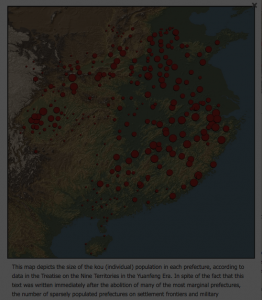
The map I chose to analyze this week was the Digital Gazetteer of the Song Dynasty. The maps on this website are static screenshots of the team’s research, created in Inkscape and Gimp. It documents Sinologist Hope Wright’s 1958 work that details the geographical names in Song Dynasty China. Wright’s work is also derived from another three works: “the Song History (宋史Song shi) Geography Monograph, the 980 Records of the Universal Realm in the Taiping Era (太平寰宇紀Taiping huanyu ji), and the 1085 Treatise on the Nine Territories in the Yuanfeng Reign (元豐九域志Yuanfeng jiuyu zhi).” (Taken directly from the website)

screen-shot-2016-11-07-at-12-59-35-am

(The pictures wouldn’t load properly on my browser, they came out with this weird dark grey overlay that obscured a lot of the image and its details, and I couldn’t scroll down to read the rest of the description either.)

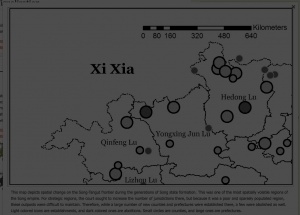
Just by looking at the map I inserted above, you see how the researchers have assumed a few things about us as viewers. Firstly, they assume we know what exactly those red dots mean and why they’re sized the way they are, as there is no legend (as there are in their other maps). While it does show how the population was distributed around the Song Dynasty, it is also confusing because unless you are familiar with that particular dynasty, the border of the country is not actually depicted.  Even when they do have “county/country lines”, such as below, they are not often put in context.

screen-shot-2016-11-07-at-1-01-04-am

Due to the nature of their research, they may be making these assumptions because it is geared toward a niche population of people studying the Song Dynasty in detail. Considering that Wright is a Sinologist, and that Ruth Mostern, the head of this digital project, specializes in Chinese history, that assumption may not be too far off.

Since the data is taken directly from Wright’s work, one can say that these maps reflect the culmination of Wright’s own research, transcribed, translated, and understood twice: initially by Wright during her analysis of the three source books, and by Mostern, who takes Wright’s book to create this project. They look at published and preserved works that reflect what was seen and recorded as a city/county/province/street etc, and so it may obscure what was deemed unimportant by government officials during the Song Dynasty. As there is no time traveling machine that would allow either one of them to go back to the Song Dynasty, they (and subsequently us) can only put their faith in these three source documents.

It would be interesting to see an interactive map, similar to the first image in style, where you could hover over the dots and see the information about the township/particular population of the region. As this also goes into the abolition of townships, it would also be cool to see why these townships were abolished.

Week 5 Blog Post: Marvel

screen-shot-2016-10-28-at-12-25-11-pm

If you can’t see the visualization, here is the link

My visualization today is a network graph that shows the alignment of characters in the Marvel Universe. The Marvel data I used to make this visualization categorizes characters into four categories: Good Characters, Bad Characters, Neutral Characters, and [No Alignment] (aka the box was left blank). It is a simple network visualization, as the nodes cluster around only four different labels, with no connections between the clusters (therefore, it is not a bipartite network). For the purpose of this analysis, I’m going to be ignoring the [No Alignment] cluster, since my group still needs to find out why there was no alignment assigned to them.

From this data set, it is easy to see that Marvel definitively divides characters into Good/Bad/Neutral, with no overlap occurring. The same can be said for the partner DC data we were given, and is not a surprise considering that is what is most easily marketed to a vast array of audiences. Since they are all isolated into singular clusters, with no edges connecting to more than one vertice, it is very clear that the characters are presented by Marvel as only having one possible attribute. However, this leaves out a lot to the viewers, especially those who are not die-hard fans of the company.  We are given no reasons why particular characters have the alignments they do, and whether or not those alignments have been consistent. Some questions that had come up when looking at this data visualization were “Are their alignments static? When were these recorded?”, as there is no way to tell until we look further into this dataset and the history behind it.

To put it a little in perspective, when running the DC Comics data (formatted exactly the same as the Marvel data), you see a node pop up that says “Reformed Criminals”. I’ve inserted a screenshot below:

screen-shot-2016-10-23-at-9-20-14-pm

Therefore, one questions whether or not Marvel has those types of characters present in their universe at all, or if their characters, once typecast, are then forever labelled and characterized as good, evil, or neutral.

The reason why I chose to use a network diagram for my visualization is to show that these edges are clustered into isolated nodes, and that even Bad Characters, who made the transition into Good Characters, get isolated under the term of “Reformed Criminals”. Maybe, for the sake of having cleaner, more understandable data, they have been put into these binary-type labels, as a spectrum of labels would make it more difficult to draw meaningful conclusions from. Having a spectrum of labels, although it makes the narrative of the individual clearer, does tend to obscure the overall narrative of the collective data.

Blog 3: Top Earners

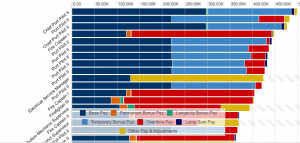
This week, I looked at data about the Top City Earners from the LA City Controller’s website. This data, as the name implies, looks at who the top earners in Los Angeles are (using data since 2013), plus a break down of their salaries. Its data types are the types of pay (Base pay, Overtime, etc), Pay (in the hundreds of thousands), and occupation, ordered highest paid to lowest paid. One record is the salary of a particular occupation. The record is then broken up into smaller parts in order to more accurately see how the salary gets to the number it is (ie how much is earned from overtime? Bonuses? Base pay?)

When looking at Wallack and Srinivasan’s definition of an ontology, which is primarily “systems of categories and their interrelations” that groups use to establish order and manage information about the things around them. This dataset’s ontology looks at how different types of pay (Bonus, base, overtime etc) can affect the overall total salary a particular occupancy gets. For instance, the base salary of a Fire Captain I is only around $120K, but their total salary ends up just shy of $450K because they were paid around $311K in Overtime, unlike the Chief Port Pilot II whose base salary is $211K, but worked no overtime.

screen-shot-2016-10-16-at-10-01-46-pm

When looking at this dataset, people who would find this ontology the most illuminating/useful would be someone who works with the city’s budget, and would want to know how the funds allocated to pay were being distributed. There are trends that emerge when you look at the top 10 highest paid positions – they work less overtime on average (the Fire Captain I position aside), and seem to make a lot of “temporary bonus pay” (the light blue). Thus, the people in charge of the budget would find the division of types of pay useful for seeing how they affect one another, and if adjustments need to be made.

This data tells us that port pilots seem to make a lot of money (they make up the majority of the top 15 earners), and that while the base pay may not be /extremely/ high, other things such as overtime and bonuses almost double their total salary. However, this only tells us that this phenomena occurs, but gives no indication as to why it is so. Going back to the previous week’s topic of narrative, this collection has no distinct narrative that can be formed from looking at the data.

If I were to start over with the data collection, I would take into account how many years of experience each position requires, as well as how long each person at that particular post has held the position. It would contribute to the ontology by giving reference to how longevity of their time in their particular field can contribute to the type of income they receive.

Week 2: Bonnie Cashin

The Bonnie Cashin archival collection is a personal collection of illustrations, concept art, writings, etc about her work in fashion and design throughout her lifetime. It covers her work in fashion, theater, and film costume design, while also including press releases about her collections. There is 440 pieces in the collection, that includes 318 boxes and 4 garment racks, gifted from Bonnie Cashin’s estate in 2003. However, there is also a limited number of examples of her fashion and accessory designs that had been anonymously gifted to UCLA in 2005.

If one were to solely look at this archive, the historical narrative that emerges would be one of her personal development as an artist practicing her craft, beginning from her youth and initial interest in fashion, to the rest of her adult life and career in the industry. A timeline emerges from this vast collection due to the variability the collection has, and it paints the narrative of a young, Fresno native whose dreams of working in the fashion industry eventually became a reality. It also shows a period of time in which she was working almost exclusively in the film industry, providing costume designs for different studios in Hollywood (1943-1949), which occurred after leaving her jobs designing for ballet and theater.

Another part of the archive, aside from her illustrations, photographs, and actual pieces, are the writings. There are personal letters and essays pinned by Cashin, as well as press releases from her/her studio, which gives an idea of how her personal ideology on fashion and the fashion world changed over time. The press releases indicate more about how she presented herself and her collections to the world (similar to the photos of her that are in the archive), while the essays, letters, and personal photos let us see Cashin on a more personal, intimate level, although it is still largely about her professional life and involvement in fashion.

On the other hand, there are things that the archive most notably lacks: pieces on Cashin’s private life, away from her position as a notable designer (especially for Coach). While the archive contains pictures and letters of Cashin from a personal setting (not taken professionally), the majority were still of her in her professional environment, or talking about work. The archived correspondence was mostly about her designs and the general state of the fashion world, but leaves much to be desired when you start wondering about her personal life.

Week 1: Photogrammar

The project I’m covering is Photogrammar, a database of photography projects sponsored by the federal government from 1935-1944, which was collected by the Farm Security Administration – Office of War Information (FSA-OWI).

screen-shot-2016-10-02-at-11-09-44-pm

Even with over 170,000 photos in the collection, only about 88,000 were placed into the FSA-OWI’s cabinets, organized using Paul Vanderbilt’s Lot Number system and Classification Tags system. (This is what is used to search throughout the Photogrammar website).

The photos themselves were taken throughout the decade-long time period, which also happened to be when World War II was being fought (although the United States would not enter the war until after the attack on Pearl Harbor in 1941). They were taken by various photographers, 15 of which are shown on the Photogrammar website. The team behind Photogrammar took the negatives of these photos and scanned them, digitizing them to be added to their digital archive and shown to the world via computer screen.

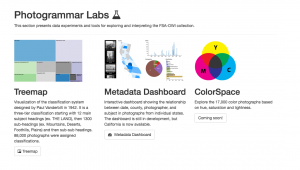
The Photogrammar team decided the best way to create meaningful visualizations for this set of data would be to make their main map a density map by county (shown above) and by photographer. By doing so, they were able to succinctly show where the Federal government was sending its contracted photographers, although the reasons why can only be speculated. However, what is more interesting are their visualizations that can be seen under the “Lab” tab on the top right hand corner of their website. Under the Lab, there are three different types of interactive visualizations that are dissimilar to the two main maps and can allow for further analysis of the images, from how Vanderbilt decided to classify the images as, to the metadata dashboard where the relationship between the photographer, the date, and the subject can be further analyzed.

screen-shot-2016-10-03-at-1-20-38-am

*Also, funnily enough, my hometown is featured on the Photogrammar website here. In one of the pictures, I recognize some buildings that are still around in the Historic Downtown.

screen-shot-2016-10-03-at-1-21-42-am