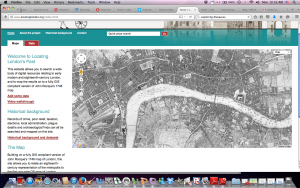
The home page of Locating London’s Past features a map that gives us a few optional views of that city: London in 1746, 1869-80, or a satellite version. This is an interesting way to show broad changes in the same geographical location over different periods of time. Though navigating the site will probably be a lot easier for someone who is already familiar with the topic and knows exactly what information they are looking for, the designers do offer ‘how to navigate’ the site videos for non-experts like me, but, unfortunately, the audio wasn’t working on these videos when attempted to use them.
The site’s narrative tells us that its intention is to allow us to “search a wide body of digital resources relating to early modern and eighteenth-century London, and to map the results on to a fully GIS compliant version of John Rocque’s 1746 map.” The designers of the website disclosed that Rocque’s map are biased to his view of London at the time and features details of religious institutions more readily than it offers complete information on industrial buildings, for example. Though the designers used different sources to balance this bias, the information presented on the maps would inevitably skew towards Rocque and his contemporaries’ views on what was information worth including, at the time. So this bias is something the map reveals.
There are different datasets one can choose to have featured on a map. They are:
-The Centre for Metropolitan History Datasets
-London Lives, 1690-1800: Crime, Poverty and Social Policy in the Metropolis
-MOLA Archaeological Data
-Old Bailey Proceedings
-Estimating London’s Population
What the maps obscure is the relevancy to the modern layperson who is curious about London’s history. To make it the site more user-friendly, I would start with a map of modern London with clearly marked historical sites as way to introduce the subject. I would add more view options throughout the centuries marking key historical events at those same sites. Then, after the user is comfortably situated, I offer the ‘how to use the data to navigate the site’ videos. I would offer key word options. The current design somehow assumes you’ll know what key words to type in. And, for those that don’t, it offers a pop up with an explanation. For somehow who is simply curious, the site is expecting me to do too much work. This website seems academically focused in its design, even though the information could be engaging to a wider audience.