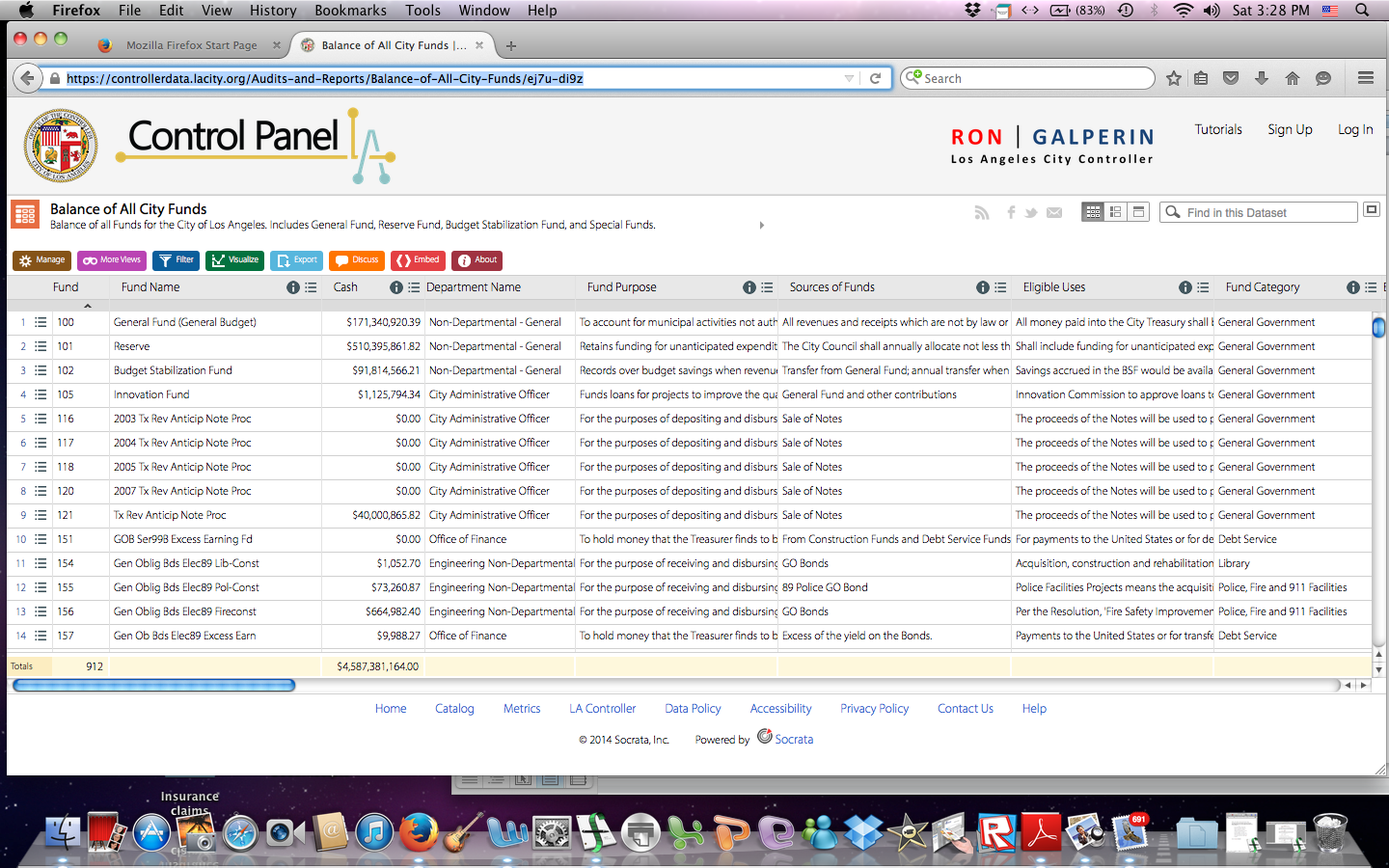
The Special Funds Report link takes us to a dataset for the balance of all the funds for the City of Los Angeles. This includes the General Fund, Reserve Fund, Budget Stabilization Fund, and Special Funds. Here, the Special Fund is titled the “Innovation Fund” in the Fund Name content type and it represents the smallest cash amount of all the funds. The definition under the Funds Purpose label, tells us that these funds are used as loans for special projects. (Though the “accounts for gifts” section of the definition is confusing).
There are 912 records or rows of information in this dataset. Each record is made up of 36 content types (or labels) including:
- Fund Name
- Cash
- Department Name
- Fund Purpose
- Sources of Funds
- Eligible Users
- Fund Category
- Ending Fund Balance
- Assets
- Liabilities
- Grant Receivable/Other Assets
- Current Collected Revenue
- Cash Disbursement
- Outstanding Commitment
- Date Fund Established
- Fund Group Name
- Fund Type Name
- Council File Link
Using Wallack’s and Srinivasan’s definition, the ontology or the logic that underlies how the information in this particular dataset is framed, points towards our local government’s desire for financial transparency. But, it also points to a gap between the government’s understanding of transparency and how the community might define it. First, the information is only available in English. Second, it is not layman friendly. These two issues alone might leave large segments of the local population in the dark, which points to either a disconnect between the government and the real needs of its community or to the fact that the community at large isn’t the dataset’s target audience.
If the community isn’t the target audience, then who is? Who will find this data most useful and illuminating? I would answer: The City government itself (for clarity in their record keeping), lawyers (to assure legal and fiscal accountability), and anyone up the hierarchy to whom the City managers may be accountable to. The sheer number of content types is overwhelming for a normal resident who, like me, may expect to click on the Special Funds link in order to get a clear picture of what the Special Funds are, how much money is allocated to a particular project, which community stands to benefit, and past & future allocations of these Special Funds. Because this table doesn’t answer direct questions like these in a simple to understand manner, it doesn’t feel like the everyday citizen is whom they are trying to reach. And, if they are, then there is a gap between the state and local ontologies that ought to be addressed.
If I were starting over with data-collection from the community’s point of view, I would ask the community how they would define “Special Fund,” what information they would find useful, and discuss ways to present the data (design the website) in a manner that is community-friendly. I would gather information on language choices and how to involve individuals with disabilities or lack of access.