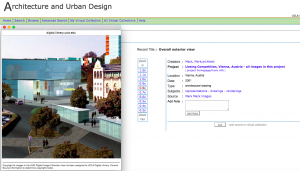
The digital collection I selected is the UCLA Architecture and Urban Design repository. This repository houses various projects, that consist of images of buildings and other architectural structures. The website can be searched by keyword, architect, subject, title, or location. Furthermore, the site can be browsed either by architect’s name or by subject/type of structure. In this Browse section, architects’ names are listed alphabetically by last name. The subjects are also organized alphabetically, and they are categorized into compounds of two to four parts. For example, a subject can be “architectural drawings – landscapes,” or “architectural drawings – ornaments,” or “built works – infrastructure – transportation structures.” Both the “Search” and the “Browse” functions allow to aggregate the results either by project or by individual image (result titles are also organized alphabetically). “Project” in this repository basically seems to mean a mini-collection of images that belong to the same author and are about the same subject (This is my own understanding of it, since the site didn’t have an “About” page).
When you aggregate results by project, and then click on “Display”, and it will show you all of the images that are in that project. Next, when you click on a specific image, on the left you will have the option of zooming in to view, and on the right there will be details about that particular image, including name of architect, title of project, location of the building, date, building type, subject(s), and additional notes (all of these are also hyperlinked, which makes it easier and faster if you’re looking for similar works). All of this information on the right is descriptive metadata since it gives us more information about that one particular piece of data – the image.
The repository seems to be quite easy to operate and allows to link to relevant material with minimal effort. Based on the information and the search tools available in this repository, I could explore and write about the types of buildings that were built by a particular architect if I browse by his/her name. I could gain insight into how a particular architect operates, what types of projects he/she has been working on throughout his/her career, and see if perhaps the artist has been actively involved internationally, if he/she has designed buildings in multiple countries. Likewise, by using the Advanced Search option, I could also explore and write about, some aspect of a building’s architecture, for example, I could look at various interior designs of buildings by typing “interior” into the keyword search. There are, however, interesting stories I would like to tell about, but will not be able to, or it would take me too much work because of the way that the images are stored on the website.
What’s missing is some key information about the buildings themselves – What were they built for? Who used them? Were they ever abandoned? What function did they serve? Who sponsored the project? Let’s say I want to tell about department stores’ construction in 1950s. Based on the information provided, I could find out the various architects involved and look at various countries, and perhaps find structures with similar features. However, I would not know anything about the buildings themselves, aside from the title, which oftentimes reveals very little. I would not know which corporation the construction was initiated by, how much it cost, and how long it took to complete, for example, if I were interested in the allocation of resources for these buildings.
The way to remedy this omission is by either including an additional piece of metadata with more detailed descriptions and notes, or, perhaps to partner with another repository thats specializes in the historical context of architectural buildings, and which would also contain other types of documents regarding the construction of these buildings.
Overall, the UCLA Architecture and Urban Design repository is quite well organized and structured. It seems that it was made simply for examining images of architectural buildings, and for being able to search for those and similar images quickly and conveniently. The additional materials and information that I suggested the site should have would be “extra”, in case they wanted to appeal to more expert audience of scholars interested in the buildings, and/or, perhaps, real estate agents exploring the history and designs of these architectural structures.