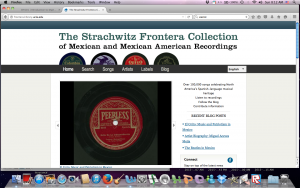
If I were writing a paper on this website, I could tell you that it is a collection of over 100,000 Mexican and Mexican American recordings; a joint project by the UCLA Chicano Research Center, the Arhoolie Foundation, and the UCLA Digital Library. I could also give details on who owns, runs, and funds the collection, what the data sets are, the source material, how it’s presented, what artists are included, how to navigate the site, and who has what kind of access to the information. I could also write about its blog and the stories contained therein. Including the guest blog from the owner of the Frontera Collection titled: Chris Strachwitz’s 50 Favorite Frontera Recordings.
What is missing from the site is a narrative that bridges the archive to the Mexican and Mexican American communities from which it originated. It is not clear how this collection is important to the community or if they are even aware that this collection exists. It feels as if the project’s primary audiences are scholars, collectors, and academics. But, given the lack of comments, it’s difficult to assess what level of interest it has actually generated within those groups. It seems as if the audience who would be most excited about this collection hasn’t been considered in the development of this website.
As a Mexican native who grew up listening to some of this music, I was immediately curious about the collection, but turned off once I began to navigate it. The approach to the presentation of this collection feels sterile and extremely removed from my real experience of what these artists and their music represent within my community. The Frontera Collection has left the community out of the conversation. Even their level of access to the information is minimized. The Copyright and Access page tells us that due to “copyright restrictions the digital collection is only fully accessible from computers on the UCLA campus.” This restricted access keeps the Mexican and Mexican American communities from participating in their own narrative. And, keeps every other community from learning about our cultural contribution to this art form.
I would remedy the issue by taking a cue from Michelle Caswell’s paper Seeing Yourself in History: Community Archives and the Fight Against Symbolic Annihilation and SAADA’s approach to community inclusion. Following their example, I would develop an outreach program to generate community participation. I’d open up the site for the community to share their stories, like SAADA plans to do. And, I’d research examples of projects that have been successful at bridging scholarly archiving with community participation. I’d include a bridging narrative to the home page and answer questions like: What was the environment that gave rise to these artists’ work? What is their historical significance? How is it relevant?
Unfortunately, from what I found, it doesn’t seem like interacting with the community was the project participants’ main objective.