Do you ever marvel in awe at the seemingly infinite amount of intellect that spawned during the Enlightenment period? Do you ever wonder if they had access to information that is not immediately accessible to them like we do today? Well, upon a comprehensive analysis of the letters of prominent intellects during the period, like Locke and Voltaire, the astonishing network of the transmission of information is made visibly apparent. This network has been digitized and is visually represented by a website called “The Republic of Letters”, which is a digital humanities project undertaken by Stanford professors and students. The project can be found here: http://republicofletters.stanford.edu/index.html and appears as follows:
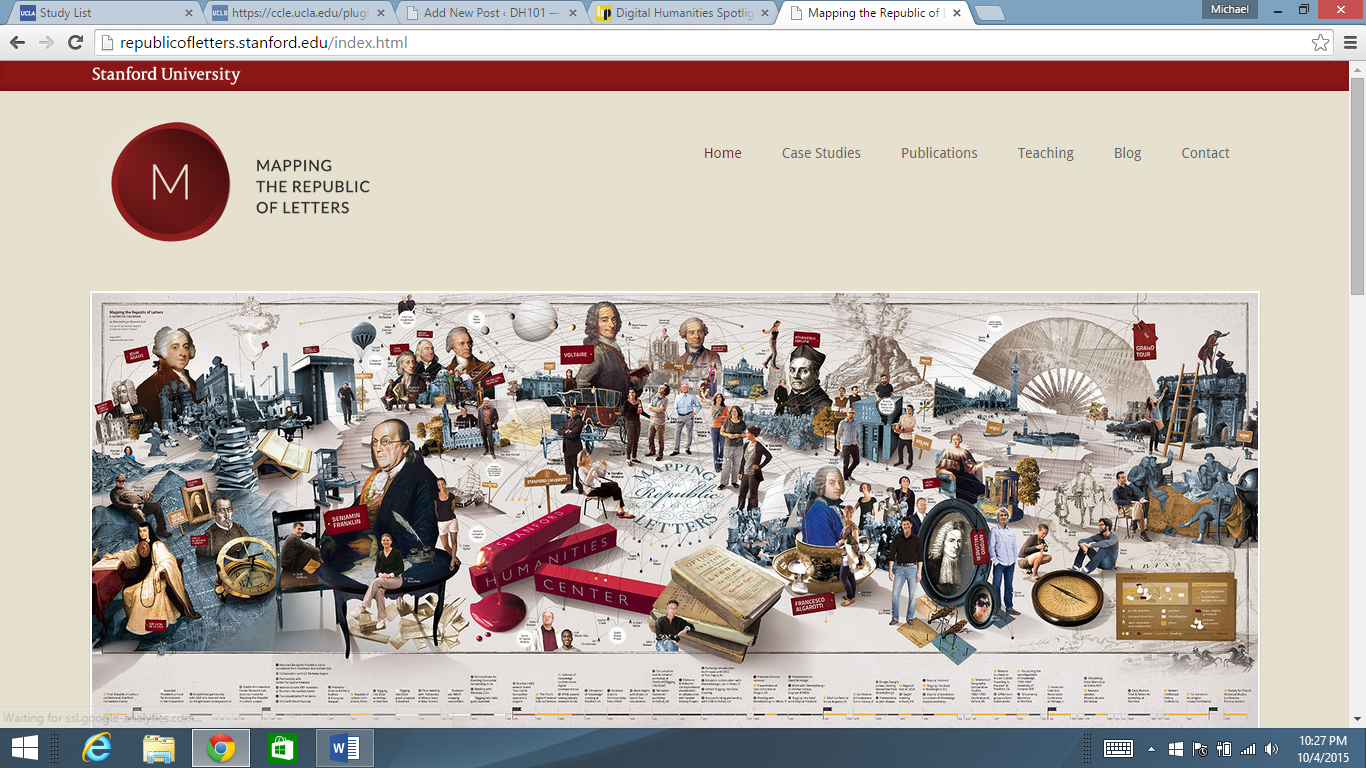
Upon further investigation, one can discover the underlying elements that have made this seemingly impossible operation a daunting, though feasible task. We begin with the base of the project, called the source. Where did this project gather its information? Well, according to the introduction video conveniently placed on the home of the website, the entire database comes from “The Electronic Enlightenment Database”, which is an archive of over 50,000 letters from the period as well as their correspondents.
The next level that must be examined is called “processing.” This is the level in which data is organized in a particular way. The way Stanford has elected to process its data in this instance is by matching the authors of the intellectual’s letters with the people who received the letters. The people who received the letters names are made clear, but even more interesting is how the location of each letter becomes pronounced, both from where the letter was written and to where it was sent. Also, the times of each letter have been recorded.
The final level of interpretation is the presentation, or how the creators of the site chose to represent their data. There different levels in which the data is represented. First, you can click on an induvial name and the site will give you a brief biography of the person as well as a quick look into who the person was in correspondence with as well as where and when the letters were sent. But after the biography, you can click on the “correspondence” button which actually displays a map of where letters were sent and from where they were received by an intellectual. This allows someone to get a really good feel for the nationality of people the intellectuals were contacting. One can also contrast the network of letters from one individual to another! This allows the user to, as a creator of the project put it, “see things that we didn’t see before.” The user can also click on the network button, which shows in a Venn diagram of the kind of people that the intellectual would interact with (say a scholar or an aristocrat.)
This presentation of such a large amount of data is brilliantly done, as it is extremely user friendly and provides an easy way to juxtapose one intellectual from another. One can garner major insight into the lives of these intellectuals that was not readily available by noticing patterns in their correspondences. This would be a lengthy and daunting task if not for this digital humanities project.
-Michael Mathis