Overview: For this assignment, I decided to further examine the “Virtual Paul’s Cross Project”. Created by NCSU (North Carolina State University) graduate students and professors, this site serves as a digital re-creation for John Donne’s Gunpowder Day sermon that occured on November 5, 1622 in Paul’s Churchyard, London. Not only does this website create a interactive visual model of Paul’s Churchyard during that time, it also allows users to explore the acoustics, the sermon text, and the speaker that would have been present on that day. I thought this project provided detailed information to the user as well as interactive models that captured the user’s attention. However, there were still some organizational areas I thought the site could improve on — showing just how difficult it is to compact such a large amount of information onto a layered digital platform.
Sources: The creators of the website actually worked with very little evidence, because Old St. Paul’s church burned down. So they used archaeological surveys, engravings, paintings, and text to create an accurate portrayal of what the church would have looked like in that era (can find info under overview > installation). Also they used manuscripts, published works, and secondary sources to help create a conceptual framework for this sermon. (can find under support > works cited). For the actual sermon, they compiled photos of the actual speech during that day into one larger sermon that they then presented in their simulation (can find under sermon > developing the script & sermon > the script).
Processes: A team worked these layered processes to create this digital platform. After the collection of all the information, the team first carefully created the visual platform of the church — specifically choosing materials and textures they thought would have been seen during the early 17th century. Then for the acoustic re-creation, sound engineers were employed to create a highly accurate representation of what the sermon would have sounded like from different sections of the audience. They used geometry during this process too to determine how sound would be refracted. They also attempted to reconstruct what the setting would have been like then as well — including the weather and social aspects.
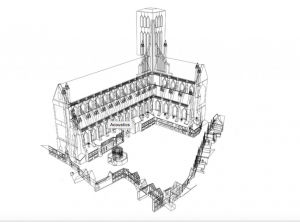
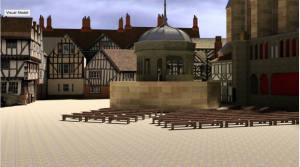
Presentation: The presentation was successful for this project, as they layered the visual and audio models on top of one another. The user could interact with the virtual 3D modeling, showing how various positions in the church would have sounded/appeared as well. Also, the information and background was also presented in a user-friendly way. The use of youtube videos with the website creators made it easier for the user to understand how this model was created. I also liked the option to “Fly Around the Visual Model”. Overall, the information presented on the website was compiled well.
Even though there were a lot of positives, I also noticed some organizational setbacks. For the tabs at the top of the website, I wish that they were labeled more specifically. Also I wish that the tabs themselves were not separate links for pages — it confused me at time/made it difficult to navigate through the website.
Overall, I think they successfully accomplished their goal to create a multidimensional experience of what it would be like to experience a sermon in Saint Paul’s Church during the 17th century.