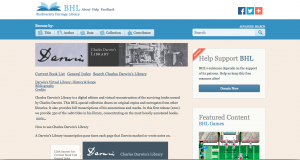
Charles Darwin’s Library is a digital humanities project created by the Biodiversity Heritage Library. Some of Charles Darwin’s surviving books from his own library have been virtually reconstructed and formatted into a digital edition. The creators of the project focused on not only digitizing the books, periodicals, and pamphlets, but also transcribing the notes that Darwin wrote in the margins of these books in order to “retrace and reduplicate Darwin’s reading of a wealth of materials”. This digital collection has 541 volumes from 436 titles.
Sources:
The project began with original copies and surrogates of Charles Darwin’s personal collection of books from his own library that are now found in other libraries. In 1908, Charles Darwin’s son Francis gave away a part of his father’s library to Cambridge University, and so the Cambridge Library has provided the scans of 120 original books from Darwin’s library with all the handwritten annotations to this project. Some of the books from Darwin’s library have separated and were moved to different library collections. Some were available at The Natural History Museum, and they have also provided with scanned surrogate imprints from their collections.
Processes:
The scans and copies of the books were digitally recreated, organized, and studied. Darwin wrote notes on his books, and BHL has typed up the annotations, making note of where he marked on the book and what he marked. BHL created a full transcription of all his annotations and markings.
Presentation:
The project is presented as an extensive online archive of books from Darwin’s personal library with a transcription pane for each page, detailing page numbers, line numbers, and the content of the annotations. It also provides index of subjects and concepts for those who are interested in specific topics from his library. There are also links to photographs of slip notes related to a specific marking in the book for further study. There’s a link to the Current Book List that lists all of Darwin’s books that have been digitally reconstructed and are available at BHL site, or you can click on the General Index to see the list of terms that have been used to classify Darwin’s annotations. By clicking on the term, you are linked to materials in the collection that are related to the term. Darwin’s books are also made searchable if you know what you are looking for. There’s not a lot of interactivity, except for the fact that you can navigate pages, zoom in and out, and click on links for more information about a marking or a scientific name. Charles Darwin’s Library seems to be more geared towards Charles Darwin fans and researchers who need easily accessible collection of his books for their studies.