Blog

Concerns About Open Cultural Data

The open cultural data movement has many positive and negative aspects. With available open cultural data, there is a plethora of educational benefits and research opportunities. However, open cultural data also presents a number of questions and concerns.

For instance, what happens when collections that include items that were never meant to be shown publicly, are culturally significant to a marginalized community or have been stolen from a community, make their collections and data freely available on the web?

Additionally, Open cultural data made available on the web can exacerbate negative effects that happen within a musuem setting. Narratives generated by museums rather than the culture from which the object/image came from can reach wider audiences on the internet.Despite licenses and copyrights, images often circulate on the web without any context and can be used for a variety of purposes, thus images can also be appropriated, decontextualized, and redefined by a wider audience on the web.

Furthermore, many open cultural platforms on the web, including wikiart, showcase objects and images, as well as define art, through western art historical ways of categorizing and defining art, which is problematic for many reasons and leaves many art forms and movements out of the conversation.

Ultimately there are many positive and negative potentials for Open Cultural Data.  Images and data can range from being completely appropriated, decontextualized, and redefined, or highly contextualized and democratized.


Week 3

Mia Ridge’s article “Where next for open cultural data in museums?” talks about the movement and history of museums’  utilization of open cultural data. Through proper licensing, this has become more prominent, expanding availability of content to the public. This is great for a number of reasons- it’s a cost friendly way to see the objects and material for those who may not have access to museums, for research purposes, and, when archived in one place, there is much that can be done (hence our DH101 project). Ridge also brings up some of the downsides, including under usage due to incompatible licenses, poor quality, and ambiguity in the collections.

I read an article a while ago called “7 Reasons Not To Use Open Source Software.” (http://www.cio.com/article/2378859/open-source-tools/7-reasons-not-to-use-open-source-software.html) Open source software, though in a different realm than cultural objects, aims to provide the same thing- alternative options to paid commercial software, where it is usually in development. The article outlines a lot of the same downsides including lack of support and discrepancies in comparison to big name software on the market. It is important to consider that the open source software are alternatives and different options, but do not replace big name software on the market.

Per our brief class discussion last week on accessibility, and digitization of museum content, I like how Mia Ridge brought up these issues, despite the great advantages open cultural data may bring to society, because it’s a lot of things many people don’t think about. I am all for open data, being a college student in social sciences, and can benefit greatly from it, but I think it’s important to keep in mind that because these archives are massive in size, they are not perfect, and there are reasons why they are underutilized. Like open source software, is important to keep in mind that these archives do not replace a museum or the museum experience.

Week 3 Blog: Open Data

The articles that we read about today talked about all of the kinds of projects we can make using open data sources. Mia Ridge describes open data as data made usable outside of the institution that collected the data. As a result, projects like the digital visualization projects of the Museum of Modern Art are made possible. This made me think about what other kinds of analysis with open cultural data.

This weekend I was watching the democratic debate. Throughout the debate there would small showing of Twitter trends in response to the debate. There was also a Google Trends report after the debate (below)that showed that after the debate, Bernie Sanders was the more searched for candidate in every state.

Going back to the article by Mia Ridge, she says that she believes that the future of data is that it will become more and more open which will allow for better analysis and understanding of what the data means. This is what made the Cooper-Hewitt project possible. With the archives of thousands of photos, he was able to create a visualizations for what colors were most popular in art throughout the 1900s decades. As more and more data becomes readily available, we will start to see more analysis and understanding of the data that has been privately examined and represented.

Mia also makes a fair point that in order to maximize the usefulness of the open data, it must have a standard ontology. A standard is going to be needed in order to represent the most honest data possible. It also is needed when working with algorithms in order to avoid duplicates or some categories being left out or null. The Bellander script was able to run because he had a common ontology for the single of data that he was working with. Once we start to collaborate with other data sets and begin to take larger samples of data, we are going to need a standard that unify the data so that we can then make sense of it. How this standard will come about is left question.


How Open Data Can Be A Museum Exhibit In Its Own Right

When reading the articles for this week which focused on the use of museum’s open data for developers in creating visualizations, I had to ask myself how this can enhance the museum experience. Helen Wall’s work with the Moma collection’s data is a historical backlog that would be most relevant to scholars rather than a casual viewer. But as Mia Ridge says, “Like many participatory projects, open cultural data projects seem to work better when they set aside resources for community interaction.” Since we’re interested in presenting art in a way that expands the mind of an everyman museum visiter, we have to ask how this viewer can take advantage of a network of links between sources, which is essentially what open data is.

Mia Ridge, in “Where Next For Open Cultural Data In Museums” states “the internal and external benefits of linked data are in linking to other sources as well as providing linkable sources.” One example of this is an interactive Collection Browser I saw at NYC’s Cooper Hewitt museum earlier this month. At the museum, there was a table whose top was like a giant tablet. Using a stylus, the user would scribble on the table. A famous work of art which contained a similar line or shape would pop up, as well as the work’s metadata. If this doesn’t make sense, you can view a description of the Cooper Hewitt Collection Browser table here: http://www.cooperhewitt.org/new-experience/

This is much more relevant that a bunch of graphs and charts giving biological data about artists and their art. Open data will also be useful for those who wish to access museum archives remotely. The problem with remote access is that it is even more decontextualizing than the typical museum format which we discussed last week with the Exhibitionary Complex: thousands of images and their metadata on one page with absolutely no caption or story as to why they are relevant.

Practical Uses of DataViz: Identifying Trends in 800 Degrees’ Pizza of the Day

I was thrilled to see several articles on data-manipulation this week, since I am considering working on an exploration of museum data for the final project. I also had a lot of fun exploring the different examples- it was very interesting to see how one data set from the Tate could be interpreted and presented in many different ways by a single person.

Big data is a hot topic in many circles now, in part because people seem to view it as a good way of challenging the power structures and relations that exist between curators and viewers, as discussed in the Exhibitionary Complex last week. The fact that more institutions are now becoming open to sharing their data online also seems like a win for democratization of information, although it would be difficult to deny that the release also comes with questions about what kind of data they have (selectively) chosen to reveal to us, and what (if anything) they are hiding from us.

On the positive side, though, Helen Wall mentions in her data visualization study of MoMA’s online collection that having access to such data and the opportunity to explore it with visualization tools gives us a new perspective of the artworks that we would not be able to glean from simply visiting the gallery or reading catalogues. I agree that the insight we get from well-designed data visualizations changes the way we view artworks- I would even argue that it gives us more of a bird’s eye view perspective via which to identify historical trends and artist preferences that might not be as apparent when we are viewing the works individually.

Apart from the art world, where data visualizations are used primarily to reimagine information and chart historical trends, other professions have used available datasets to assess current situations and predict future trends. For instance, datasets have been used by environmentalists to conduct climate change vulnerability assessments, and by geographers to track population density. More casually, it was also used by a friend of mine who was interested in identifying trends in 800 Degrees’ Instagram phenomenon Pizza of the Day, where he attempted to predict what toppings would be put on the pizzas before they posted the picture. Although he ended up not being able to develop a model with sufficient accuracy, he was able to extract information from 800 Degrees’ account using the Instagram API to create several interesting visualizations that revealed the most frequently used toppings, and which pizza bases were most popular (by assuming that the number of likes and comments on a given photo reflected more interest in the pizza of that day). I leave you with some screenshots of his work, but if pizza is of any importance in your life, you should definitely check out the original post here for some real insight and good fun.

toppings

bases


Digital Storytelling as it relates to Entertainment

This week I read the article about digital storytelling, which I found to be particularly interesting. I am involved in the entertainment industry, specifically in film and television, which is all about storytelling in a sense. The beginning of the article was great – it gave pointers on what sorts of questions to ask yourself to form a proper narrative. For me, that was especially helpful because I am interviewing for a couple real jobs this week and being able to effectively communicate the story of my life and experiences is crucial. To do this, I found the “Accomplishment Stories” section particularly helpful because it made me reflect on certain instances in my work career. I know that I am qualified, but sometimes it is difficult to pull up extremely specific instances and be able to talk about “what the event taught me” and “how the event changed my life.” I thought it was interesting that the article talked about storytelling as a way of “filtering, indexing and repackaging tools.” The story is always there – it’s just a matter of putting the right materials in the right place to form something that will be appealing and interesting to others.


However, I did disagree with the “Good Consumer Habit” section of the article. When I started to read, as I mentioned at the beginning, I immediately thought about film and television because directors, cinematographers, actors, show-runners – they’re all storytellers. And then I get to the section that discusses mass media and it only mentions that we are “immersed in too much TV” and that exposure to mass media depletes our “critical intelligence” and I have to strongly disagree with this. Sure, reading a thousand magazine articles about the Kardashians might deplete a few brain cells… but ultimately I believe media and television are a universal tie between all cultures. Films themselves are true art forms and directors and scriptwriters should be applauded, not lumped into the group of people that tell their story to simply just garner attention.

Week 3 Blog Post

Frankly, I think data visualizations, when butchered, sap the charm and wonder out of art works displayed in museums. The act of quantifying certain aspects of an art work – dimensions, color and creditline – is definitely a nod to the scientific method, which yields practical insight, but it is not a priority for viewers, especially in a nuanced, nebulous and creative humanities field like art.

(Note that I’m specifically talking about art museums. All the readings for this week are about the way open data is utilized by art museums like the MoMA and Cooper-Hewitt, so I figured I’d make them the topic of my blog post.)

Visualizations of the nationality of artists represented in museums, trend in color use and top donors of museums (as shown in the post by Helen Wall) may be useful for academics, curators and other professionals who work in the industry, but beg the question of so what, why should we care for viewers. I would imagine that for a viewer who paid either in money or time to see a collection, he or she would be more interested in the collection itself, not the minute, out-of-context details about the collection. Would you read about the dimensions of Michelangelo’s artworks from early- to mid-1500s while standing in front of David?

Also, objectifying and quantifying a masterpiece like William Turner’s “Fishermen at the Sea” adds formality and rigidity to the natural thought process that occurs when one stands in front of an artwork. Data visualizations of art works, more often than not, I think, inhibit resonance and wonder which evoke personal connections, deep thoughts and feelings – stuff that allows viewers to form a more lasting connection to a museum.

Personally, if I were in Paris, I would choose a visit to the Louvre over a flip through data visualizations of art works by da Vinci that are displayed in the Louvre. And that is precisely what I did when I visited France a few summers ago. The line at the Louvre was unforgivingly long that day, and my very very impatient father half-jokingly asked, “What if we come back tomorrow? You know, there are so many e-tours, articles and data visualizations of the collections.” Knowing my dad (who’s a stats and data junkie by the way), I knew that the chances of him suddenly becoming more patient the next day was close to none. So, I said no and we waited hours and hours. And I am so glad that we did because I still remember how thrilled I felt when I saw “July 28: Liberty Leading the People.” It’s art, not data visualizations, that make you feel.

Museum’s Open Cultural Data & DH101

Museums have increasingly been joining the global movement for open data by opening up their databases, sharing their images and releasing their knowledge.

This week, Mia Ridge’s Cultural Data in Museums discussed how museums are making available their content and knowledge to the general public by utilizing open cultural data–that is, data that is made available through “machine-readable formats” by cultural institutions under an open license. This data includes anything from metadata, narratives, bibliographies, quantitative records, and so forth; and the open license gives access to anyone from outside the institution whom created it by clarifying permissions and restrictions.

I hate to bring this up but I can definitely relate this week’s reading to my team’s DH101 project last quarter, where we explored the Tate Britain’s collection of Joseph Mallord William Turner’s paintings. With the Tate Britain granting us access to their open cultural data via an (extremely comprehensive) Excel sheet of the collection, we were able to analyze and explore the data to ultimately contribute a unique interpretation of their collection.

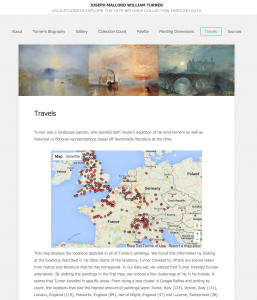
In Cultural Data in Museums, Ridge goes onto conclude that open cultural data ultimately unlocks great potential for the museum to spread knowledge due to its web data’s networked nature. That is, each cultural dataset added contributes to wider knowledge and creates new possibilities for innovative experiences of shared cultural heritage. I feel like our website kind of exhibits this. The Tate giving us their open cultural data for us to form our own narrative and interpretations, it could potentially lead to a domino effect of other people seeing our website and then wanting to explore the data on their own to form their own  analysis separate and unique from ours’. Take for example one of our tabs on the website, Travels, which looked at Turner’s paintings in relation to his travels through Europe.

Screen Shot 2016-01-19 at 3.37.41 AM

Here lies the potential for someone to look even further into this data than we did to come up with an argument that may have not yet been brought up. Through this, I can definitely see Ridge’s point of the networked nature of open cultural data. Open cultural data leads to projects such as that of DH101, which can then possibly spark curiosity in someone else to further interpret the open cultural data, adding to network of knowledge.


Week 3: Open Cultural Data and How We’re Not Using It

Mia Ridge’s article about Cultural Data in museums, and more importantly, the existence of open cultural data brings an interesting new commentary to the history behind many web sources we have today. The author breaks down the term ‘open cultural data’ to us step by step, as well as explaining to us what ‘linked data’ is. Essentially, open cultural data is data from cultural institutions that is made available for use in a machine-readable format under an open license. This means that it could simply be a PDF we have to read for a class. Linked data, on the other hand, is similar to open cultural data, but requires specific technical protocols to support connections in the ‘web of data.’

I related this article to my personal experiences with museums, namely the EMP (Experience Music Project) Museum in Seattle. Ridge states in her article that journalism ad politics were key drivers for the movement toward open data in the early to mid-2000s. However, it is quite interesting that museums followed journalism and politics into the era of open data in order to do a public service – share their knowledge of culture and history with the world.

The EMP museum website is no different. It is a beautifully designed website that provides access to information for all site visitors about the various exhibitions that the museum has. But aside from just logistical information, it also has historical and cultural commentary about the implications that certain exhibits had on the world. Unfortunately, these information pages, along with those about the programs and education that the EMP museum has, are rarely visited.

Screen Shot 2016-01-19 at 2.04.26 AM

Ridge, in her article, states that though there are many API libraries, galleries and archives, not every data set gets a lot of use. This is for a myriad of reasons: confusing/incompatible licenses, poor or inconsistent record quality within datasets, lack of images/interesting descriptions and undocumented/ambiguous vocabulary.

The EMP museum website tries to mitigate these reasons with aesthetically pleasing and modern design and easy-to-use layout. It goes to show that museums really are putting their best foot forward in creating an environment where learning is encouraged and welcomed—it’s not just a matter of whether or not the public will decide to make use of the resources available to them.

Week 3: Art is Data is Art

Within the museum setting, the relationship between object and viewer is convoluted. There has always been a tendency to keep a certain distance between the two. However, with the pervasiveness of technology and the advent of the Internet, we’ve begun to modify our experiences with objects and our relationships with them. With the rise of interactive and immersive art, the distance between object and viewer is beginning to collapse. We are no longer detached observers. We take on many roles; we are at once the audience, artist, and curator. We want to be an active part of the conversation. The accessibility and pervasiveness of content on the Internet allows us to become those active participants. Mia Ridge in her essay, “Where Next for Open Cultural Data in Museums?” explores the ways in which museums are beginning to adapt to our newfound roles. With open cultural data, museums are able to share their databases, images, and knowledge with the world. This new level of accessibility is rendering new experiences, interactions, and even new art forms. We are beginning to see open sourced art emerge as the new medium. For example, data visualizations that utilize metadata from the Tate’s collection have become art in of themselves. One project, aptly titled “Art as Data as Art,” simply sums up the process and newfound medium. One example of Tate data usage that I enjoyed the most was Shardcore’s “Machine Imagined Art.” In “Machine Imagined Art,” Shardcore provides a description of a non-existent piece of artwork implied by the Tate Data. It encourages it’s participants to even create an art piece of their own. I think this form of data visualization is an abstract piece of performance art in of itself. I believe that open sourced data and open cultural data is where our future is headed. We are a “remix” culture. We upload, download, remix, and reuse content as we see fit.