Blog

The Difference (Or Lack Thereof?) Between Work and Image

Hopefully, the title of this post encompasses what most of us were thinking while reading Cataloguing Cultural Objects: A Guide to Describing Cultural Works and Their Images; the top of page 6 had me going, The digital image is surrogate for a photograph, which is a work, that contains a work inside of it, which emulates another work, work? What? Admittedly it took another close look at the text to decipher what author M. Baca was implying. In part I of the manual, Baca briefly explains the differentiation between a work and an image.

CCO recommends making a clear distinction between the work and the image.

A work is “a distinct intellectual or artistic creation limited primarily to objects and structures made by humans, including built works, visual art works, and cultural artifacts.” An image is “a visual representation of a work. It typically exists in photomechanical, photographic, or digital format.” This part of the reading sort of reminded me on our discussion on categories and how these categories affect the veneration and exhibition of works in museum settings. The mouthful at the end of that section is, in a sense, true; an image can contain a work, which may be based off an initial work itself. Baca gives the example of “a photograph of a work may also be treated as either a work of art or an image, depending on the stature of the photographer and the aesthetic or historical value of the photograph.” But what does the reputation of the photographer have to do with distinguishing a photo as a work, and why does the photo need any sort of historical or aesthetic value? Baca states, “…another photograph purchased from a commercial source depicting the same structure would probably be treated as a photographic documentation of the [object]…” This, again, highlights the controversy behind what and who gets venerated, esteemed, or put on display due to name and cultural significance.

Lichtentein-Mirror-1_1

A work versus below, being an image.

mirror2

Art is, of course, full of contradictions; but in this day and age, it seems that the justifications to make something an art work aren’t as unattainable. More popular artists do exist, but would that be more of a matter of time, or just general popular opinion– then again, who’s opinion makes an artist consensually great across all boards? I feel that Baca’s point on works and images being two different categories are valid to an extent, but with the residence of the digital age, it’s hard to say where the hard line is. Is my photo of the painting of Roy Lichtenstein’s Mirror #1 just a documentation of the work, or can it be a work itself if I decide to put it on display somewhere, or if someone requests for it to be put on display? There is never a truly finite answer to questions like this, much like how there is not a limitation on what digital humanities can explore or withhold within the field of museum studies.

Appropriating week 4

Isaac’s case study of the National Museums of the American Indian is the potentially the best demonstration of many of the issue and tensions that we have been discussing in class. The Museums aim in incorporating technology into the museum was to open the discussion about the objects, express different cultural view points surrounding the objects, and to moderate the ideas of both letting the object speak for itself as well as culturally contextualizing it. The intention is very positive, as it always is, but Isaac notes several ways in which the technology doesn’t work out as planned. The overwhelming amount of it can be distracting, some visitors never look up from the screens (particularly the younger generations). The act of never looking up, however, seems to be a very common current trend in younger generations, period. I’m always amazed walking through campus and seeing how many people never look up from their phones while crossing streets, or just walking down sidewalks. I have a suspicion that the screen viewing obsession is not something that museum curators took into consideration when working to incorporate technology into the exhibits. But videos, and tv screen tend to be distracting anyways, partly due to the fact that they produce sound. In an otherwise sound-less environment, where the only sound is the mumbles/talking of visitors and the shuffling of feet, music and the projected dialogue of the videos can capture attention easily. They are also attractive because they are more “conversational” let’s say, than looking at something that is behind glass – videos talk to you, present a stream of images of objects or people, and give you information with you having to interact with the objects (they present it without you having to go look for it, or read it – the idea of digital story-telling). Isaac’s conclusion states that while the NMAI has a wonderful intention of broadening the cultural scope of the museum, they seem to be teetering on the edge of having added to much mediation between viewer and object.

Week 4: Elgin Marbles

As an anthropologist, I love the idea of museums playing nice with the cultures they represent. In Zange’s piece, the work between the tribe and museum perfectly illustrates how communities should be involved with their museums. Although reading through these articles, I had to laugh at how simple this all sounds…

elgin-marbles

Behold, the Elgin Marbles! Otherwise known as the architectural friezes that once made up the Parthenon in Greece. But they are not in Greece at the moment and have not been for several decades. They are in the British Museum in London proudly displayed in a large room mimicking the original Parthenon. The politics behind these pieces is an interesting one. To keep it short, they were acquired by the British many years ago and the museum has refused to return them to Greece, partially arguing that the Greeks could not take care of such precious pieces. The Greeks, in response, send demands every year for the pieces to be returned and even have a whole section of their museum set for the display of the marbles; pedestal, placards, and all.

Although circumstances like Zange’s are ideal, they rarely occur. Improper display of cultural pieces is not the only point to consider here but also the technical theft of the object itself. While the pieces made have been acquired legally, home countries always argue the legitimacy of the dealings (as they took place decades ago). Egyptian pieces were also removed during the excavations in the early 1900s with some partially shady dealings.

While it would be nice for everyone to return the pieces to their heritage country we would be left to ponder the next problem? How do we experience other cultures if we are unable to travel there? If a country is unwilling to part with any object, how can we learn about that culture? Perhaps technology really is the answer here. Acting as a replacement for the object, 3D visuals and interaction could be used in museums to avoid nasty politics. Unfortunately, having the original piece still generates public interest and increased revenue so there is a monetary benefit to have the originals…

Digital Storytelling Links

“Founding Fragments: Freemason’s Snuff Box” (Smithsonian)

“The Crystal Palace,” University of Houston

“Founding Fragments: Mr. Peanut” (Smithsonian)

“Cheese Powder: A Brief History” (New Yorker)

“The Phone That Could Not be Killed” (New Yorker)

“Puffed: The Magic of Cereal” (New Yorker)

Questions for your group:

  • How do the filmmakers balance an affective (emotional) dimension with secondary research?
  • How does the pace of the video affect your experience?
  • Does the video inspire a sense of resonance or wonder toward an object? Which one, and why?
  • How is watching the video different from encountering an object “in person”?
  • What role does the soundtrack play? What about the voiceover?
  • How does the story create a beginning, middle, and end?
  • How is a story different from an essay? Can both convey the same information?
  • What would you do differently if this were your story?

Week 3 Reading

This week’s readings were focused on the open cultural data museums present and how they are being used for visualization studies and analysis. In particular, Mia Ridge’s “Where Next for Open Cultural Data in Museums” highlighted how the community can interact with projects and art pieces better because they are given access to the open cultural data and linked data. Open cultural data refers to any data that cultural institutions make public and accessible, for example museum images and captions. Meanwhile, linked data is another way of sharing information however, if requires other sources that relate to the data being described as well – for example the “Cooper-Hewitt’s Collection Color History”.

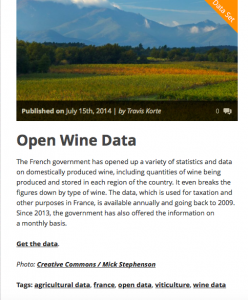
I thought it was intriguing how the idea of open cultural data could not only be applied to museums but also to any type of information source whether it be science, epidemiology, sports, food, or wines. In the past for my job, we have had to learn a lot about different alcohols – especially beers and wines. As a waitress, we would have to be able to explain why certain wines were priced differently than others and what the significance was behind that. When learning about different wines – I found a open data website for them.

Screen Shot 2016-01-20 at 9.32.42 PM

This “Open Wine Data” website has been compiled from public data released from the French government about the statistics of domestically produced wine. The data includes the quantities of wine being produced, the annual figures of wine, and where it is being stored in each country. This data helps explain for example why a 1984 Bordeaux is so sought after. During that year, the sales were really high – and the way the wine was made in particular makes it really special.

I thought open data in this situation was really interesting, because I never really expected it to be used to explain the reasoning why some wines are better than others.

Week 3: Open Cultural Data

Mia Ridge’s article “Where next for open cultural data in museums” brings up the history and usage of the open cultural data. Ridge highlights events such as the US and UK launching open data sites in 2009 and the Brooklyn museum’s release of its data through an API as key moments in the wave towards digitizing and making cultural data available. As a short aside, API is an abbreviation of “application program interface” even this definition is not very clarifying however and it is difficult to find a practical definition online.

Ridges goes on to make the point that now while many museums have made data available, the data is not used as much as the institution or organization might expect.  She points to murky licenses and inconsistent data as potential reasons for this underuse.

I resonate with this point as for my DH 101 project my group was working with data collected from a series of menus in the New York Public Library collection.  The library has been working to digitize the menus in a series of ways they have, however, been relying on public volunteer support.  This is problematic as it leads to inconsistent inputs such as in capitalization of names and the input of units.  For my own group, this kept us from being able to take our research in particular directions.

We also experienced there being too much data available.  While this may not seems like a problem it became overwhelming and the length of our project forced us to narrow our focus.  This speaks directly to the museum’s sentiments on their data not being used as much as they would have thought.  Museums house many objects, each containing its own extensive metadata and data contained within the object itself.  When we move to digitize this, the data produced is extensive and this makes it difficult for it all to be used.

Week 3 Post

I found it interesting how Ridge’s article linked the public’s call to open data and transparency within their government to museum’s movement towards open cultural data. this move has always excited me because I feel that in opening up museum data to public use, it forces the museum to further analyze their collection and find meaningful connections as well as gaps in representation. As stated in Ridge’s article I feel that museums may be frustrated with the public’s lack of interaction with these technologies because most people only go to museum websites to check the hours and see what is on view, and these newly pubic datasets tike a large amount of time and money to produce.

This race to make museum data public I encounter everyday in my work at the Hammer Museum. I work with rights and reproduction and digitizing the Hammer’s collection of works. Right now the Hammer has a few works online but we are working to digitize the entire collection. This process has been extremely arduous with getting copyrights form artists, galleries, and estates and then getting images created for these works. As a student I was always frustrated by the lack of information museum’s provided on their website, however, through this internship I have gotten a lot of insight into the roadblocks that occur when creating this info. In the Wall reading we see the importance of standards in creating and presenting understandable and meaningful data. I think that with contemporary and modern art it is becoming increasingly hard to set uniformed classifications especially with medium. Many artists blur the line between previously rigid lines of what defines mediums. I found that in making my DH101 project using the Tate’s collection of Turner paintings it was hard to classify works as drawings or paintings because of the multimedia work of the artist and it became hard to discern which pieces were sketches and which were finished works solely by looking at the data. It is important to see the image itself. In flattening this to produce data do we loose the multidimensionality of the work?

Week 3 Blog Post

This week’s readings were very interesting because they prompted a conversation about what it really means to have access to all of a museum’s pieces of art. I believe this article raises a few key points and concerns regarding the mass publication of artwork and embracing openness within the museum setting. Some such concerns are questions about whether the pieces will loose their significance when they are all available. Will the public still come to the museum to see it or will objects transition to be just digital information that is occasionally looked at? Are there ethical issues with presenting particular museum pieces online? Will this openness hinder or help museums in their relationships with the public?


I feel that it is important to consider the Smithsonian X 3D project to address many of these questions. The Smithsonian, as an institution, has international fame and draws people from around the world to come see their collections. By putting some of their pieces online, they have allowed people from around the world to view their pieces without necessarily being physically present. However, when I was working with Smithsonian X 3D, I felt encouraged to go see the objects in person. This desire to visit the Smithsonian in person was sparked by me wanting to see what differences there were between the pieces in person and the pieces online. I feel confident that many other people would have a similar thought process, or at least would be similarly intrigued by visiting the museum. I believe that this project could be difficult to work with while looking at particular pieces because of the cultural norms that the piece is associated with. However, I feel that in instances such as human remains and other objects, such as culturally significant masks, the museum could work to create alternative modes of expression. These expressions could range from descriptions about the object to recordings of voices from the culture that the piece is from. Overall, I believe that the museum should be using this technological turn to embrace a multivocal approach and expand the viewership of the museum.

Week 3: Data and Museums

Open cultural data, according to Mia Ridge, is “data from cultural institutions that is made available for use in a machine-readable format under an open license,” and museums have only recently begun to participate in this data trend. And with so many of them now available for open use, data enthusiasts everywhere have been producing amazing results, such as the MoMA study by Helen Wall. Although data analyses and visualizations, no matter how great, will never replace the experience of physically being present in a museum, they can add to the viewers’ experiences by providing educational details and fun facts and by invoking a richer interaction with the art pieces instead of a cursory or disinterested glance by the viewers.

For example, the Color History of the Cooper-Hewitt Collections is a nice data visualization, but it is essentially useless, especially for those who have never seen the collection or been to the museum. However, museum curators can use this visualization or the information extracted from the visualization to make viewers’ experiences more meaningful without distracting their interests away from the actual art pieces.

Furthermore, I agree with Ridge’s argument regarding the usability of open cultural data. I have had first-hand experience in wrestling with ambiguous categories, inconsistent quality of the records, and just the sheer messiness of the dataset when I had the pleasure of working on the University of Pennsylvania’s Schoenberg Database of Manuscripts just last quarter. It was very daunting and overwhelming at the very least. In order to produce higher quality work, museums and other cultural institutions should work on creating better and more usable open cultural data.

Also, I would have to warn against misusing and misrepresenting data. Anyone with the time and skills can conjure up beautiful visualizations. However, with careless data management, analyses can mislead readers into false assumptions which will be detrimental to the museums and the communities. We should take care to let the art piece speak for itself first and allowing the data visualizations to supplement the objects, the artists, and the viewers’ experience.

Week 3: Toward a Common Language

In doing this week’s readings, Mia Ridge’s point about the tension between the utilization of “easy-to-use datasets using common vocabularies” and “more sophisticated data structures and specialised vocabularies” stood out to me. I spent this past Sunday doing a “communication progression” as part of staff training on the UCLA challenge course (an on-campus space dedicated to experiential education). As part of this training, I participated in a series of activities with each building upon the last, that each had a different takeaway regarding communication methods and drawbacks. In two of the challenges, one group of people had an object (a multicolored lego structure in one, a complicated pvc pipe sculpture in the other) that they had to get another group to replicate, without being able to show the other group the object and without the ability to see the building groups’ attempts. The final results of our efforts (the comparison of the two structures at the end) provided a visual representation of the amount of information that was lost along the chain of conveyance. We recognized the need for establishing a common language, as many of the discrepancies occurred as a result of differences in explanation and understanding amongst different people (e.g. in trying to convey length of pipe, metric system versus customary system provided a discrepancy in the pipes chosen).

All this to say that once a widely-used common language has been established among those who practice data visualization, the graphs and charts themselves can act as a powerful common language for understanding museums and collections. With a properly done graphic, anyone from any walk of life or level of understanding should be able to look at it and gather what the creator was attempting to convey. I see this as the purpose of data visualization itself– it takes a trained eye to make sense of raw data, but visualizations transform that data into a universally accessible format. Such methods aide in transparency and public engagement, enforcing the openness of “open cultural data,” and the purpose of integrating technology into the museum sphere.