Blog

Blog Week 4: Catalog

I found fitting that this week’s readings had to with cataloging since I recently did a museum report of Diane Thater: The Sympathy Imagination exhibit in which I state how the experience of the art is in itself the art that Thater is creating, in other words she is creating an experience. When we discuss about how we are to catalog cultural pieces of art, a major question can sometimes be “what is art?”. In the reading, I was very pleased that under what is an object, the term is broad enough to accept essentially anything a  human creates is deems as art.

What I like about this document is that it almost begins to sound like a guideline of not only what we consider art, but what data is used in the creation of cataloging records. The sections of cataloging pieces or architecture are fascinating to me because they feel as if they needed to be added because they did not fit into the umbrella terms of what are is and what are its characteristics. For example, paintings and sculptures are similar in that they have in formation like what material was used to make them, artist, and city but with things like architecture, there are different data points that are relevant. There in lies the beauty of this document, it seems like it is possible to simply update the document when new items or forms of objects become art. Just like the exhibit that I observed at LACMA, there are new forms and modes of art and cataloging items with different physical properties will need to be made when we begin to archive and gain data on some of the most innovated forms of art that begin to arise. This document really leads the way for how we should catalog certain objects and what cataloging consists of, from core values to relationships with other work. I think that agreeing a set system of catalog helps set up a standard which helps fight some of the problems digital humanists face with so many different ontology sets that we work with.

Week 4 Reading- Cataloging

When beginning this week’s reading about “Cataloging culture objects: a guide to describe cultural works and their images”, I expected the reading to be somewhat of a basic formula describing how to catalogue art pieces. However, as I read through the different parts, I found that Baca presented the concept to be more abstract and layered – which I did not expect. When cataloging art, certain aspects must be focused on. For example, the person cataloging has to decide whether there is a difference between a photo of the art work versus the piece itself. After that, the ownership must be decided – is it actually then the artist who created the piece the owner of image, or is the person who took the photograph. I had never really thought of cataloging as being so specific and layered. I just assumed it was a way to archive pieces of work. Because Baca kept bringing up examples of different specificities in cataloging, it really made me wonder when is it a reasonable place to stop layering.

One part of the readings that resonated with me was the relationship between different objects such as the difference between a work and an image. I kind of struggled finding a good example for this, I am not sure if this is the best…

From what I understood, there are layers within pieces of art. For example take Leonardo da Vinci’s The Last Supper. When cataloging pieces that relate to The Last Supper, there could be a work that related to another work – for example another art piece that is based of that original one. In this case Andy Warhol’s The Last Supper (first image). Then there is another layer where there is an image of an art piece, where someone has taken a photo of Leonardo da Vinci’s The Last Supper (second image).

warhol

da-vinci

I thought it was interesting that even an image of the art piece is considered not the work – which completely makes sense, but had just never thought of it that way when cataloging. Baca’s reading opened my eyes to just how layered cataloging can be.

Week 4: The Museum as an Apparatus of National Identity

What provides the basis for any given culture’s sense of self and nation? I wrote a paper in an anthropology class last quarter about the power of sport as an apparatus for shaping nationhood. In one example, I looked at soccer tournaments in rural, Amazonian Peru and how the structure and rules of the sport help integrate modern laws (which favor unity under the state) with indigenous cultural values (which hold the individual in high regard). In another example, I looked at ski telecasts in Slovenia and how the media acts as a vehicle for contrasting Slovenia with other nations and using visual cues and language to construct a national identity.

Bennet’s “The Exhibitionary Complex” points to the State using museums as a means of setting up rules and control in much the same way as do soccer tournaments in Peru. But as this week’s readings point out, the role of museums in shaping a nation and a culture extends much further. One quote from the Introduction to “Exhibiting Cultures” really stood out: “Carol Duncan and Alan Wallach have analyzed the architecture, decoration, and art-historical arrangement in what they call universal survey museums—the Louvre, the Metropolitan Museum of Art, and so on—and conclude that these elements create rituals of citizenship.” What museums choose to display and how they choose to display it has a great influence on the public’s notion of a place. Tourists often seek out museums when traveling, and citizens visit museums for education and enrichment, so curators and museum architects are instrumental in shaping these experiences and peoples’ views.

An interesting tension arises when museums display art of other cultures. Does the displaying museum get to define nationhood by means of its exhibitionary practices, or does the culture whose works are on display have a say? Which state has the right?

Week 4: Community Engagement

I read Zange’s piece on museum’s relatively new role of displaying cultural artifacts online. While museums have a long history of getting it wrong when it comes to including cultures when displaying there artifacts, they have a relatively short history with online material.

I agree with the points being made in the article about creating a dialogue and a community with the cultures involved. My additional point that I’d like to make is that cultural exchange works best when a person of that said culture actually works on curating, informing or researching these exhibits. It is a great step for art historians and museum professionals to conduct interviews and ask permissions of specific groups in question. However, whenever possible, I believe it is even better when that career field becomes more diverse, and the actual people the objects belong to are able to represent themselves.

The example where I see this working is when the woman from the South Asian American historical archive, SAADA, came to speak to the DH 100 class last quarter. Although this was not a database and not a museum, it shows how communication with a community can lead to employees and board members from that community. From there bits of information from personal family stories came out in a way that I don’t think would be possible if many contributors weren’t South Asian.

I do not believe full repartition is the best solution because in some cases it takes away from knowledge that the general public can learn, especially from material that is easily accessible online. However I also don’t think the solution is just creating a dialogue. I believe efforts should be made to take that concept a little further and actually employ or get members of that community as part of the team that makes decisions for how pieces are shown online and in person.

Week 4 – Cataloging in terms of photographs

To begin, I thought this particular reading was going to be very procedural, just a “how-to” guide on how to catalog, but it turned out to give much deeper insight into the meaning of art. One section I found particularly interesting was the section that asks you to describe what you are cataloging. This seems like it would be the most basic step but like Baca mentions, this could be incredibly complex. To define objects and to begin to catalog them means you have to understand exactly what they are and how they relate. However, this begins to get tricky when Baca gets to the section describing what is a work and what is an image. It begins to become entangled here because you are forced to make the distinction between what is a work depicted in a work (like the painting displayed below – an artistic visualization of Michelangelo’s David)

david

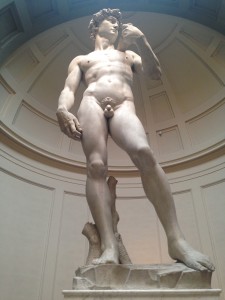
and what is just an image of a work – similar to the picture I took on my cell phone of David (as an example of something you might find commercially).

IMG_6507

However, I believe that this really just depends on perception. Some photographs really could be considered works of art. I know that it isn’t my place to disagree, because this is all pretty technical, but I think that often times the photographs that Baca writes will “be treated as photographic documentation and recorded in an Image Record” could be considered by the photographer as an actual work of art. In the picture I took, it was just clearly meant to document what I was seeing so that I could bring it home and show it to my friends and family. However, often times the images people take of large architectural scenes or the Eiffel Tower have lovely photographic displays that shouldn’t just be accounted into an image record because they’re not from the 19th century.

Week 4: Cataloging

As someone who doesn’t come from a digital humanities background, and who has little to no knowledge about how cataloging works, I was overwhelmed and shocked at the depth and complexity to which cataloging entails. “Cataloging Cultural Objects: A Guide to Describing Cultural Works and Their Images,” provides both simple, yet complicated guidelines and solutions to cataloging a work of art. On one hand, they condense the process into seemingly two simple components: “promoting good access to the works and images coupled with clear, accurate descriptions that users will understand.” On the other hand, when it comes down to cataloging an actual piece of work, there is so much to be taken into consideration. One must consider the difference between the work itself and a picture of the work. This process further complicates the notion of authorship. Is the author of the work the one who took the image? Is the author the one whose work is documented? Furthermore, the amount and type of information given may vary depending on what types of materials are being documented. There is just so much to be taken into account and the examples provided, though well done, gave me so much anxiety. When Baca goes into detail about the difference between works and images, it becomes so meta, so fast. A photograph of a work could be treated as either documentation or an image in itself. It could also be both. It could be a work of art that documents another work of art. It could be a photograph that documents a work of art that depicts another work of art. So where do we draw the line? Where do we begin with cataloging? As someone who is very bad at making decisions, I don’t think I could ever be responsible for having to catalogue an entire museum collection.

Week 4: No winners here

This week’s readings reflect what we as a class have discussed since Week 1: how museums have shown and appropriated non-Western cultures, although the Introduction written by Karp and Lavine go into discussing how this is changing. Museums are reacting to the growing sensitivity and political correctness of its constituents (and potential ones), and are beginning to take steps to ensure that the most amount of people are happy.

Karp and Lavine pose three solutions to the problem Western museums have with displaying non-Western cultural artifacts/pieces: increase transparency, give populations more agency when it comes to their presentation in museums, and hire people who are specialists in non-Western culture. Of course, it’s best to always have an expert on staff to handle projects in the best way possible, but that is costly, especially if the exhibition is only temporary.

This is still a learning process for museums around the country (and world). The Metropolitan Museum of Art in New York held a “China: Through the Looking Glass” exhibition until September 2015, and it shows how Western cultures, who historically have held more power over other countries, happily take aspects of other countries’ cultures and use/interpret it for their own means, although it can sometimes turn out quite funny (as pictured below). At least the Met was recognizing that the exhibit they were putting on was a Western interpretation of China, although it still makes me cringe today.

Screen Shot 2016-01-26 at 2.13.04 AM

(original image here)

At the same time, there is no way for museums to make everyone happy. As Karp and Lavine so succinctly put it, “the larger point, however, is that no matter how the exhibition was organized, it would have been disputed”. People will find a reason to complain about everything, so all the museums can do is make sure that they are not grossly misinterpreting or representing the non-Western cultures they’ve put on exhibit, while also trying to understand (and let the audience understand) its special place in history.


Week 4: Image and Art

At first glance, an entire chapter dedicated solely to cataloging cultural objects seemed a little unnecessary, since the act in itself seemed so much like common sense. However, Baca surprised me with a ton of situations that I had never thought of before. One of which stuck out to me was the distinction between an image and a work of art. I had never realized that there was such a distinction between the two until he provided the example with the Eiffel Tower:

The photograph La Tour Eiffel by the well-known French photographer Brassaï is a popular image that shows the Eiffel Tower standing majestically at night. In this case, La Tour Eiffel is considered a work of art, not just an image of the Eiffel Tower.

I had always known the photograph and considered it a work of art because of how it was displayed and revered in the art world. I never really thought that at the end of the day, it is what it is—a picture of a building. There was no clear distinction between this photo and a photo I could take of the Eiffel Tower at night other than the fact that somewhere down the line, an art connoisseur deemed it to be a work of art.

This distinction definitely stuck out to me, especially when I think of myself or others taking pictures with art at the museum. Sometimes, people like to pose in a way that reflect their own understanding of the piece, which I feel, when photographed, shapes the way that others understand the same piece.

Processed with VSCOcam with se3 preset
The Broad

For example, taking this picture (see above) makes it a photograph just like any other. But if some art curator were to deem that this was a work of art, would it be mounted and revered as one? What are the ‘standards’ to which something is considered art? And who takes the credit—the secondary producer of the art or the individual whose work is encapsulated?


Culture as Subject and the Ontology of Digital Photography

This week’s readings encouraged us to think about the relationship between a museum, a cultural object, and the community to which it belongs. Charles Zange argues that the museum’s “ownership” of the object is an opportunity for them to showcase and educate the public about cultural artifacts. However, this does not mean that they are free to emphasize or omit certain facts at their discretion, while ignoring the richness of the community voice and their role in influencing the cultural backdrop of the object. Especially in the context of digital display and networks, where information is as easily disseminated as it is misrepresented, ignoring the conditions and means of information display would affect the object’s cultural network and therefore its “ontology”.

More so than cultural artifacts, I thought about how digital photography fit into the argument. In this age of Instagram, DSLRs and the obsession to create the perfect digital image, photographers often travel to exotic locations to take snapshots of the landscape, the people and/or the culture. However, it is not as clear to me how many actually bother to connect with the local people and understand the cultural context in which they are capturing these shots. It is easy to see how a well composed shot with the proper lighting, saturation etc would garner a lot of likes, but they might lack the perspective and the narrative behind what compelled them to capture that moment. This is a clear example in which the “risk of dual digital networks” is clearly exemplified- the information asymmetry between a digital photograph and the actual scene in a cultural community or landscape can result in a split of information with “both sides only getting one piece”.

One photographer who does do this well is an environmentalist named Chris Jordan. He travels to rural areas of the world where plastic pollution is prevalent, and uses what he knows about the environment to capture and convey the reality of the situation to others (as opposed to just taking pictures of things that look pretty). While this course discusses the importance of preserving the authenticity of man-made cultures, we have not really touched on what it means to preserve and protect our natural environment, which has a carrying capacity and ontology of its own. It’s easy to deny the reality of environmental degradation even when the facts are presented to us, but there is hope that photography as a journalistic device will be a better way to spread this message if photographers i.e. photo curators are able to reflect critically on their work on not only an opportunity for artistic expression but a means for cultural investigation and education.

chrisjordan

Midway: Message from the Gyre by Chris Jordan

Week 4: Technology as Objects

Digitized images and objects along with electronic kiosks are nothing new nowadays in museums. Many have adopted the practice of incorporating technology into their exhibitions. However, based on this week’s readings and my own experience, I am a little doubtful about the effectiveness of technology in museums, especially when it involves minority cultures. Gwyneira Isaac argues in her essay that media technology has become a ‘museum object’ rather than a platform that provides for better exploration and cultural understanding of the artifacts in the exhibitions. Its presence has distracted the viewers’ attention from what’s really important. When I visited the Getty Center for my museum field report, kiosks were usually occupied by younger kids. Adults just stood back and watched as their kids became immersed into the technology. These kids did not look up from the screen to examine the real object in front of them, and instead treated the kiosk as if it was a part of the exhibition. I wonder if they have attained any cultural knowledge or understanding of the object or if they were simply drawn in by what the device can do. If it is the latter, wouldn’t technology pose a threat to the objects it’s supposed to support?

There have been arguments regarding the lack of diversity or underrepresentation of minority cultures in exhibitions. And as cultural institutions, museums have the social responsibility of educating the visitors, broadening their perspectives, and encouraging conversations among the community members. However, Lavine and Karp point out that exhibitions reflect the views and attitudes of the people who created it. They wield a form of authority where “decisions are made to emphasize one element and to downplay others, to assert some truths and to ignore others.” With this in mind, exhibiting cultures that were historically undervalued, misrepresented, or silenced can be a great challenge for these exhibition makers. With an already sensitive issue at hand, a misguided use of technology within these exhibitions can lead to further marginalization of cultures and trivialization of their issues.

Isaac also points out how media technology is used for the wrong reason, such as to “present the image of modernity.” Museums need visitors to function, and with places like Apple, they might have felt the need to amp up their image among the younger generations. However, incorporating some kind of technology into the exhibit does not necessarily mean that it will enhance the visitors’ experiences. It can actually deflect the purpose of the exhibition. Therefore, museum curators really need to weigh the pros and cons of incorporating technology into exhibitions and decide if it is appropriate and carefully examine the effects on the museum visitors.