Digital Dynamics Across Cultures
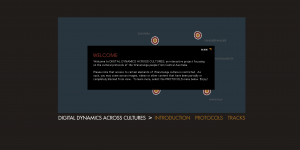
Made in 2008, the site, Digital Dynamics Across Cultures, created by authors, Kim Christen and Chris Cooney, and designed by Alessandro Ceglia, is a really beautifully made interface, with a modern sleek approach that focuses on the anthropological narratives of the Warumungu people. It opens with a sliding transition that proves its interactivity with the browser as well as its beauty in the little details. The opening of the site starts with a welcoming introduction pop-up that explains Digital Dynamics Across Cultures as “an interactive project focusing on the cultural protocols of the Warumungu people from Central Australia” and immediately the viewer can understand that the site is a socio-cultural and anthropological analysis through the vehicle of web interface.

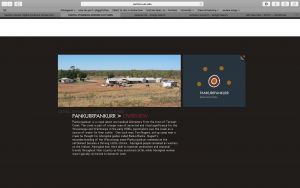
As soon as the viewer clicks off the pop-up, visualizations of bubbles appear that represent the “territories of cultural and political important to Warumungu people.” Upon selecting a bubble, it opens a new site of information, pictures, settlers, schools and the lives can be accessed/seen/read. With the tabs, the user can also read further on the networks built amongst these cultural territories through the “tracks” and importance of a variety of protocols in which the Warumungu people ensure that their culture is maintained properly. This made the entire navigation experience simple, exploratory, and overall, enjoyable, especially as a designer.
What I appreciate the most about this site is the intentions that the editors had behind their design decision-making processes. In the editorial statement, the team made it a clear objective that this site was “experiential, but it does not presume cultural experience to be something we should take for granted,” making it clearly known that a simplification in a website’s design does not reflect in any way that the culture itself is something considered to be “simple.”
Furthermore, I feel that their design is successful for what the anthropologist are trying to achieve. The team highlights that just because the site is something in which we can view for pleasure, this in no way should mean that the Warumungu culture is for the “tourist’s gaze” as well. Therefore, the development of the website articulates this concept well, for it refuses to make the site a product of commercialism, with such an earnest design and ad-free page. The site purely provides the materials in hopes to give others the opportunity to explore the smallest sliver of the Warumungu culture.