I chose to read The Buddhist by Alan Rossi for this week’s blog. I looked at the interactions mentioned in the story–narrated in third person–and made the following edge list.
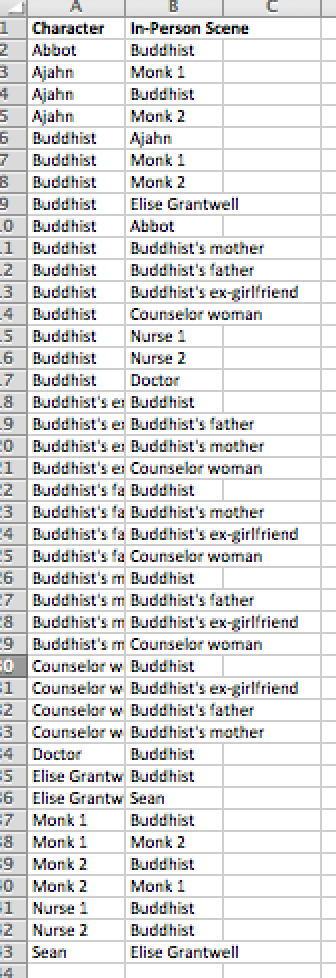
Note: I included reciprocal relations, as the network seems to be an undirected network.
Below is the resulting network graph, made using Google Fusion Table. You can see it here.
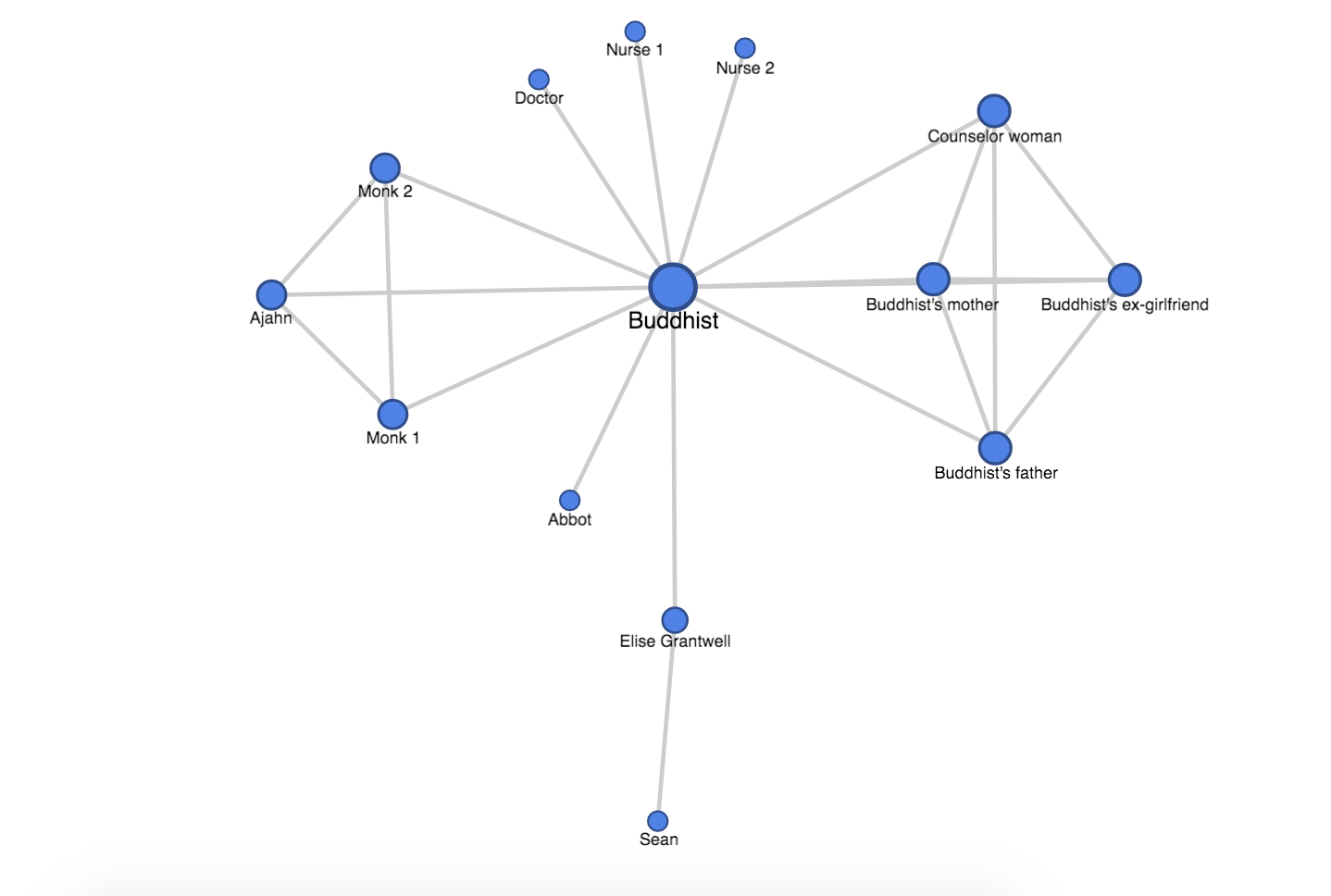
The nodes are defined as characters in the story; its edges are, again, any conversational or physical interaction indicated by the narrator. The narration became murky towards the middle of the story, as the story shifted from the present to the past in the form of the Buddhist telling a flashback to Elise Grantwell, but the flashback did include dialogue nonetheless, which is why I chose to include those characters and interactions in the network graph as well.
The network graph illuminates upon how central the Buddhist’s role is in the story (well, it’s already obvious given the story’s title… but nonetheless, the network graph confirms this.) The story at first seems to be coming from the narrator’s perspective as if he were a character in the story as well, but reading and mapping out the story proves otherwise.
The network graph is effective in that it is straightforward with mapping out the interactions between nodes. However, it does not accurately show how important Elise Grantwell is in the story, given that she only interacted with the Buddhist. The story is centered upon her interaction with the Buddhist, but the network graph shows only the Buddhist’s role in the story as vital, given that I included the flashbacks. The network graph is also unable to show the depth of conversation between the nodes. Again, the interaction between Elise Grantwell and the Buddhist is extremely important, but the network graph does not make it seem as such.