The UCLA Library’s Center for Oral History Research collects oral histories through interviews in order to document the history of Souther California and the Los Angeles metropolitan area. The online database provides over 1,400 transcripts of interviews and many audio recordings of interviews, which are searchable through subject area, interviewee, or transcripts. The website also contains information and resources about interview guidelines and content, other oral history archives and programs, and their bibliography. I think this database would be an excellent source for writing a research paper about broad topics such as the history of Los Angeles, and methodologies for collecting oral histories, as well as more specific topics such as, “Filipino-American Activists in Los Angeles during the 1970s.” Through an oral history, one is able to learn a lot about personal relationships to, and experiences of spaces, events, eras, people, and more. In comparing diverse and similar oral histories, one can also learn a lot about the differences and similarities people have to spaces, events, eras, people, etc. The wide range of oral history subject areas on the database:
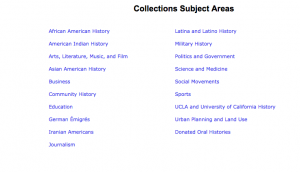
and more specific categories within these subject areas:
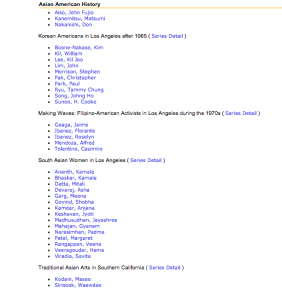
provide an immense amount of information that would be very valuable for humanities research papers. However, this database lacks a lot of visual data that could provide a lot more information for a researcher. Visual data could be addd to the site in many ways. For example, there could be more photographs that accompanied the oral histories. These photographs could include personal photographs from the interviewees that illustrate various geographic locations, people, events, etc. discussed in their interviews, as well as photographs of the interviewee. Photographs of important memorabilia and objects relating to the interviews could also provide more information. Adding video recordings of oral histories could also provide the researcher with more information that one could not get from transcripts or audio recordings, such as body language. Including different types of maps on the site would also provide more information. Maps could show a multiplicity of important geographic information about various locations, people, and events discussed in interviews. They could also provide information about how oral histories on the site, and in similar subject areas relate to one another. Data visuals of social networks and family trees discussed in interviews could also be helpful. A visual timeline of significant events in the Los Angeles area, U.S., and world could also help the researcher to situate oral histories in a broader socio-political context.