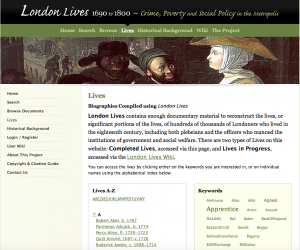
Intro: The project London Lives is a digital archive that aims to represent the lives of London commoners in the 18th century. The website claims having “over 240,000 manuscript and printed pages from eight London archives and [being] supplemented by fifteen datasets created by other projects, [and providing] access to historical records containing over 3.35 million name instances”. The goal of this digital project is to allow interested users to recreate the lives of London plebeians by using the documents, images, and manuscripts that the project has collected and organized either by individual’s name or by the type of record. As of 2012, the update to the website allows users to search for people by name, or to search for documents by keyword.
Source: The site developers point out that individuals’ lives are often linked with institutional documents (e.i. criminal justice system, medical records), thus, a large part of their primary sources come from these institutional records, which were available for digitization and which were most likely to contain information on the same individuals. In addition, they have also included links to externally created databases, which include tax and voting records, fire insurance registers, and urban dictionaries, allowing to make more connections about the same individuals throughout different sources.
Process: The developers of the project stated in their methods for source selection that whenever possible, the entire archives were included; however, they excluded sources that were too large (e.g. parish rate books), or, in some cases they used representative examples with “good record survival”. The manuscripts were scanned to create high definition, 400dpi JPEG files. And a useful feature is that there is an automatic HQ zoom view available just by hovering the mouse over the image. The makers also used text analysis to process their data: the manuscripts were manually typed up by using a procedure called “double rekeying” where two typists independently transcribed the text, and then the computer looked for differences, which were then resolved manually.
Audience & Presentation: All of the data and the records in the entire website are available free online to the public. However, by registering with the website, users can get access to special features, such as saving their searches, creating a workspace and group sets. In addition, registered users can assign roles to individuals in the records, by which they can later also search. The website interface itself seems quite static, however, since it includes many hyperlinks, it allows the users to dig deeper and deeper into each layer of information. It is a somewhat laborious process, but doable after spending some time on the website. The way that the project has organized all of this data is somewhat confusing, however. By clicking on the “Lives” tab, users are taken to a page with about 50 individuals’ names organized alphabetically. On the right, there is a box with hyperlinked keywords, such as “attorney, hospital, pauper”. By clicking on the individuals’ names, we can dig deeper to some manuscripts of external sources. However, by clicking on the keywords, we access links to additional individuals’ names which were not included on the original first page. It is confusing why not all of the names are there initially. The good thing, however, is that the website allows to search by person’s names, keywords, and type of source, which is organized by location and social institution.
Additional Critique: Reflecting on how the makers collected their data (excluding records that were too big), we can guess that their dataset may not be as complete and have significant omissions for achieving their grand mission of reconstructing individual Londoners’ lives. Nevertheless, the project does seem to achieve building a system which in some way links people’s names to institutional records, common themes (e.g. apprenticeship, theft, illness) and vice versa. Considering such linkage of individuals to these institutions and events, one improvement for the project would be to perhaps create a visual representation of these links focusing on time, place, and/or type of event that connects these individuals, places, and events in some way – somewhat like the Kindred Britain project. Perhaps the individuals aren’t linked at all, but we won’t know until some visual representation allows for such interpretation of the data.