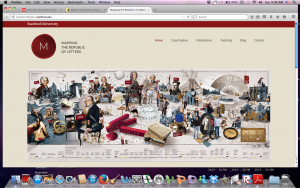
Reverse engineering Mapping the Republic of Letters
The Republic of Letters was an intricate network of correspondence between intellectuals of the Enlightenment. Mapping the Republic of Letters is a project by a team of students and professors at Stanford, who, in collaboration with international partners, seek to answer the questions of what these networks looked like, how expansive they were, and how they evolved over time, by visualizing these networks of famous intellectual correspondences. Their goal is to “bridge humanitarian scholarship and computer science by creating a repository for metadata along with guidelines for future data capture.”
Sources:
The data for this project is taken from the Electronic Enlightenment database, which is an archive of more than 55,000 letters and documents exchanged between 6,400 correspondents. The data also includes 20,000 letters that were written by and sent to 17th century scholars who lived in the Dutch Republic. The source material for the Intellectual Map of Science in the Spanish Empire 1600-1810 is the Diccionario histórico de la ciencia moderna en España Vol. 1 and 2. The project will also include a Salons sub-project, which will “construct its datasets from the mémoires of salonnières, the letters and journals of habitués, biographies of socialites, the columns of the Figaro, and the research of notable historians in French and European history agreeing to participate in the project.”
Process:
The data was geocoded, refined and linked to maps. The data was organized by collocation and affiliation.
Presentation:
This project features a combination: videos, images, maps, and graphs to visualize the networks across geographical boundaries.
One of the international partners is Circulation of Knowledge and Learned Practices in the 17th-century Dutch Republic. “CKCC created a web application called ePistolarium, visualizations of geographical, time-based, social network and co-citation inquiries.” In navigating through the ‘suggested tools’ section of our class page, I also found that Palladio was one of the tools used to process the data for the Mapping of the Republic of Letters. Other tools used are: Shuffle, Knot, Ink, Inquiry, Fineo, Priestley Timechart, and Corrizpondenza. A breakdown of these tools and how they process the data can be found here: http://hdlab.stanford.edu/tools/
I found the project to be too expansive, too multilayered, and not very user-friendly. The home page, for example, features one large image of the some of the intellectuals and their cultural contributions along with a timeline below the image. This could be a great way to enter the site via subject or date, but neither the image not the timeline are interactive or clearly legible. You enter the site by clicking on: Case studies, Publications, Teaching, Blog, and Contact. The Blog and contact options aren’t workable pages. Upon linking to Case Studies or Publications you see images of intellectuals, so one assumes you will be getting to the data via the network of correspondence by individual subject. But, the images include options for ‘Grand Tour,’ ‘Salons,’ and ‘Spanish Empire,’ which muddied and confused my expectations of how I was to navigate the site.