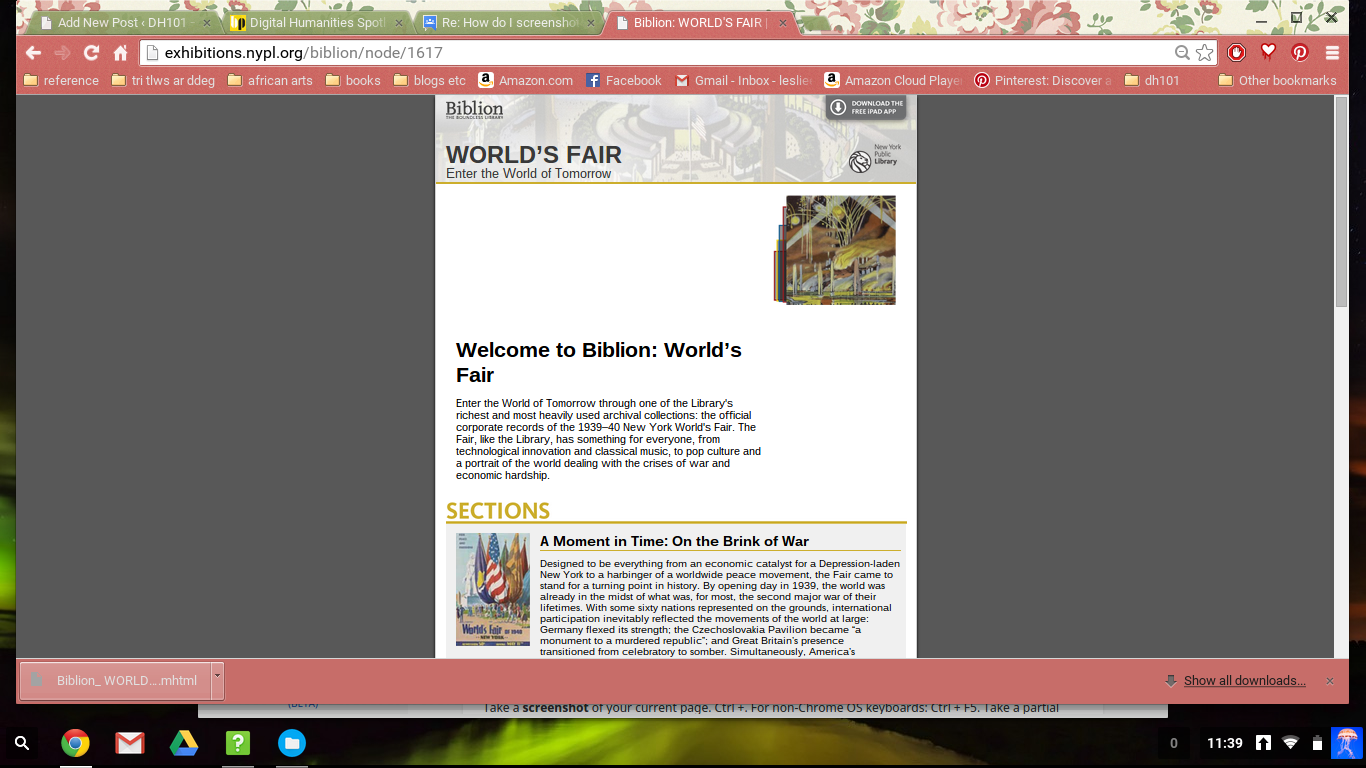
Home page of Biblion: WORLD’S FAIR
New York Public Library’s Biblion: World’s Fair: Enter the World of Tomorrow presents an exhibition/visualization of material from a huge archive deposited with NYPL in 1941, after the close of the 1939 World’s Fair, consisting of documents, drawings, letters, newspaper clippings, photographs, and other ephemera associated with the development of the World’s Fair project in the 1930s. The site is also available as an iPad app.
The home page presents six sections (in this order): A Moment in Time: On the Brink of War; Beacon of Idealism: Building Democracity; Enter the World of Tomorrow: To Futurama … and Beyond; Fashion, Food, and Famous Places: Pop Culture at the Fair; From the Stacks: The Fair Comes to NYPL; and You Ain’t Seen Nothin’ Yet: Fun at the Fair. Each of the sections presents a short introduction, featured stories, image galleries, and a set of essays. The galleries include images with links to archival information, related material, and to a page with information on how to purchase the image for your own use; the featured stories offer a little more contextual information on the material (mostly photographs, although there is some audio); and the essays are the most analytical, although still strongly tied to imagery.
The project represents a major public library’s digitization and electronic presentation of an early twentieth century archive that was created with the future in mind; not only was the World’s Fair designed to present the “world of tomorrow” (ironically, in an age that was well aware it was facing a potentially catastrophic world war) but the Fair Corporation had worked nearly from the start with the intention of preserving its papers at NYPL. The assets are almost entirely paper-based texts or images that have been organized according to best archival practices since their acquisition in 1941.
The project is constructed in several layers, moving from easily accessible, popular material (pictures, general information) to, with increasing numbers of clicks, deeper explanatory/analytical work. Given that the archive itself consists of some 2500 boxes of material, someone (uncredited) obviously spent a lot of time sorting through it all to come up with the 15 or so images that appear in each gallery; essays range from an interview with well-known popular culture theorist Henry Jenkins to a second-hand reminscence of attending the fair to an analysis of the Fair’s menus by a restaurant critic . Given the enormous size of the archive, it’s clear that a great deal of the work involved in the construction of the project went into winnowing it down to a relatively broad, but still bounded, set of representative topics that would be of interest to a general audience but still provide scope for scholarly analysis.

Shagging and Shimshamming: An Abundance of Dance presents static shots of dancers but no video or even audio of the music and dance presented at the Fair.
The presentation is a largely static collection of text and images–it seems a pity that there is no film or audio, for instance, in the gallery on song and dance at the Fair. However, since the project is based, it seems, solely on the material in the archive, it is also limited by what it was decided to include in the archive in 1941, when film and recordings were not usually considered archiveable in quite the same way as text and photographs. Still, it seems a little odd that the story of a 22-minute home movie of the Fair, donated by its maker, only links out to the videos on YouTube rather than hosting them on NYPL’s site, as do the few other videos in the project. How permanent will those links prove in the long run?
One of the most interesting aspects of this presentation is the extent to which its process is part of the project itself. This is reflected in the the fact that From the Stacks, the section on the archive as a thing, does not appear at the end, where such matters are usually relegated, but smack in the middle of the implicit hierarchy of topics. As the essay by Thomas G. Lannon notes, “Beyond painting a picture of the totality of the venture, [the records] capture the inner workings of the World’s Fair Corporation as if frozen in time, thus presenting to contemporary researchers a model of the record keeping system in a typical 20th century office place.” Since a major focus of the Fair was the prewar world’s imagination of the future, the project offers not only a look at the envisioning of Today by Yesterday, as time continues to go on, the project itself will soon offer a snapshot of Today’s cutting edge for the perusal of Tomorrow.