The UCLA Preserved Silent Animation library houses a collection of 11 silent animation films that are extremely rare to find or access online. These films stemming from the early 1930’s animation “Golden Era” are described as survivors of their time; many of the films in this project had been painstakingly recovered from neglect, mishandling, vault fires, and nitrate decomposition. The collection’s purpose is to showcase many forms of animation spanning the silent film era, using an archival website designed as a sort of play-reel that filters through all 11 silent works on a screen made to look like a theater.
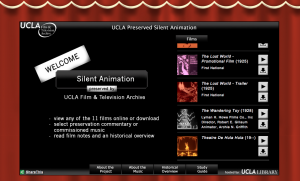
The layout of the website, with links below about the project and a slideshow-like sidebar with all the films.
The way the films are set up to be displayed on the site works in exhibiting the variety of the collection’s nature; all are animated yet can be seen to clearly have different art styles and animation and filming methods, just through the thumbnails alone. The title, creator(s), and year of release of each film appears above the respective thumbnails; I would say that this is an unconventional way to organize content, but it nonetheless works for a medium such as film. Users are also not only allowed to view the 11 films in their entirety, but may also download select preservation commentary or commissioned music, as well as read preservationist and historian notes for each one. One can also select which version(s) to play: whether the silent film by itself or with the music scores or preservationist commentaries layered over it.

How it looks when you view a film; users can check more than one box to hear piano accompaniments, music scores, and preservationist commentaries.
The films themselves serve to demonstrate different depictions of life as it may have been during the Golden Era of the United States. Comparing the very first and earliest film, The Enchanted Drawing, to the last, Theatre De Hula Hula, users can see how much society had progressed culturally and historically through viewing one after another. Mixed into each work are hints of comedy, drama, romance, and pure fun; the essence of animated works at that time allow rather sensitive or deeper topics to be expressed through a lighter, more engaging art form during the silent era. If I were to write a paper based on this archive, I would be able to tell how the impact of these films still pose in history as extraordinary pieces from a time of artistic revival. If any one or all of these 11 films had been lost, we may very well have never known what the extent of silent animation was, how the majority of silent animation films are often unknowingly destroyed, and why it is necessary to pursue even more preservation efforts for silent animation works.
What I was not able to tell based on this archive, however, was the individual significances of these 11 films; out of all the silent films to exist, why are these the only ones that is archived in the UCLA silent animation library? Surely, if a brief description was included stating why preservationists and historians decided to archive these select films, it would help in comprehending their importance in a wider perspective. To remedy this, I would (and I did for some, just out of curiosity) have to further research each of the 11 films and find out their plot lines and characters, the method of animation and film used, who their creators were, and their final product as a film and relate them back to the social and cultural climates they emerged from. Even better, if there were an easily accessible outside archive of all silent animated films that would make extra researching more convenient. From there, it would be more clear to understand the value of this archive in terms of a broad American history, as well.