John Rauch
DH 101 Blog Post 1
DISC. 1C
Intro:
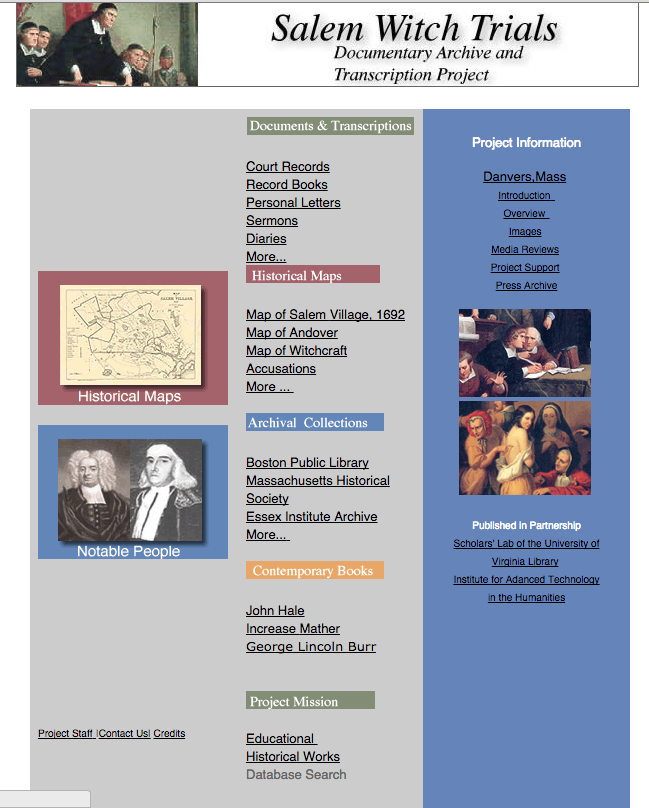
This is a very unique and interesting project brought to us by the University of Virginia. This website serves to do many things, but its main goal is to allow users to explore all the information and sources available on the topic of the infamous ‘Salem Witch Trials’. This website is unique because it has gathered texts, media, maps, etc. from many different original documents that would other wise be very hard to locate. The information on this website can be explored more interactively and organized than attempting to cultivate this kind of topic synthesis at the library. This website serves as a good example of the possibilities and goals of the Digital Humanities.
Sources:
The creators of this website used many different sources, or assets, to produce all the content. If the user visits the “Archives” section on the website, they will notice the great variety of places that these original sources were pulled from. These creators had access to several libraries, state archives, and museums. This is where all the maps, archives, documents, books, painting, and information of people came from. These sources ranged from different states across the United States, so attempting to find all of these sources on your own, physically, would be nearly impossible. This goes to show the importance and significance of digital humanities work such as this one.
Process:
A few ‘newer age’ processes were used to modify and enhance the sources being worked with. These authors used document scanners to transform physical originals to computerized copies. Once these documents are computerized, they can then be analyzed, modified, enhanced, and explored by a computer’s software. A user can also interact with these documents in a new way, being able to zoom in, view things side-by-side, and even save these documents to their own computer is permitted by the authors. The creators of this website also used transcription as a process, as they transcribed many documents from hand written text to computerized text. Again, this digital transformation opens up a whole new world of possibilities of how to view, analyze, and study these documents. A computer can now analyze text with clever coding to look for similarities or common themes, and also show how certain documents are connected that otherwise would have gone unnoticed. The last big process used is the mapping. While there are some scanned original maps, there are also maps made completely digitally in some kind of GIS software. These maps are unique because they are interactive, having points of interest that can be clicked on, and use a wide variety of visual elements to better visualize the importance of certain geographic and topological features in why these witch trials may have happened, and how the city may have looked and operated during this time of history.
Presentation:
This website used many different presentation tactics. They used tables for organization, indexing for search ability, and source aggregation. What these presentation tools do is helps to organize a large archive in a way that opens up the work to the public to be viewed easily. The creators also use certain colors and images to help guide the eye around the website and facilitate the navigation of information.