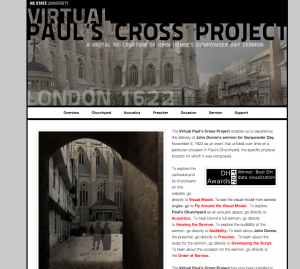
I chose to reverse engineer NC State University’s “Virtual Paul Cross Project,” which aims to explore the practice public preaching in early modern London, through specifically examining the sermon John Donne delivered at Paul’s Cross on November 5th, 1622 on gun powder day. The site focuses on recreating the experience of the sermon as a performance event by utilizing architectural and acoustic models, in order to, “simulate the original conditions of delivery as fully and as accurately,” as they can.
Sources:
The assets included in this website include John Donne’s sermon, which was sourced from original manuscripts; visual data about St. Paul’s Cathedral, sourced from multiple engravings and paintings from the 16th and 17th centuries; as well as acoustic information gathered from the drawings of the cathedral.
Processes:
John Donne’s sermon was recreated through the use of a voice actor and a linguist, who attempt to present the speech as it would have been performed in an early modern london accent. 3D models were created to give the visitors of the site a physical recreation of Paul’s Cross, as well as access to various vantage points within Paul’s Cross. Translucent black figures were placed into these vantage points to give scale and an idea of how many people were in the audience. Two acoustic engineers generated the acoustic models that site visitors are able to play from different vantage points to get an idea of the speech being delivered in real time and space.
Presentation:
Data is presented to the site visitor through 3D and acoustic models, writing, drawings, graphs, and videos. The visitor is able to navigate the website by clicking on different tabs based on the information they are seeking. the 3D and acoustic models give the site visitor multiple options for exploring the physical and aural landscapes of Paul’s Cross.
I really like the emphasis this website put on visual and aural forms of knowledge, in order to best recreate a performance event that happened in real time and space. I enjoyed that they allowed the site visitor to engage with the 3D and acoustic models by placing themselves in different areas of Paul’s Cross. I thought that the site could have been organized a little more clearly. For example, when you click on the tab headers you are taken to a picture with no information; you have to click on a sub-header to get more information, which confused me when I first interacted with the site.