The Salem Witch Trials: Documentary Archives and Transcription Project
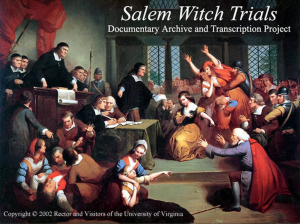
The Salem Witch Trials occurred from February 1692 to April 1693 in the New England village of Salem (Ray). The trials occurred when over 160 people were accused of witchcraft (Ray). Most of the accused were jailed and many had their property and legal rights taken away. Several people were tortured and executed. The Salem Witch Trials Project is an online compilation of primary sources which were then transcribed to give a more comprehensive idea about this infamous time in history.
Sources: The collection consists of court records, contemporary books, record books, images of original court documents, diary entries, personal letters, sermons, maps, and images. There were several different sources that contributed to this archive including books, museums, and magazines. The seven main archives that the sources came from were Boston Public Library, Massachusetts Historical Society, Peabody Essex Museum, Massachusetts Archives, Judicial Archives Boston, New York Public Library, and Maine Historical Society. The Documentary Archive part of the project was supervised by Professor Benjamin C. Ray from the University of Virginia while the Transcription section was supervised by Professor Bernard Rosenthal from the University of Binghamton. The site also includes a Project Support page that recognizes the organizations that funded or helped out with specific aspects of the research. This includes the American Academy of Religion providing the grant to digitize the original court documents and the UVA SpecLab supporting developing the Salem Witch Trials timeline.
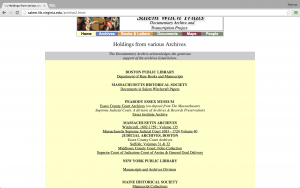
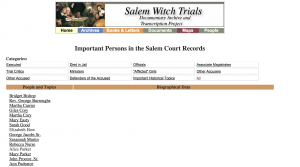
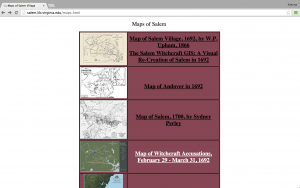
Processes: Several processes were used to create this collection and thus, the site can’t be categorized as one type of digital humanities project. The site makes use of digital edition, timelines, mapping, and text analysis. The site is indexed according to various archival collections. There is also a transcription of the court records as well as scanned images of the original court records. Everyone mentioned in the court documents is alphabetized while the notable people in the Salem Court Records are categorized into eleven groups which includes “executed” and “officials.” By clicking on a name, the visitor is redirected to biographical profiles and images related to that person. The archive also provides interactive maps of Salem Village and the locations of the houses of those involved in the trials, as well as Accusation maps that display accusations in chronological order, the locations of the accusers and accused, and the spread of accusations across Massachusetts Bay.
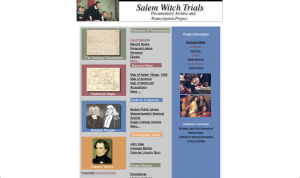
Presentation: I was very confused by this site and spent a lot of time determining where I would find everything. Considering the amount of great information provided by this project, I wish it was easier to navigate. It also didn’t help that the database search wasn’t working so instead of being able to quickly find what I was specifically looking for, I had to go through several tabs to find the information. Another aspect of the site that I didn’t like was the layout. For me, it was confusing that the homepage was organized by rows and not columns. And then, it was also confusing that there were main categories displayed on the homepage with subcategories beneath them that linked to material not listed underneath the main category. For instance, under one of the main categories such as “Documents and Transcriptions,” the subcategories beneath it are “Court Records, Record Books
Personal Letters, Sermons, Diaries.” However, when I clicked “Documents and Transcriptions,” it took me to “17th Century Documents” where the original subcategories weren’t immediately evident.
The example that Francesca showed us in class of Pietro Mellini’s
Inventory in Verse, 1681 did a better job organizing its layout and even gave the visitors the ability to look at the original manuscript side by side with the transcription of the manuscript. It would’ve been nice if this site had adopted the side by side method, however, in defense of the Salem Witch Trial Project, it was copyrighted in 2002 whereas the Mellini site was copyrighted in 2015. Therefore, it’s no surprise that the Mellini site is much more advanced and modernized.
Overall, I would most likely not recommend this site to someone needing information about The Salem Witch Trials. I would probably direct them to a more updated site that would be easier to navigate. However, for an interesting read and for several first-hand sources, this would be a good site to check out.