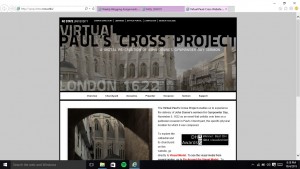
The project that I decided to breakdown was the Virtual Paul’s Cross Project. This project’s mission was to create visual models of St. Paul’s Cathedral in order to emulate what it would be like to attend a Paul’s Cross sermon in London in November of 1622 from different locations in the churchyard.
This project used a wide range of sources in order to create the model. The sources of data come from various visual sources. Among these sources, the project was created with detailed sketches, drawings, maps, pieces of artwork, blue prints and information from the where the churchyard in the current day. All of this data shows different representations of the church and the experience from a sermon. For example, one of the paintings shows people closely together trying to listen to the sermon from various angles relative to the preacher. Some are sitting on the ground while others appear to be standing in front of a podium.
All of this information then gets processed in a unifying matter. Most likely, the data was used in order to make measurements of podium, churchyard, and other nearby buildings. After obtaining their data from various blue prints and images and processing the data into a visual model, they were able to recreate how a sermon would sound like given the spaces they were able to visually recreate. They referenced other preachers such as John Donne to help recreate the sounds of languages one would be likely to hear at a sermon in London. All in all, the data was processed to figure dimensions of the churchyard and nearby structures as well as a how a sermon would sound like from within various places in the churchyard.
The presentation of the project is displayed as website that let’s one look at still images of a 3-D rendering of the churchyard. To see the entire model, there is a link to a video where one can see a fly-around perspective of the model. There is also a separate link where one can listen to the sounds of the churchyard so that one can better imagine what the acoustics would sound like during a sermon. I think that had the project made it more interactive to the user it would have been better. If the user could have flown around the churchyard at will the experience would been more immersive. Regardless, the data was well process and presented in a beautiful 3D rendering in order to help people better immerse themselves and get a better idea of what it was like to attend a sermon in London in November of 1622.
-Jose Ramirezgomez