Recently, I had the pleasure of taking a look at the Virtual Paul’s Cross Project, a project that enables users to experience the delivery of John Donne’s sermon for Gunpowder Day as it may have been in early 1600’s London. Not only did this project attempt to recreate this speech through an audio medium, but it also provided the exact information of where the sermon took place through digital layouts, what the setting looked like with a visual model, the acoustics of the building structure, the occasion, a typed script of the speech, and who the speaker was. This project definitely delivered itself as a well-packaged database full of material for a user to interact with; however, there are some downfalls that I had noticed that, although minor, still highlights just how complex and difficult it is to compile and execute a digital humanities project such as this one.
Category. I would identify this project as a history-based one. Already from the title of the project, the website’s introduction page contains the event’s date, signifying that this particular date is notable in human history (or, more particularly, British history). On the Purpose page, the creators of this project state that Virtual Paul’s Cross Project, “helps us to explore public preaching in early modern London, enabling us to experience a Paul’s Cross sermon as a performance, as an event unfolding in real time in the context of an interactive and collaborative occasion.”
THE BLACK BOX: Sources, Processes and Presented
Sources. Poking around the whole site, we can see three distinct layers that truly make up this project. In terms of sources, the most distinct source that was supplied was the manuscript of the sermon– a high resolution image of it, actually. Clicking the Sermon page takes you to a page with the image of the script. If you go on the The Script page, a full translation of the manuscript is given along with the times certain parts of it were given. Clicking on the other pages on the main bar also provided sources such as a model of the overhead view of the setting where the sermon took place, audio recordings of an actor preaching the sermon, and other digital renderings of the building, weather, and crowd size. To add onto the sources coming from this project, the creators have the Works Cited and Links pages which lists every primary and secondary source they had gotten information from, listed under Support.
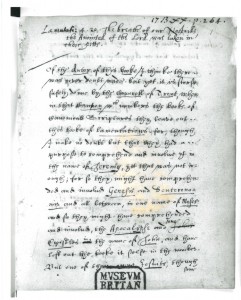
The image of the sermon manuscript as seen on the Sermon page.
Processes. Categorizing the processes in this project were pretty straightforward– I think Virtual Paul’s Cross Project did a great job in contributing a wide variety of services for users to access on each page. There were enhanced images for the script, 3D visualizations (which possibly employed the use of SketchUp) with zoom and turn features for the setting, audio recordings for the sermon, and digitally rendered flat layout designs for the acoustics and structural aspects of the building this all took place in.
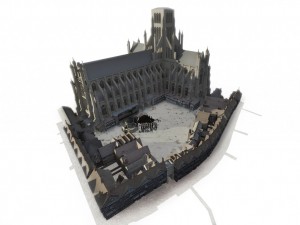
The overview model of Paul’s Churchyard, found on the Churchyard page.
Presented. This project surely succeeded in trying to give as much information as possible to allow a great virtual experience. All the sources and processes were displayed on this website through the employment of 3D modeling and mapping, which complemented the audio recreation of the sermon which users may listen to as they browse the encyclopedia-esque site. Every page allowed viewable access and was simple enough to maneuver around, yet encompassed a great deal of material.
Setbacks. I did dislike how it seemed nearly impossible to find out what this event meant in context to world history; maybe it’s because I’m an American, but I don’t know what the Paul’s Cross Sermon(s) were, and what they really did to begin, change, or improve public preaching.
All in all, I can see that even with some minor faults this digital humanities project is extensive and extremely valuable to many users, and the completed product is certainly deserving of recognition not only in fields of history, but possibly in other humanities studies.