In a world where technology rapidly cultivates human civilization, it is not unexpected that literature in the forms of books, manuscripts, journals, etc. would go untouched. Numerous amounts of information that embody these mediums of literature get lost and along with them, the knowledge and discoveries from our ancestors. To prevent this, Digital Humanists, with the help of modern day technology, have started projects that tackle the challenge of retaining the information and presenting it in a new light. One such project includes “London Lives”. London Lives is a website that holds an immeasurable amount of information regarding eighteenth-century London in a digitized form. The technological nature of the project allows for a new interpretation of eighteenth-century London because of the ability to reach a broad audience from all over the world.
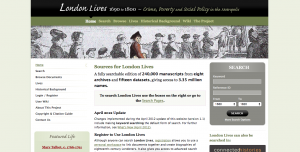
The creation of London Lives was made possible with the help of the Economic and Social Research Council (ESRC) and with the funds of the Universities of Hertfordshire and Sheffield . With these funds, a variety of sources relating to eighteenth-century London were collected to formulate the encyclopedic nature of the site. These sources include over 240,000 manuscripts and printed pages from eight London archives. In addition to these tangible sources, there are also fifteen datasets created by other projects. All these sources combined gave birth to London Lives.
With the data that the humanists collected, they have compiled a list of over 3.2 million names. One of the main functions of the site is that these names were made searchable. The site compiles a biography for the names that stand out most, along with supporting or related documents/images that they have digitized from the sources collected. Not only does the site compile biographies for the names, the site also creates categories of topics that relate to multiple documents/images from different sources. Complementing this function is the “automated matching” service that allows users to select a name on a single document type and compare it to another document type from different archives. All these functions allow the users to explore the world of eighteenth-century London in a different dimension than those who did not have digital technology back then. Being able to easily connect people to other people/events has brought about a new interpretation of the lives/culture of London and its past. The simplicity of the site functions and the compilation of the recourses into one website provide a great resource for scholars, students, and people in general.
With the users in mind, the creator had taken into account the design of the User Interface. The home page contains a search box where keyword is the default function to highlight the broad range of searchable text. This I would infer would be for the general users who are curious about what is available on the site. Once the curious users are done playing with the search function and see what the site has to offer, they are given the option to dive deeper into the content of the site through the option to browse documents (located below the “Search” tab) under specific categories. By providing these categories, the site, in a way, is educating the curious users of what these documents contain and what they generally mean in order for the users to generate their own ideas of what they think the documents say about eighteenth-century London. After having explored the site in greater depth, the users are then given the option to become “Research users” (located below the “Browsing Documents” tab). These users are those who become more invested in the site and are given more advanced functions to explore the site. The designer of the website cleverly navigates users through the site in ways that can allow the most general user become a “Research User” . This project’s presentation would generate more audience than an enormous stack of textbooks ever could.