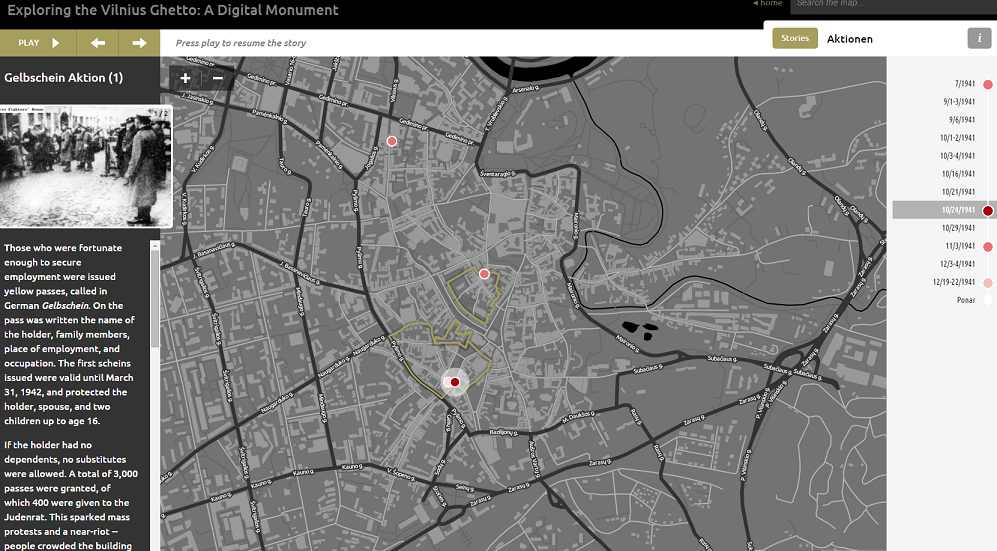
 Looking this week at Revilna, a website project that chronicles life in a Jewish Lithuanian Ghetto, using a number of sources including photos, texts, letters, and of course, digital maps. It has hundreds of historical “points” pulled from memoirs, archives, artifacts, and accounts of inhabitants.
It has a well put together illustrative narrative delivery system that allows you to “play” stories and having the map highlight points which are then explained on the left side of the website. The user can follow these built in stories to learn about the education, health problems, resistance, life in the Ghetto, the formation of the Jewish Councils, and the formation and liquidiation of the Ghetto.
It draws from the point-of-view of the Ghetto inhabitants but the narrative is distinctly that of the web creators as they include lots of information that Ghetto inhabitants would be unlikely to have knowledge of such as very specific arrest records.
The only complaint I have is that the map feature is relatively unnecessary unless you are trying to answer very specific research questions about the Vilnius Ghetto such as where people went to work, or the geographic proximity of events such as arrests, siezures, and disease outbreaks. Otherwise the map serves as a bit of a distraction to the narrative of the individual stories.