The short story, “I Like Being a Woman (And I Hate Hysterical Women)” by Leila Guerriero is a partly introspective and recounting narrative that explores underlying themes of feminism, shame, obligation, and self-identity that plagues women around the world. Leila’s interpretation stems from descriptive encounters with family members, friends, strangers, and her husband as her life progresses. Each paragraph contains an instance with another person, fitting for a network graph. Interestingly, however, the process of creating the graph and analyzing the relationships between Leila and others proved to be more informational than originally imagined, and with this short story I found myself appreciating the art of writing and the deeply relative and personal connections it can mirror onto readers.
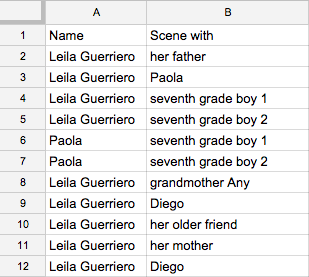
I first started my analysis by creating a Google sheet to track the characters’ interactions by name and scene. For example, I have Leila’s name in one column, and a character she interacted with in a scene on the next column. I repeated her name in the first column while adding names onto the second one as the story carried on. In one scene, both Leila and a classmate, Paola, encounter two characters at the same time. Thus, I put Paola’s name in the first column after Leila’s, and repeated the characters they interacted with in the second column accordingly.
Once I finished the sheet, I exported it as a .csv and uploaded it to Google Fusion Tables. Finally, I created a chart with my data. I found the above graph to fit best, as it demonstrates how Leila is the main character and narrator. It also shows how connected she is to all of the people mentioned; yet at the same time, the others are not connected to each other. From further analysis, one can come to the sense that this is perhaps what the writer wanted to illustrate to readers– with Leila being both an un-proclaimed feminist and a soft-spoken, inquisitive individual, it better portrays the double standards applied to women. The lack of connection between the other characters aside from Leila also may bring about the absence of direction for Leila to follow, thus highlighting how contradictory it is to be a women in a world dominated by contempt, masculine influence, and the abasement of both sexual and physical freedom.
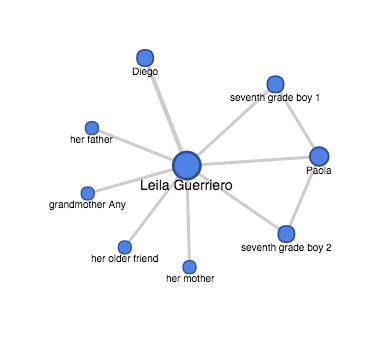
All in all, having a network graph to accompany a short story has allowed me to better understand the broader applicability of the themes present, has given me great achievement in exploring what it means to be a universal learner, and engage humanities material through employment and experimentation with digital tools.
*on a sidenote: I’m not sure how to embed the chart. I tried putting the embed code onto this post but it only displays the code. Maybe I’m not using the right code or placement?”