The UCLA Historic Photographs digital archive preserves much of the school’s earliest history and events. Historians and leisure users alike can look into the past through the 278 black and white photographs. The images range from 1925, while the school was still in its earliest formation stages, all the way through 1982. The main photographer is Thelner Hoover, who wanted to document UCLA’s history. In these photos, we can see the physical changes made to the campus that makes it what it is today, notable figures from the school’s past and important events that have shaped the path to today.
Each photo encapsulates in a frame a single moment of a specific point in time. Each photo tells a story of its own. Take for instance the “Basketball NCAA Championship UCLA v. Duke, 1964.” In the photo, both teams appear engaged in a high intensity moment. As the viewer, I place my own experiences watching a basketball game to help create the visual experience, of the past, in my mind. However, this projection of experience is unnecessary as the photo provides details that create the story of the moment. UCLA has the ball and the Duke players appear anxious. The metadata below the photograph even provides more details, stating that the photograph shows the undefeated Bruins in one of the plays that lead them to their NCAA victory over Duke University. The story is in the photo in and of itself.
Yet these photos can also be read as a collective. We can see the school’s journey. This is most prevalent with the aerial shots of the campus. Hoover photographed the campus from the air in 1929, 1930, 1936, 1938 and 1952. We see the transformation of the school in increments, almost like a checkpoint to fill the gaps of UCLA history.
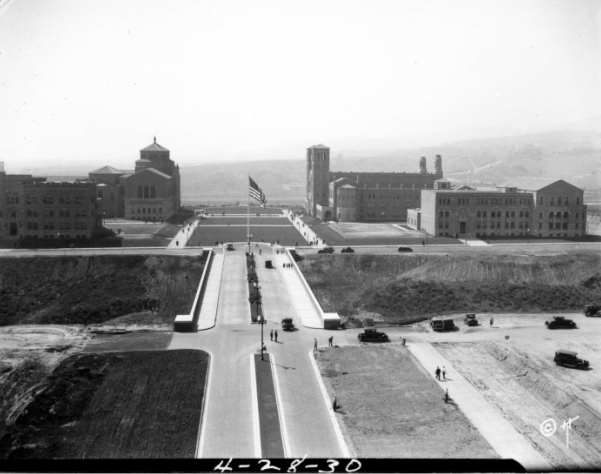
Campus as viewed from the Goodyear Blimp. Photo taken by Thelner Hoover. (Copyright UCLA Library)
UCLA’s narrative is limited however, due to lack of personal documentation about the people, the culture and the events of UCLA in its youth. It can be challenging to weave together such specific historical moments and can lead to a loss of integrity of the events. To fully understand the past that these photos depict, outside research needs to be done. Who are these people in these photographs and what led them to that moment? How do these specific moments all weave together to guide us to an understanding of the way things are today? Research could help answer these questions. Yet, even with these important questions unanswered, the UCLA Historic Photographs digital archive provides necessary context and begins our narrative as an institution.