DH101

Introduction to Digital Humanities

Author: FrancescaAlbrezzi (page 30 of 38)

Gender Breakdown of City Workers by Department

I chose the Gender Breakdown of City Workers by Department dataset from the L.A. Controller’s Office that analyzes salaries of full-time employees by gender from various Departments of the City of Los Angeles from the year 2013. This dataset is presented in a spreadsheet format, also known as a table, and it can also be visualized in a number of ways, such as the bar chart, pie chart, and the line chart. It has 41 rows with each row constituting a record in this dataset. And all the records have year, department title, total employee count, total payroll($), number and percentage of females and males in the department, total salary for females and males($), average salary for females and males($), and percentage of payroll given to females and males, making it a total of 14 variables.

Wallack and Srinivasan define ontology as a “system of categories and their interrelations by which groups order and manage information about the people, places, things, and events around them” (2009:1). As such, this dataset can be categorized under payroll and gender. The website also includes tags for this data, such as “city profile”, “demographic”, “employees”, “gender”, “women”, “equality”, and “wage gap”. Then, this dataset’s statistically motivated ontology is for policymakers and women’s rights activists who are interested in gender discrimination in the workplace as indicated by the gender-based differences in salaries. Since the dataset is primarily focused on the gaps between females and males regarding their payroll, it would make most sense for women’s rights activists to fully utilize this information to push for policy changes and reforms, which may lead to policymakers, both in private and public sectors, working towards ending gender discrimination (someday hopefully).

This dataset tells us that in 2013, except for the Departments of Recreation and Parks, Disability, and Neighborhood Empowerment, females have earned a lower average salary than their male counterparts in their respective departments. And even when females have earned a higher average salary than males, the difference is small compared to other wage gaps across all the departments. For example, in Recreation and Parks, females earned an average salary of $66,834.60, while males earned an average salary of $66,080.69. However, in the Department of General Services, females earned only an average salary of $60,854.75, whereas males earned an average salary of $73,128.41. The purpose of this dataset seems to be to expose the gender discrimination that still exists in the Departments of the City of Los Angeles. It also shows the proportions of females and males in a department, and in some departments, the difference in the proportions of females and males is staggering, which can lead to the perpetuation of biased labeling of a job function as “too manly” or “for women”.

Although the dataset does a good job of listing statistics regarding the payrolls of females and males, it can be better by perhaps adding information about different age groups as well to compare the difference in wage between females and males within separate age groups. And, perhaps, information about education level can further illuminate the characteristics of the females and males and the significance of the wage discrimination taking place.

If I were to start the data-collection all over, I would base my ontology on education and career. Since I am graduating soon, I would love to know what kind of job I want to have in the future. I would collect data on education level, such as college degree and major, industry, position, salary, job satisfaction, and years employed and divide the information based on gender, so that job seekers can have a sense of how much they can earn with their education level.
Los Angeles City: Payroll by Job Class

I chose to explore the Payroll by Job Class data set in the Los Angeles City Departments. Los Angeles City began its data collection on January 1, 2011 and ended on June 30, 2015. The data types included are the year, employment type, job class title, department title, hourly wage and the total earnings for that specific position. For this dataset, each individual counted works in any one of the Los Angeles City Departments. All of the information collected on any one of these people constitutes a record.

Both Wallack and Srinivasan seem to characterize ontology as the organization of information and concepts into structured systems. These ontologies situate the existence of specific information into the community through which they were found. This dataset’s ontology is characterized by the data types collected, as it organizes specific aspects of the Los Angeles City Employee, especially pertaining to the professional world and the economic factors directly related to their profession. This ontology situates this profession-based data within the broader context of Los Angeles. Those represented in the data might find this information most useful/illuminating because these individuals can see how they compare to others that also work in Los Angeles City, especially in economic terms. For instance, if I worked in Los Angeles city, I would want to know whether my pay range is within the same ballpark as others who do similar types of jobs. This information could also be important and interesting for someone who is looking at possibly working in a department for the city of Los Angeles. One who is on the job hunt would likely want to know if their salary is competitive with other companies.

This dataset illuminates a few key things. It lists both the highest paid and lowest paid professions. It also shows which types of professions are the most popular or most in need. By this, it would appear that the City of Los Angeles places high priority on law enforcement. For a prospective employee, one can infer that law enforcement would likely have more jobs.

If I were to re-collect the dataset, I would include a few more details to provide a better understanding of the data. I would include the individual’s time in the profession, to see if any correlation between time and salary (i.e. long time in job, higher salary) could be made. I would also include something about the employee’s sentiment in their job field to also see if there is any correlation between job satisfaction and the higher wages. To switch the perspective around though, I would either separate by level (i.e. entry level, senior management etc.) or shift it to the individual’s point of view.

October 19th Blog Post

Identify its data types

ControlPanelLa contains “Open data” which is data that is accessible, discoverable and usable by the public. It is also free from restrictions and is released in a format that can be retrieved, downloaded, searched, shared and put to use. ControlPanelLA included data detailing billions of dollars spent by the City in various transactions, including 600 expenditure accounts. The annual expenditure figures for the City of Los Angeles includes close to 290,000 disbursements paid out for a total of about 5 billion dollars.

What constitutes a record in this data set?

In computer data processing, a record is a collection of data items arranged for processing by a program. Multiple records are contained in a file or data set. The data set I selected was for Purchasing-what we buy. This was one of the featured data sets in the site that displayed the City of Los Angeles’ revenues and spending and makes them accessible, searchable and downloadable by the public. Users can search for tens of thousands of payments made by the City of Los Angeles to external vendors by department, vendor name, or expenditure type.

Use Wallack and Srinivasan’s definition to identify the dataset’s ontology.

Ontologies may or may not classify things, but they organize information and concepts into a structured system. Wallack and Srinivasan stress that ontologies are the use of classification and description systems that “act as objects” and “negotiate boundaries between groups.” They also state that they function as “mental maps of surroundings.”  ControlPanelLA is set up with featured data base options.

Untitled

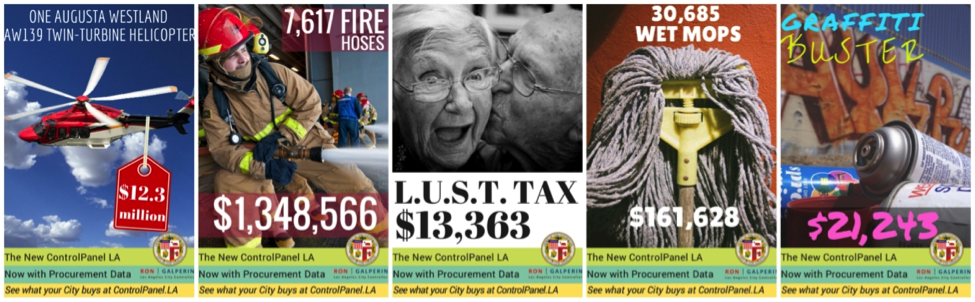
What we buy-Purchasing ,contained these colorful photographs along with dollar figures with annual amounts. This was a nice break down of very specific items graphically arranged for visual effect.

From whose point of view does this ontology make the most sense? (who will find this data most useful and illuminating?)                                                                                                                                                   The target audience of this information is the general public. Everyone who pays taxes or lives in Los Angeles has an interest in knowing how the tax revenue is spent in the City. ControlPanelLA, provides the public with unprecedented, user‐friendly, one‐stop access to LA’s financial data.

What can this dataset tell you about the phenomenon it claims to describe?   What gets left out?

The information and features of ControlPanelLA includes CheckbookLA, (which is a virtual City “checkbook”) that enables users to search payments to external vendors by department, vendor name, or expenditure type. There are search tools which allow for multiple ways to explore and view the data line‐by‐line, or in the form of charts, graphs and other visualizations and Developer tools. It also contains interactive options for users to create their own apps, and to save or to share them on the site with others.

The data provided on ControlPanelLA includes information about expenditures dating back to July 2011, ‐ when the City launched its current Financial Management System. ControlPanel LA – It is a source for data and information about the City of L.A.’s revenues, expenditures, payroll, purchasing, accounts, assets, services. The question of what is left out is a different perspective, other than the City of Los Angeles. These are the city’s expenditures and records displayed from their point of view.

Imagine you are starting over with data-collection and describe a completely different ontology, from someone else’s point of view.

This information contains billions of dollars in expenditures by the City of Los Angeles and it is a databased that they present and control. There are budget decisions, processes for selecting vendors and analysis of the appropriateness of these expenditures that is not addressed. A different ontology might incorporate a different perspective for example that of a tax watchdog group.

Week 4 Top City Earners

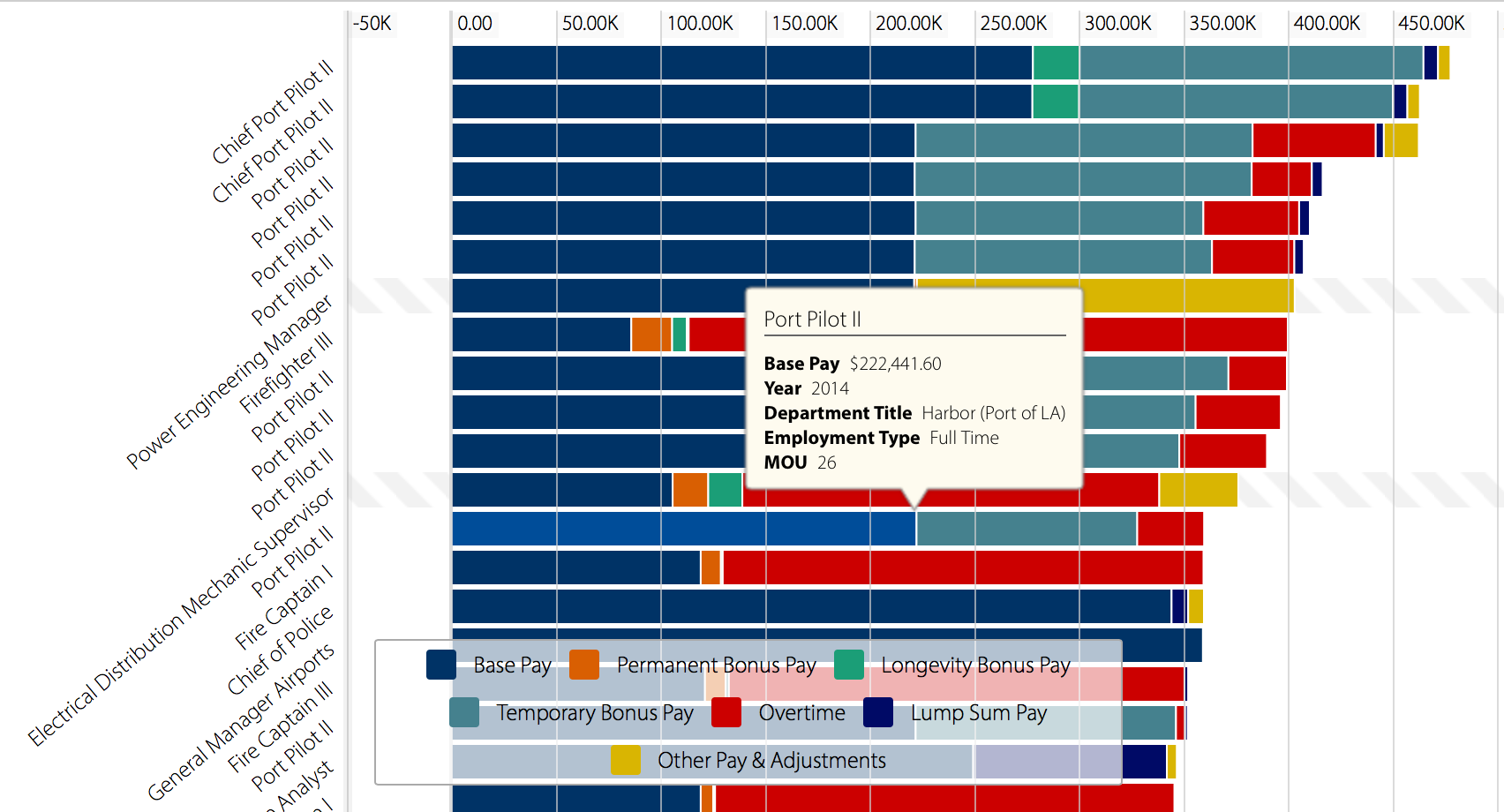
This week I took a look at the Top City Earners dataset and found out a lot of interesting facts. In this specific dataset, the viewer is presented with a bar chart that shows the max earning potential of city/government jobs. It has updated salaries for the year 2014 on the city’s top earning jobs, and to my surprise L.A. Port Pilots claim the top spot. The bar graph is color coded as to denote all types of pay these city jobs receive. Here you can see how the bars are colored:

Screen Shot 2015-10-18 at 2.11.37 PM

Blue refers to base pay, orange is permanent bonus pay, green is longevity bonus pay, teal is temporary bonus pay, red is overtime, dark blue is lump sum pay, and yellow is other pay and adjustments. Essentially it was the L.A. Controller’s Office that has compiled this data overtime and through the years they have been constantly updating it to keep it relevant. It contains the payroll information for all Los Angeles City Departments, from January 1st, 2011 through March 31, 2014.

Anyone interested in working in the public sector of Los Angeles would most likely find this data fascinating as it could help them find what kind of job they want if money is their top concern. If they wanted to be a L.A. Port Pilot, they might want to consider another job because breaking into that industry is very difficult without any connections and entering the Longshoreman’s union is almost impossible. What this dataset tells me is that the city of Los Angeles spent about 4.5 billion dollars on public jobs last year which is a substantial amount of money. I’m not sure what this project is missing. It accomplishes its goal of listing the various L.A. City Department jobs and their respective average salaries. I don’t know what else could be added to make this project more comprehensive. I like it just the way it is.

Anyone can find the project here with this link: https://controllerdata.lacity.org/Payroll/Top-City-Earners/78mt-gezm

LA County’s Top 10 Employers

I chose to look at the dataset of Principal Employers (Non-Government) in the County of Los Angeles, which compares the top top 10 employers in the county in 2005 and 2014. The data types consist of year, name of employing entity, rank, number of employees, and percentage of total count (of all employees in the county). A record consists of the relevant data associated with the individual employers, along with, for comparative purposes, the aggregate information for all other county employers.

While Wallack and Srinavasan do not define ontology as such in their paper, it appears that what they mean by the term is the philosophical underpinning of the way in which real-world events are labeled, categorized, and interpreted (2009:1). In the case of this dataset, then, the ontology appears to derive from a big-business standpoint, in which large entities–whether corporations, universities, or health care providers–employ masses of individuals to provide services or sell things to other individuals. It’s an ontology based in capitalism, and implicitly, as the title indicates, in a bigger-is-better mentality. It also seems to grow out of the the idea of a “company town,” where there are a few big employers and then a host of smaller companies/industries that support them. But given that this is a dataset produced by a local government, the ontology may also reflect the need for the provision of public services: how do all these employees get to work, where are they going to need to live to have reasonable commutes, how much water, electricity, and other utilities are these large centers of commerce going to require to operate? Also, it may be presumed that companies that employ large numbers of people are equally out-sized in terms of their tax contribution to the county coffers.

If number of employees is a sign of a successful business, then this dataset indicates not only what are the most successful businesses in Los Angeles County, but what kind of businesses are successful: this is a set that skews toward a service economy, not a production economy. Although there are only two time periods represented, you can see that, while most of the names remain the same, it’s probably significant that AT&T and Vons, which were on the 2005 list, do not appear on the 2014 list, and are replaced by Home Depot and Providence Health, which probably reflects larger trends in their respective industries as much as it represents the rise and fall of individual companies. However, it’s also significant that these 10 employers constitute only about 4% of all employers in the county, as the “All Other Employers” category represents just under 96% of employers in both years.

This does lead you to wonder why “number of employees” has been chosen to represent–what? Sheer size? Whoever “owns” the most working bodies wins? Is bigger better? The inclusion of USC and Cedars-Sinai on both lists may indicate a need for public transportation to help get employees to and from a limited number of work sites, but there are Home Depot, Ralphs, and Target stores all over the county. Also, there is no breakdown of what kind of employees these are. Boeing and Northrup appear on both lists, but are these manufacturing jobs or management? If this dataset stretched over many more decades, what kinds of trends would we see emerge? Would the big movie studios of the 1920s-1950s appear in the top 10? Would the top 10 employers constitute a larger percentage of the employer pool at different points in time?

If I were starting from scratch, I would be inclined to categorize employees by what kind of work they do rather than who they work for–not only larger categories of industries–health, education, sales, manufacturing–but also job types–for instance, another dataset, Gender Breakdown of City Workers by Category, includes categories like paraprofessionals, technicians, protective services, skilled craft, etc. Given that the top 10 only constitute 4% of employers, this would shift the ontology from a bigger-is-better mindset to a reflection of what citizens are actually doing during their workday. It would also better incorporate data from smaller companies, individual entrepreneurs, and freelancers in an increasingly fragmented economy.

Week 4 – Payroll in LA City Department

The dataset I explored was payroll for employees in all Los Angeles City Departments. The data ranged from January 1, 2011 to June 30, 2015. The data types included in the set were year, employment type, job class title, department title, hourly rate, and total earnings. In this dataset, a record is an individual working in the Los Angles City Department. The record contains the individual’s values for each data type.

Srinivasan and Wallack generally agree that an ontology is a method of classification of information. This categorization results in bias as the mere act of separating knowledge into groups creates a narrative. The narrative likely subverts the knowledge and manipulates it into a structure that is characteristic of the more powerful knowledge structure. Srinivasan states that an ontology is used to situate knowledge into a community. Regarding this dataset, the ontology is characterized by the data set listed above. It is contextualized around Los Angeles and is very Westernized as it uses terms, like dollars and mayor, that seem to be endemic to the United States. Ultimately, this ontology makes sense as it reflects the topic of the dataset.

This dataset will likely be most interesting to employees within the Los Angles City Department. Since the data is so limited and specific, it will cater to a smaller audience. Most individuals would not be interested in this data. It caters to an audience already interested or invested in the Los Angeles City Department.

The data illuminates the highest paid employees in the city department and the lowest paid. Employees of the police and fire departments are the highest paid, and veterinary aids and council aids are the lowest paid employees. This dataset elucidates that the Los Angeles society places the most importance on law enforcement. This fact may change according to different societal environments. For example, if the same data was collected in a country where law enforcement was not valued or it was not as highly developed, then the numbers would be vastly different.

However, the data does not include many factors that could widen its audience, such as job satisfaction and intensity. Under the same dataset, I would explore job satisfaction and perceived job intensity. I would either survey the individuals or access previous research. I would attempt to discern whether job satisfaction evolved over the years within the same jobs and if perceived job intensity correlated with pay and job satisfaction. Including these data types could garner more interest from a larger audience and be more universal. I believe more people are interested in job satisfaction and its relationship to job intensity. Therefore, this expansion of data would also widen the target audience. Furthermore, this data would be from the point of view of the individual rather than records from the department, therefore providing a new perspective.


Shannon Martine Week 2-City in Mind: A Lyrical Map of the Concept of Los Angeles and My Search For Its Actual Exsistence


unnamed

“City in Mind: a Lyrical Map of the Concept of Los Angeles”

la-map-libros

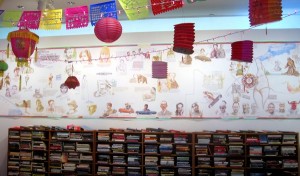
 City in Mind: a Lyrical Map of the Concept of Los Angeles is a 23 foot long and 5 foot high hand drawn map of Los Angeles highlighted by portraits, quotations and lyrics from writers, journalist, historians, poets, and musicians that are all centered around our fabled city. The map is the brain child of contemporary artist J. Michael Walker and features  geographic snapshot of LA from Santa Monica to Downtown. It was first shown at a downtown coffee shop art exhibit then Hammer Museum and eventually bought by UCLA. The map is not exactly topographically correct and is more so focused on providing various perspectives of Los Angeles. With quotes from Will Rogers to Charles  Bukowski to Tupac and Joni Mitchell, the map shows a loving portrayal of the city.

“I thought there was a lot of potential for discovery and resonance inherent in making it a map that used literary references…Particularly by authors who lived in Los Angeles–if we used some of the most powerful quotes we could lay our hands on.” – Artist J Micheal Walker

DSCN0444

As a 28 year Angeleno native, this imagery resonated so much with me. Walker spent time talking to several ethnic communities in Los Angeles and aimed for the map to be a representation of Los Angeles beyond the stars but the soul of it as well. I chose this from the list of UCLA repositories on the color pencil thumbnail of Joni Mitchell alone.  But sadly none of the pictures would load. So I searched all I could find out about it at home and then planned to see it here on campus at Powell Library. No one knew what I was talking about. Every Powell librarian and assistant told me to go to Young Research Library and everyone at YRL told me to go to Powell. I was devastated.

If I were to write on this piece. I would focus on its inception and its journey from a coffee shop to UCLA (allegedly). The piece encapsulates the parts of Los Angeles that locals love. Our history told by us, in our language and art form. For more on the piece please listen to this Daily Bruin Podcast.

Index of Medieval Medical Images (IMMI)

The Index of Medieval Medical Images (IMMI) is a digital collection of drawings, sketches, paintings and manuscripts about medicine and human biology from Medieval Europe. Examples include physicians’ and surgeons’ diagrams of the brain function, manuscripts about instruments used for head and rectal surgery and instructions on how to make an incision in a person’s ankle. Metadata about the source of data, date, place of origin, content, dimensions and type of data  are provided on the website.

Based on the archive, one research question worth delving into is, how advanced was Medieval Europeans’ knowledge about the human body? Based on the descriptions of the manuscripts provided, we can get an idea of how they visualized the human brain and conceptualized its function, for instance. Of course, outside research is necessary to crosscheck how accurate their understanding of organ functions, illnesses and surgeries was. Given that many of the manuscripts are illegible (because of the handwriting) or written in another language, it might be difficult to extract meaning from the manuscripts ourselves. For some of the images, not enough description is provided to get a good understanding of what the images mean. Outside research on the content of the manuscripts might be necessary to fully comprehend the extent of their knowledge.

The logical follow-up question to ask would be, were they able to treat patients effectively based on their understanding? So what if their theories were accurate? Did they work in practice? How much trial and error did physicians go through to come up with a working theory? It would be difficult to find out how successful the surgery processes were and how effective the surgical instruments were simply based on the archive. We can determine what they knew, but the archive does not provide information on the repercussions of their understanding as well as the behind-the-scenes story about how the physicians came up with their theories. One way to remedy the lack of information is to conduct some outside research on the efficacy of their medical theories. Taking keywords from the description of the images (such as the name of the drawing, name of the artist and the institution that owns the collection), we can branch out our research and retrieve more information about the data in question. It’s possible that the institution provides more information about the data or that the artist has a body of work that has been analyzed by medical experts today.

It’s important to know that we can go beyond what has simply been given to us.


UCLA Library’s Bonnie Cashin Collection of Fashion, Theater and Film Costume Design

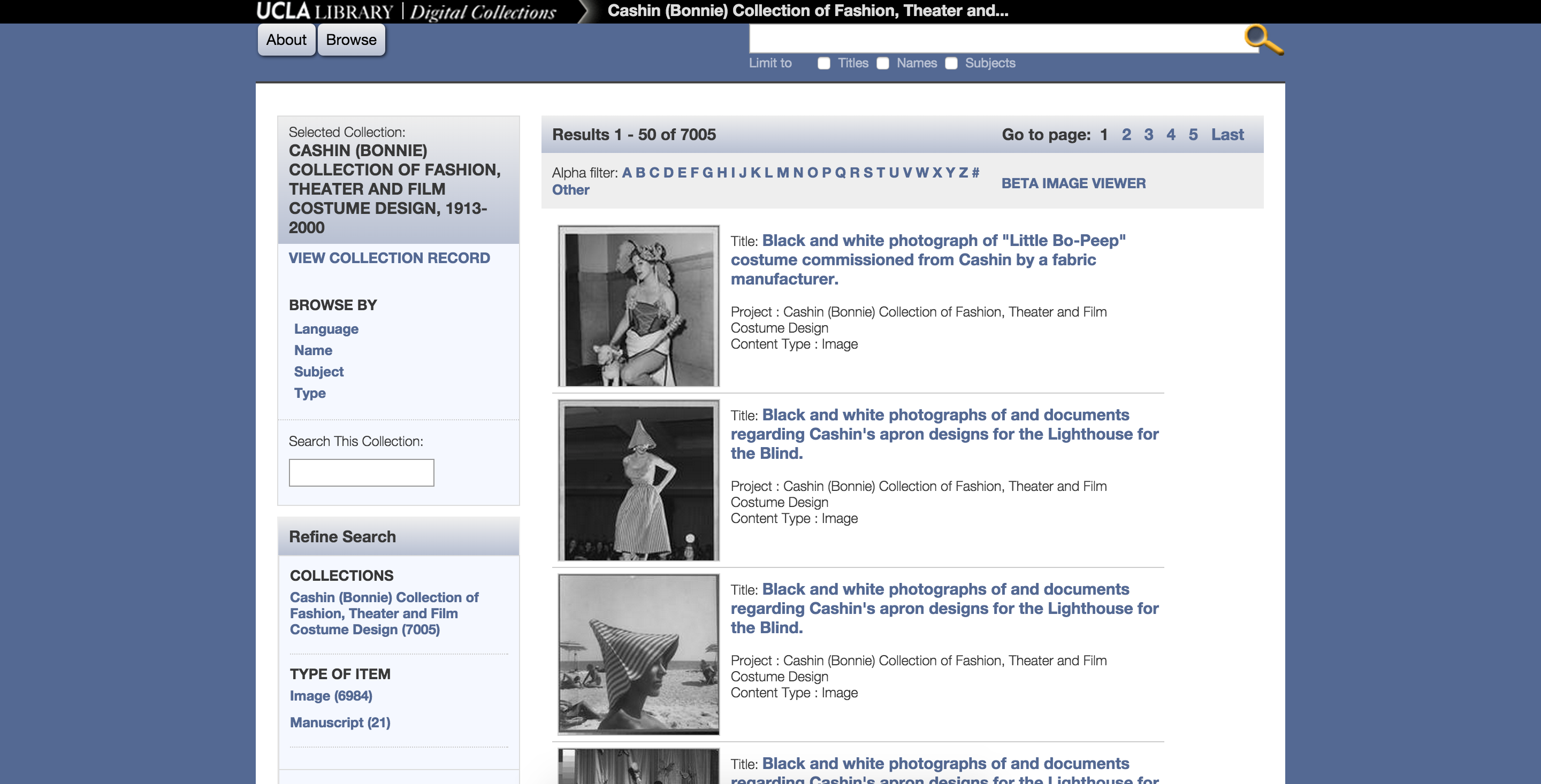
Bonnie Cashin has been renowned as one of the greatest designers of the 20th century, and is credited as the pioneer of women’s ready-to-wear fashion, otherwise known as sportswear. Her unique silhouettes, through use of ponchos, kimonos, and various layering techniques, are now considered timeless and can still be seen in fashion trends today. UCLA Library’s Bonnie Cashin Collection of Fashion, Theater and Film Costume Design gives us a unique look into the fashion world of Cashin throughout the decades. Through this database, we are offered Cashin’s sketches, look books, catalogues, marketing materials, front-row fashion show still shots, and movie still shots, all showcasing the designs of the legendary women sportswear designer. As a former intern for BCBGMAXAZRIA, I personally love this collection. Designer’s conceptual materials often do not see the light of day, and the database offers a peek into the creative mind of a huge name in the fashion industry.

Screen Shot 2015-10-12 at 12.56.29 PM

The database contains over 8,000 images from Cashin’s various lines and collections throughout the years, ranging from 1913, on through her late works in 2000. If one were to write a paper on this database, multiple stories could be told. From a fashion standpoint, the story of Cashin’s aesthetic could be told through analyzing the silhouettes of her looks, the materials used, the fabric manipulation techniques employed, the trends utilized (and pioneered), etc. One could further divide this analysis into her work in different fields, such as her film and television costume work for Twentieth Century Fox, her ready-to-wear lines for coat manufacturer Adler and Adler, and her conceptual sketches for fur companies, and even the window displays of her flagship and department store lines. The database could also tell the story of Cashin through an industry perspective, as the collection includes press releases, press clippings, fashion editorials and brochures, marketing strategies, boardroom notes, among others.

Although the database is successful in telling multiple stories from Cashin’s perspective, the collection would not be able to stand alone in telling the story of the fashion world holistically, as Cashin is only one designer in such a large industry. As mentioned before, the Cashin’s looks are consistent and considered timeless, employing silhouettes and techniques that are still seen today; paired with the layout of the database (non-chronological), it would therefore be difficult if one wanted to report on fashion trends representative of these specific time eras alone. To remedy this, it could have been helpful if there were a filter provided to arrange the photos in chronological categories. Furthermore, the database can tell the story of Cashin’s creative mind, but not the story of her commercial success. The database does not provide insight from the consumers’ point of view, as it’s voice is strongly that of the industry’s point of view, evident in it’s showcasing of unedited black-and-white photoshoot proofs, press coverage, etc. To remedy this, the collection could have include sales figures, photos of everyday women wearing her looks as opposed to models, etc., although this may be hard to do as time travel is impossible.


Los Angeles Aqueduct Digital Platform

The Los Angeles Aqueduct Digital Platform is an incredibly comprehensive archive documenting the history of the LA Aqueduct, and has a huge variety of stories to tell. It categorises its content into three branches: archives, resources and scholarship. Inside the archival portion of the website, you can filter and search through 3381 records, including photographs, newspaper clippings, letters and legal documents, all of which are geolocated mapped. With such a vast collection of records, the controversial decision to build the LA aqueduct and the subsequent histories are very easily accessible through this platform. Inside the resources section, you are presented with official Department of Water and Power blueprinted maps as well as publicity maps produced for the public. The resources section also includes government publications, films, digital media (including a car audio tour through Owens Valley) and oral histories under a bibliographies tab. The LA Aqueduct has in fact played a large theme in many Hollywood Films and has thus been well documented in this form, too. This digital platform succeeds in effectively reporting on these films and their roles. The scholarship content consists of descriptions and details of the aqueduct’s construction and fictional personal accounts of the construction, newspaper clippings shedding light on the culture and mainstream attitude of the day and photo collections. What is especially impressive is the video interview featuring primary source accounts of the St. Francis Dam Disaster. In addition, the platform offers valuable environmental content, much of which speaks for today’s current water crisis in Southern California. This documention of hazards and data on the future rates of flow also provide pertinent warnings for the future of Los Angeles. Owing to the fact that this digital archive is very well put together and there is a large variety of source data, you can tell a very thorough, well-rounded story with this archive. There is also very effective metadata visualisation of the source material which can bolster one’s analysis of the whole picture surrounding the history of the LA Aqueduct.

Older posts Newer posts

© 2026 DH101

Theme by Anders NorenUp ↑