The Index of Medieval Medical Images (IMMI) is a collection of 13 manuscripts that have been digitized and are accessible through the UCLA library. Along with a digital copy of the manuscript, each entry also includes the repository, date of creation and place of origin. Despite being called medical images, most are primarily pages of text with images in the margins. These images are not all medical related but are often portraits of scholars or saints. In this way the title of the index is slightly misleading. The sources of the manuscripts themselves are from UCLA, Yale, University of Vermont, the Rosenbach Museum and Library, and the National Library of Medicine.
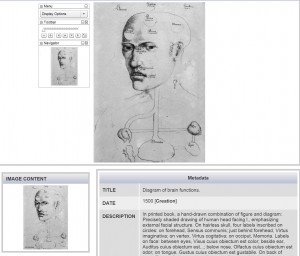
Another challenging aspect of this archive is that the sources are not translated. We would have to translate them ourselves or concentrate on interpreting the images. Concentrating exclusively on the images limits what can be done with these sources. Assuming that we could translate them in some form, we could do a series of things with these manuscripts.
Having the manuscripts available digitally enables us to easily compare and research them. One approach would be to look at these manuscripts, in particular the images, and see what healing was associated with during the middle ages as a whole. Along a similar vein, we could use these manuscripts to study medical practices of that time and compare them to ours now. In doing this we would concentrate less on the practices themselves, which clearly have changes over the past millennia, but more on how these practices reveal their understanding of the human body. Concentrating on their understanding, we could actually learn how correct or wrong their views were.
Another interesting rabbit trail would be to investigate the sources of these manuscripts and compare the different practices between source locations. This is a more difficult enterprise because the location of the manuscripts may be lost. The location where the manuscripts were acquired by the last owner does not necessarily mean that that is the source of the manuscript, which could have traveled with numerous precious owners. This sort of comparison is also assumes uniform knowledge across time at any particular location. And while it may be tempting, it would not reveal accurate information. If we had more sources, then this approach would be more plausible. To do this we could search for more manuscript sources, perhaps which were transcribed online, not digitized. This would hopefully broaden our scope.