The repository I examined was the Los Angeles Times Photographic Archive. It features a variety of pictures, revolving around the 1920s and 1930s.
With this source I could write a paper on the several different narratives. One of those narratives could be the fashion of the time of each piece, and how that changed over time. In the first photo, most of the men are wearing fedoras and nice suits, while the women are wearing conservative dresses. The formality of dress could be explained by the fact that the photo was taken at the Rose Bowl Parade in Pasadena, which would be considered a special event. By comparing the fashion trends of the photo with that of modern day photo, perhaps a photo from the Rose Bowl Parade from January 2015, I could produce an interesting analysis of past and present fashion trends.
Since a large portion of the photos are in fact the Tournament of Roses Parade, which is a tradition that is still around today, I could also acknowledge the similarities and differences in the festival itself. I could answer questions such as “Are the modern floats and pageantry displays any different from the 1930s?” or “How has spectacle changed since the 1930s?” Problems I may run into when answering interesting questions such as these ones is the lack of timeline progression of events. It would make my narrative much more exciting if I was given access to photos of the event throughout the 20th Century, allowing me to analyze and compare a larger set of parades. This would especially important for the floats, because I could see which floats continued to appear in the Rose Parade, and therefore were staples in the Rose Parade’s purpose, and which floats only appeared for a short amount of time. Obviously expanding my research to find these photos could easily solves these problems for me.
The inclusion of metadata in the digital archive is really helpful in the creation of narrative between the pieces. The metadata is in fact that way I found out that all of these photos were taken at the same event spanning the 1930s. Because of this metadata I could potentially recreate the feel and substance of a 1930’s Tournament of Roses Parade. These photos give insight into the look and feel of the event, and with the metadata linking them together, a narrative could be formed. However, the archive would have to provide a little more information for this narrative to be acceptably fleshed out. It would be helpful if this repository provided not just dates but context, or personal anecdotes, about those pictured in the photographs.
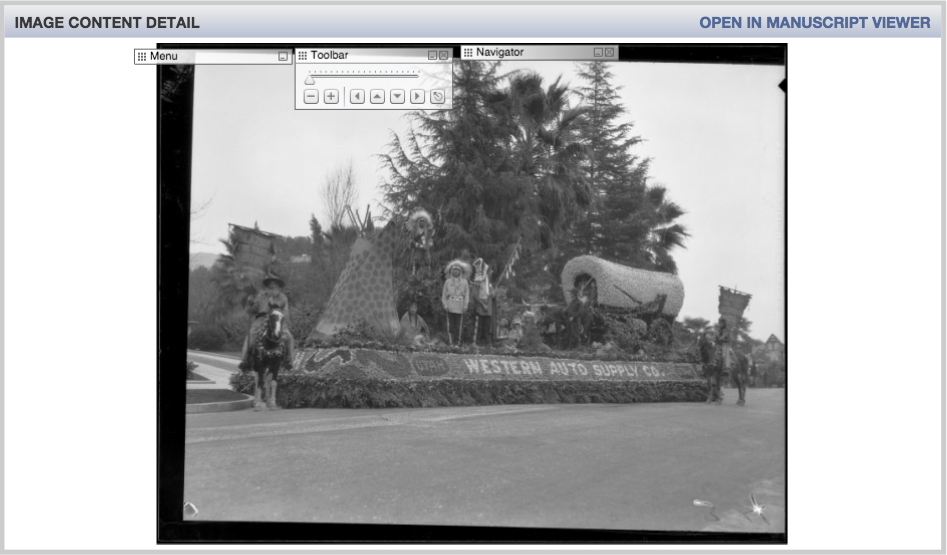
“Blazing the Trail Westward” float in the Tournament of Roses Parade, Pasadena, 1928
It is one thing to include a photo of the Western Supply Co, it is another entirely to include information as to WHY the company participated in the parade, and why they chose Native American imagery in their float. The context of the Great Depression is also an important angle to consider when producing a digital humanities project about this archive. These problems could be remedied through several interviews with primary sources, such as the people who put on the parade or those in attendance.