http://digital2.library.ucla.edu/viewItem.do?ark=21198/zz00253vz2
I was absolutely delighted to find a repository of Aldous Huxley. Being the philosophy nerd that I am, I was genuinely excited to explore the content of this archive. The archive has absolutely no aesthetic appeal, but I do not think that that is the purpose of an archive in general. It is very neatly organized into four distinct categories, which include audio, videos, collections (of some of his works), and photographs.
One aspect of his philosophy that I have been especially attracted to is outlined in his novel “The Doors of Perception”, in which he details some of the more profound experiences he had taking psychedelic drugs (mescaline). During these drug trips, he recorded his experiences on an audio tape in order to give the listener insight into what it is like to have an altered state of consciousness. I have always found this topic fascinating, and the way that the repository has been able to compile these ground breaking recordings is not only convenient for easy access, but mind-blowing.
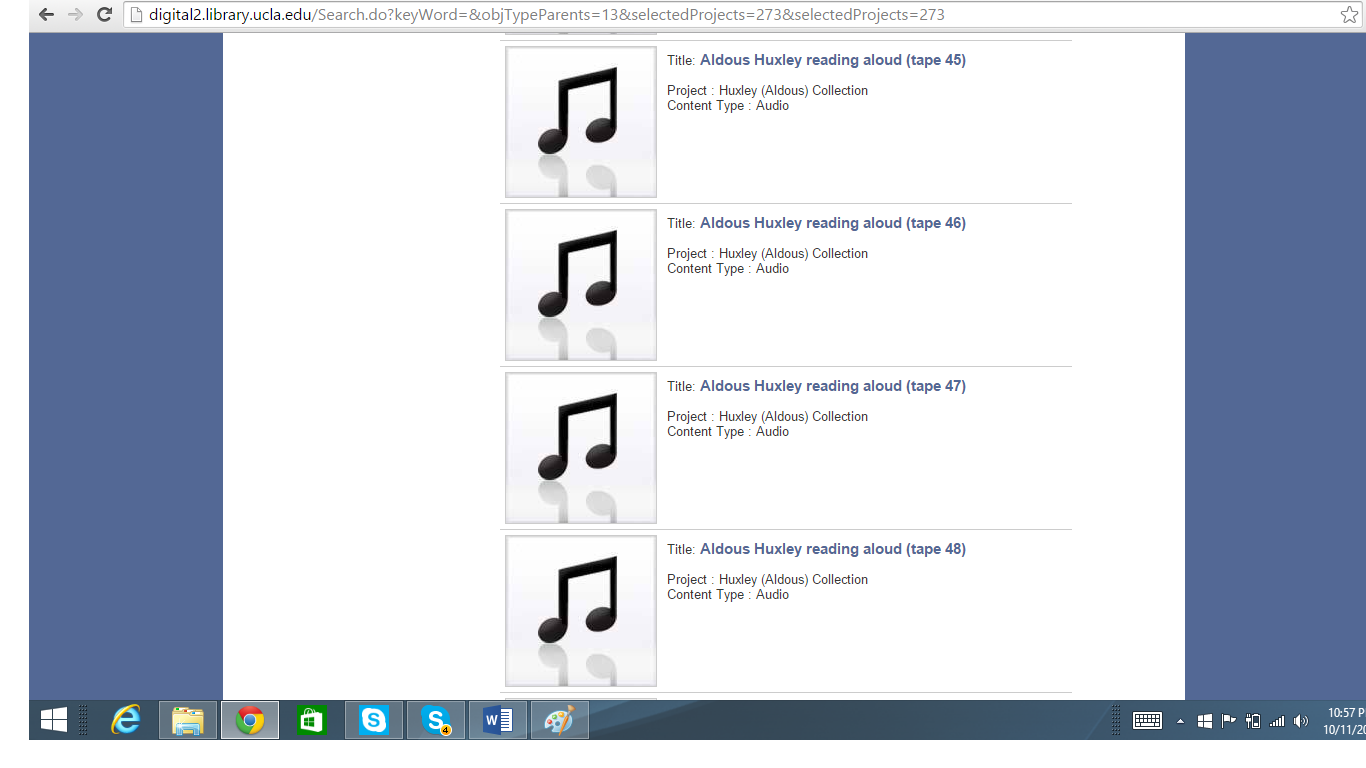
It would be very easy to tell a story about Huxley’s life, because there are 123 images of him throughout his life, from a young boy to an older man. It would be possible to fit together bits and pieces of these images in a way in order to get a more complete image of the life of this interesting man. The amount of audio recordings in this archive is massive; 544 to be exact. There are some audio files about specific details of his life in general, but, as mentioned, far more interesting are his multiple accounts on the mind. He speaks in great detail about how his mind responds in certain ways in sober states and also drug-induced states. I would write a story that would compare and contrast his varying states of mind depending on whether he is in a sober state of mind or on mescaline; this would make for a very interesting story because I would be able to uncover various contrasts in the mind of a single individual.
However, there would be a missing element to this story; I would not know when he would be experiencing this different states of consciousness and as a result it may be difficult to adequately track his progress as he delves into the mystery that is the mind. The repository does not include dates of the audio files, and to make matters worse they are not in any temporal order. If I had the ability to alter this archive, I would first include the year the audio recording was (taken to the best of my ability given available evidence). I would then give the user the ability to organize his famous recordings by years. This would give the user a more compelling, cohesive story of how Huxley’s conscious states changed over time.