Aldous Huxley is well known for the book Brave New World, written in 1931. The UCLA Library Digital Collection’s Aldous Huxley Paper, created in 2009, reveals the personal histories behind Aldous Huxley’s life, from 1894- 1963. The archive collects information between 1925 and 1963 through scanned photos of his childhood to handwritten postcards to sound recordings with his wife (Laura Huxley).
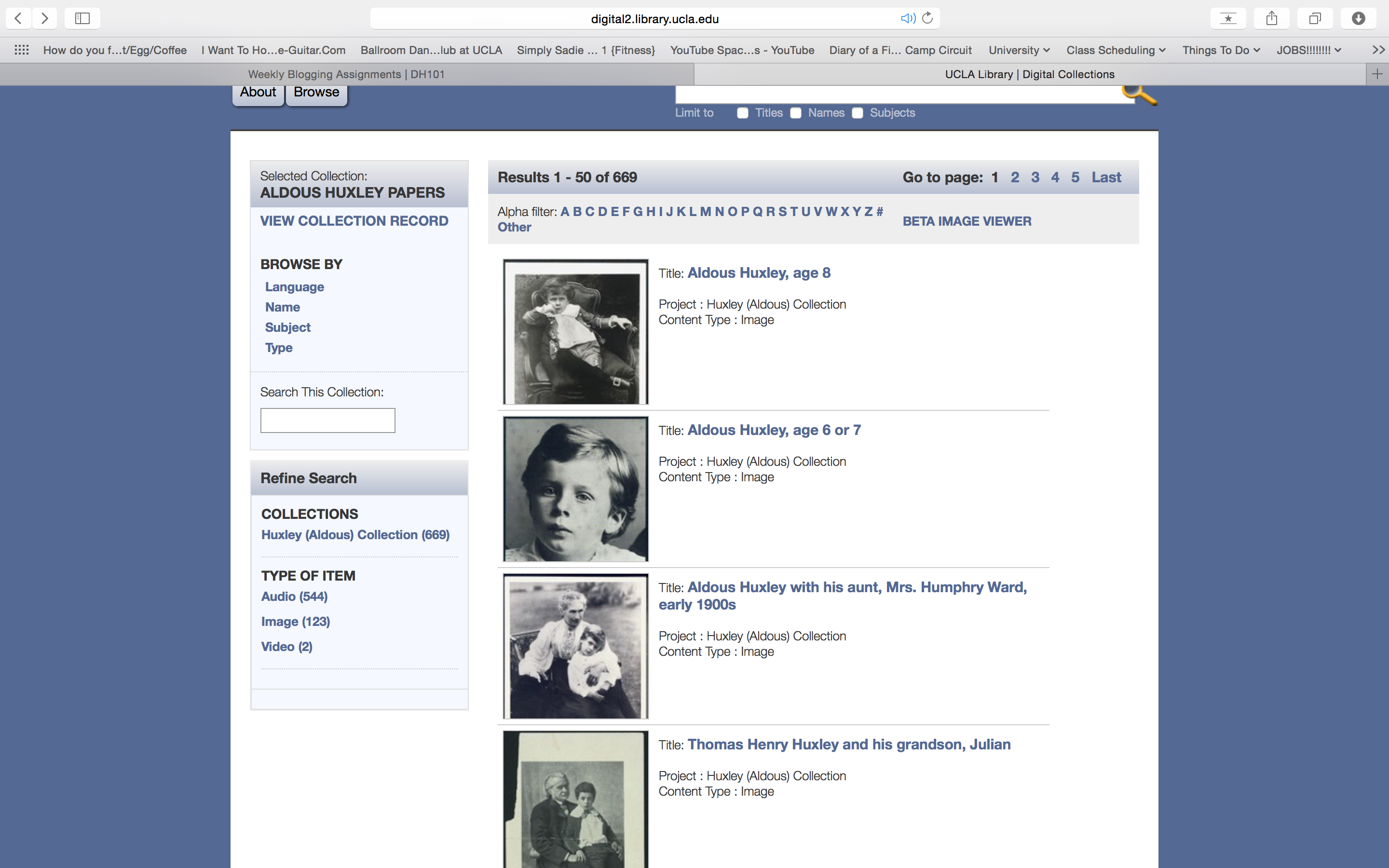
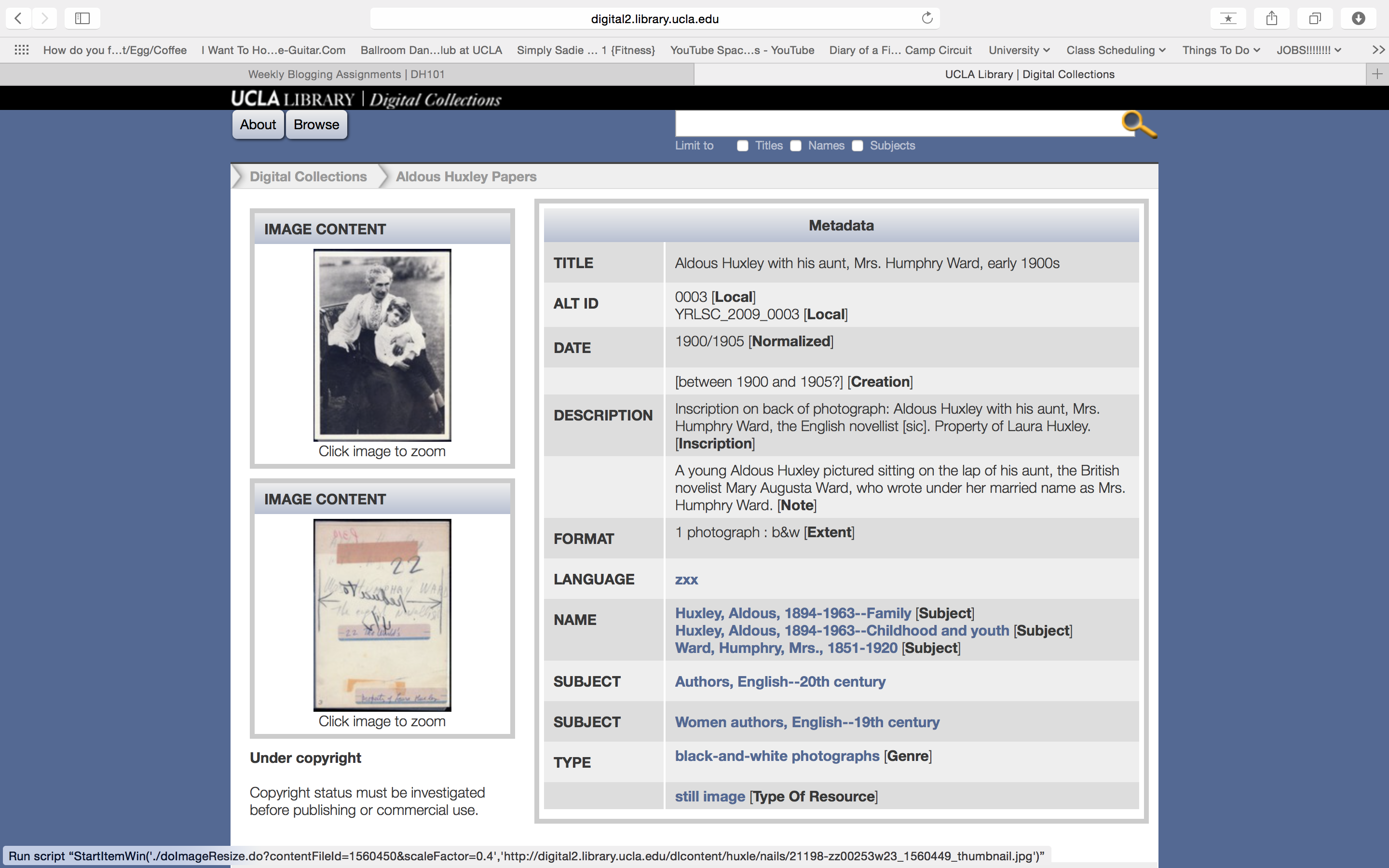
This archive lightly covers stories of Huxley’s family members, providing the audience with context of Huxley’s potential influences that promoted his writing career. For example, the archive holds a photo of Aldous Huxley with his aunt, Humphry Ward. The image alone only shows the family lineage. However, by the archive’s incorporation of metadata of dates and descriptions, the archive reveals that Humphry Ward was an English/ British novelist as well.
Through this archive alone, I would be able to see the biographical stories narrating the relationships that Huxley maintained. There are many accounts and photographs illustrating the relationship Huxley had with his first wife, Maria Huxley, and second wife, Laura Huxley. Moreover, the archive does not only cover Huxley’s timeline, but involves many photos of the histories of others, especially Laura Huxley. The viewer can browse through Laura Huxley’s photos as a young lady, her portraiture and listen to her seminars. However, there isn’t nearly as much information or data of his first wife, Maria. There are even multiple stories revealed between the brotherly relationship that Huxley held with his brother, Matthew, through the images of the postcards they exchanged in Italy.
On the flip side, the archive does not go in depth into the personalities of each person, merely underscoring the existence of each person involved in Huxley’s life. In order to remedy the lack of information in the metadata, it would be useful to find other biographical websites of Huxley’s history that dictate the characteristics that defined Huxley, as well as the others connected with Huxley, during his time. Also, as mentioned earlier, Huxley was a writer. Yet, someone who was not aware of this detail may not have actually known that he was a writer from the archive, simply because the information presented hold a more prominent emphasis on the lifetimes and life stages of Huxley (and friends).
I find that the importance of this archive lies within its ability to, in a sense, immortalize Aldous Huxley and his work. The archive essentially enables Huxley to continue working in the lives of others and affecting others, as if he was alive, even when he is gone. Virtual tools, such as these online libraries, preserve works and images that physically deteriorate faster than that of an online presence.