This week I decided to look at the very first archive which is title La Accion Socialista which was a socialist newspaper published in Buenos Aires, Argentina. The years in which the issues are available to be seen are from 1905-1907 and the year 1910. For an individual fluent in Spanish, they could learn about the political and social atmosphere in Argentina at the very beginning of the 20th century. One could reiterate the stories, sentiments, and hardships of the working class by reading this left-wing newspaper. With three years of material, there is a vast collection of information that could be utilized to compose a story about the Argentine Revolution of 1905, also know as the Radical Revolution of 1905. As a predominantly English speaker with limited ability to speak or read Spanish it would be challenging for me to determine what was going on in Argentina; however, if the archive implemented a translation tool then I would be able to decipher the emotions and opinions of the large socialist movement that was going on in Argentina in the beginning of the 20th century. As you can see here the newspaper is written in Spanish and was primarily directed to the working class as the title of this piece is WORKERS in Spanish.
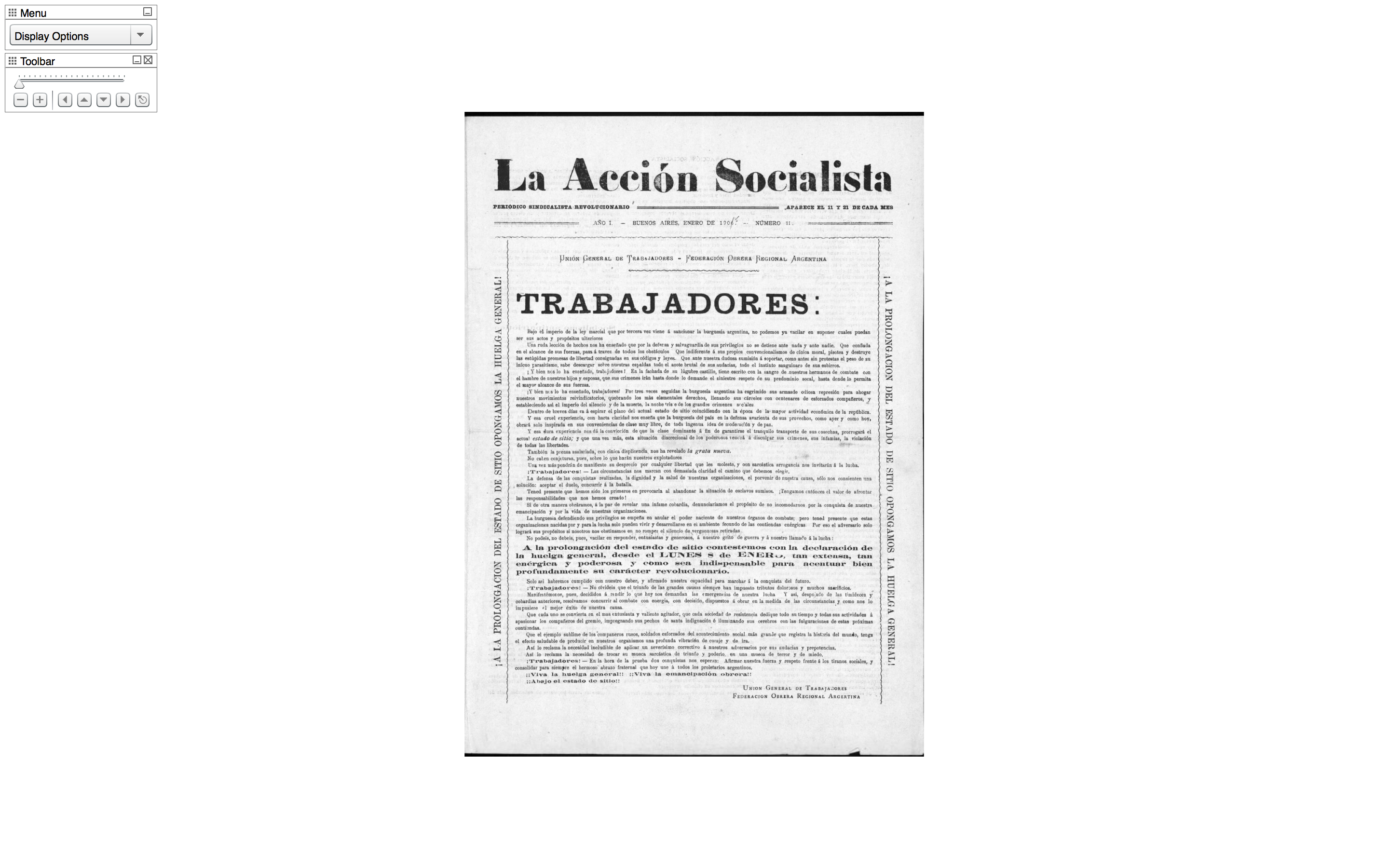
This paper is inherently biased as it only really explains and documents socialist sentiment, so while it provides insight into this particular group’s feelings it most likely doesn’t acknowledge the other side of the political spectrum, the conservative side of Argentina. I think the archive could really be improved if they provided other newspaper issues with other opinions other than just the socialists just to create a bigger picture of the political and social environment in Argentine during this troubling time period where a revolution was actually happening.
In conclusion, I thought this archive was really cool because I am able to read Spanish moderately well and words I don’t know I could easily find definitions for or just figure out the meeting in context. However, I will reiterate that I think a translation tool would be very useful for those who are unable to read Spanish and who are interested in this exciting time period in Argentina. With the implementation of the translation tool this project would reach a lot more people. Anyone can look at this project here: http://digital2.library.ucla.edu/viewItem.do?ark=21198/zz0028tdsv