In the present day, we are overloaded with media and advertising, and the field of health and medicine is no exception. Whether you are muting a bizarre Mucinex commercial or hearing your sick friend count down the minutes until they can take their next dose of DayQuil, you intake suggestions from media and people about which medicine you should use – like any product, it needs to be advertised in order to create revenue. Before the invention of TVs and even public radio, remedies were publicized through simpler means, as shown by the Patent Medicine Trade Cards Collective: an archive that contains 247 trade cards that advertise medical compounds in circulation from 1860-1906. The front of the cards are embellished with a colorful illustration and the title of the medicine or company, and occasionally feature a brief description or slogan, and the back has a description of the topic being advertised. They’re almost like advertisement flash cards; the key term is on the front, the definition is on the back, and the image on the front helps create an association with the term so you won’t forget it.
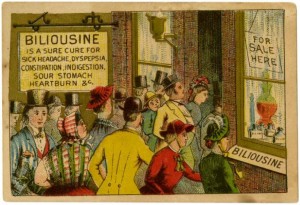
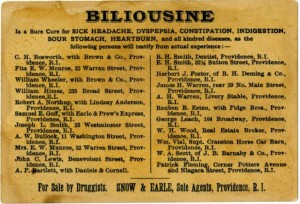
If you were to write a paper based on this archive, you would be able to choose between a few different paths. One essay you could write is a comparison between the advertising techniques for a certain kind of ailment or disease – e.g. looking at all the trade cards for dyspepsia and see what commonalities or differences they have in their use of illustrations and language. This would be expedited by the ability to search the archive by “Subject,” which provides an alphabetical ordering of all the topics on the cards. However, this search function is slightly confusing, as its categories list actual diseases like “Anemia,” but then also has categories like “Angels” and “Dogs.” The latter categories actually refer to descriptive topics – the illustration on the front of the card – rather than the actual concept topic.

This somewhat baffling organization does lead into another possible paper story: the card art. By perusing these descriptive categories, it would be interesting to see what patterns emerge. Does a prevalent use of dogs in illustrations indicate their significance to the audience, or do they have some correlation to medicine? While this archive would provide the primary sources of art for such an essay, outside research would be necessary to back up any claims made about themes that can be traced through the illustrations. The archive could fulfill at least part of the need for context by providing a section of historical background, and a timeline of revolutionary medical advances or relevant global events.
This archive is not well-suited for writing an essay analyzing geographic patterns of medical compounds – for instance, whether some areas featured a certain type of medicine more than other areas, and whether that has environmental or societal implications – because there is no way to search by the “Place of Origin.” While the cards do list an origin once you click on them, clicking on each individual card to see where it is from is not a feasible method for writing a research paper. An interactive map would be useful in this case since it could pinpoint geographic origins of each of the cards, thereby providing a better idea of where the highest distribution concentrations were. As is the case with place of origin, there is no way to search through the cards by date. This would make it challenging to write a paper tracking the changes in types of medical compounds, and/or methods of advertising such compounds over a period of time. Both of these problems could be fixed by creating headings that group the cards in different ways: alphabetically by name (the current system), and then by year, place of origin, publisher, descriptive topics, concept topics, etc. This would provide a streamlined and effective method of grouping data and assisting visitors in pursuing the content path they wish to follow, rather than forcing viewers to virtually shuffle through cards.