Purpose and Product
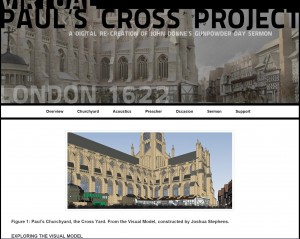
Virtual Paul’s Cross Project is a multi-layered project that aims at enabling the viewer to see and experience the November 5th, 1622 (Gunpowder Day) sermon by John Donne at Paul’s Cross. The project produced two separate models, visual and auditory, which are integrated and put into context with a textual description of the various aspects of the event. This sermon was chosen because Donne’s Gunpowder Day sermon is well documented and enables the exploration of early modern London preaching, which was done as a public performance.
Sources
Digital Model
The digital model finds sources in things ranging from archaeological documents to various drawings of the surrounding structures and even to descriptions of Paul’s Cross itself. Archaeological findings provide concrete dimensions of the foundations of Paul’s Cross and the surrounding structures. While the elevation can be seen in drawings, the dimensions were determined from textual descriptions that roughly described the height and space available inside Paul’s Cross.
Audio Model
The acoustic model incorporates an actor reading the sermon, the sounds of various estimates of attendees, and other ambient sounds. The model itself was influenced by the visual model which was taken into account to be as accurate as possible with the actual acoustics of Paul’s Cross.
Textual Descriptions
The textual descriptions of the sermon, environment, and preaching style of John Donne find their sources in various contemporary descriptions of Donne, a manuscript of the speech, and other documentation of Paul’s Cross. The speech manuscript was found at the British Library.
The environment depicted in the digital model and described in the textual description was created from a source that deduced the weather and sun’s position during the speech.
Processes
The digital and auditory models were created with Google Sketch-up and an acoustic simulation software. The architectural model was created first and was then used in the acoustic simulation to ensure the accuracy of the acoustics.
Presentations
The project is segmented into various parts for presentation. The physical model and acoustics each get their own sections of the site. Sections were made for describing the Preacher, Occasion, and Sermon separately. This is separation allows for easy access to the specific sections of the model which can be viewed largely as independent parts.
The presentation of the physical model is done primarily through a video which gives fly around views of the model in black and white. The video pauses in various locations where the image then becomes colored and filled with detail as a painted scene. While this presentation is effective, it does not enable the visitor to interact with and explore the model.
The acoustic model presents various sound clips of the sermon and ambient sound from various locations around the churchyard. The sound bites also enable the visitor to experiment and listen to the various attendance estimates that the project explored.
The Preacher, Occasion, and Sermon sections are presented in their own sections as essays. These sections provide context for the sermon and its importance in history and why it is being researched so thoroughly. It is also on these pages that Donne’s style is described along with an explanation of the environmental research.