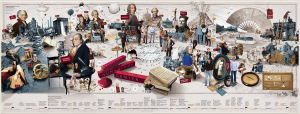
Mapping the Republic of Letters is a digital project that maps out and connects the network of scholars that corresponded with each other, otherwise known as The Republic of Letters. The project, created by Stanford University scholars and professors in collaboration with international partners, is made up of case studies that you can go into and explore to see the deeper connections. The user can go into the project and discover the correspondences between great thinkers and study in further detail, the Republic of Letters.
Sources:
The digital project is based on The Electronic Enlightenment Database which is an archive of over 50,000 letters from the correspondents during this period of time.
Process:
The information was separated by author and location, and then put into a timeline, in order to see the time between each letter and connection.
Presentation:
The project was presented and separated by different case studies which are divided into difference categories, such as Correspondence, Publications, and Travel. However, as you go further into the website, you are able to explore the different connections between individuals, the project turns into a data visualization which lets the user see the number of correspondences between certain individuals against each other in a visual way.
Personally, I did not like this project very much. There was too much information trying to be handled, and the way that it was presented was not to the project’s advantage. If the project could have been simplified, or more focused on certain individuals instead of trying to fit in all of the information regarding the Republic of Letters, I think the website would have been much easier to understand. The amount of information provided was too much for a person to understand, and I spent more time trying to understand how to learn how to use the site than learning about the actual Republic of Letters.
I also did not enjoy the way that the project was presented. After clicking on the top tabs, the blog, and the contact tabs were no longer functioning which meant that the project had not been kept up to date. The way that the website was also designed was very confusing to me. I kept clicking buttons and exploring the site, but instead kept going into a deeper and deeper rabbit hole into the site, and wondering how I had ended up on a certain page. The site had too much information that was not made very clear, and therefore, the website itself did not help me understand the project, but instead, confuse me.