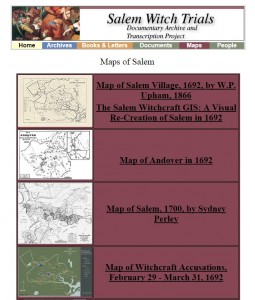
Last week, with the rest of my discussion group, we explored the Salem Witch Trials Documentary Archive and tried to pick apart its innards to gain some understanding of how the site was put together.
The website uses a number of sources, from which its creators pulled documents, texts, maps, and more, in order to create a comprehensive archive of the Salem Witch Trials and a timeline of the events and accusations preceding and surrounding the trials. All the sources and documents are categorized according to type, such as transcriptions, maps, and books. The sources are pulled from a number of reputable museums and libraries from the East Coast including the Boston Public Library, Massachusetts Historical Society, Peabody Essex Museum, Massachusetts Archive, the New York Public Library, and more.
The website uses a number of digital humanities tools and techniques to archive and present the numerous documents. The maps of Salem and the surrounding areas in which witch accusations occur have been digitally scanned, but a number of computer-crafted maps are included as well to supplement the collection. All documents have been digitally scanned and/or transcribed from handwritten to computer-printed English. Best of all it provides a text search function to help prospective scholars quickly find the documents they need for their research.
While a comprehensive and well-put together archive the Salem Witch Trials Documentary Archive suffers a bit from its aesthetic. It has a very 1999-esque web layout that is a little jarring to the eye in the modern age, but given the quality of the large number of sources, and the simple-to-use methods of categorization and search, it does not harm the overall presentation from an academic point of view.